



Shure
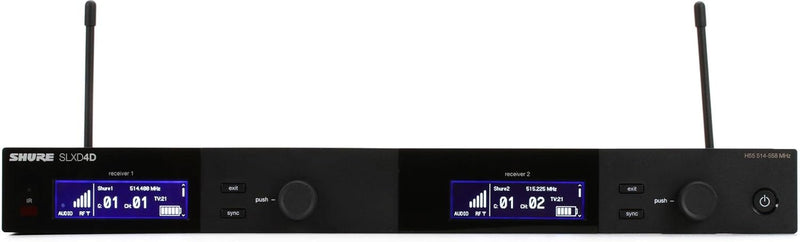
Shure SLXD4D=-H55 Dual Channel Digital Wireless Receiver
Two channels of 24-bit digital wireless audio with 120 dB dynamic range and predictive diversity — built for live performance and broadcast where dropout is not an option.
View price on Amazon
Affiliate Disclosure: As an Amazon Associate, Studio Supplies earns from qualifying purchases made through links on this page, at no additional cost to you. This helps support our editorial team.
Notice a mistake? Let Us Know
Overview
Key Features
WIRELESS FREQUENCY BAND SELECTION: Before purchasing, please ensure that the wireless frequency band you select works in your area (refer to Shure website for details > search Shure Wireless Frequency Finder).
COMPONENT ONLY: For this SLXD4 receiver to work, please make sure it matches the frequency band (style) on your SLX-D digital wireless transmitter.
WHAT'S IN THE BOX: (1) SLXD4D dual-channel receiver with antenna and rackmount accessories
DIGITAL WIRELESS TECHNOLOGY: Digital predictive switching diversity. 44 MHz tuning bandwidth (region dependent). 32 available channels per frequency band (region dependent). Up to 10 compatible systems per 6MHz TV band; 12 systems per 8 MHz band. RF Scan and IR Sync to quickly find an open frequency and link the transmitter to a SLX-D receiver. Easy pairing of transmitters and receivers over IR scan and sync.
SOUND QUALITY: Crystal clear 24-bit / 48 kHz digital audio. Extended 20 Hz to 20 kHz frequency response (microphone dependent) for natural and clear sound. Stable digital RF signal transmission. 120 dB dynamic range - excellent for vocals & acoustic and wind instruments.
Specifications
Channels
Dual
Audio Quality
24-bit / 48 kHz
Frequency Response
20 Hz – 20 kHz (microphone dependent)
Dynamic Range
120 dB
Operating Range
330 ft (100 m)
Frequency Band
H55 (region dependent)
Tuning Bandwidth
44 MHz
Available Channels
32 per frequency band
Brand
Shure
Model
SLXD4D
Frequently Asked Questions
What does the H55 frequency band cover, and how do I know it works in my region?
The H55 designation identifies a specific RF frequency band — availability and legality vary by country and region. Before purchasing, use Shure's Wireless Frequency Finder tool on their website to confirm H55 is cleared for use in your area. Buying the wrong band means the system is unusable.
How many SLXD4D systems can run simultaneously at a single venue?
Up to 10 compatible systems can operate per 6 MHz TV band, or 12 systems per 8 MHz band. In practice, the RF Scan function identifies open channels automatically — but in dense multi-system environments like large theatres or broadcast facilities, antenna distribution and careful RF planning still matter.
Does the SLXD4D work with older SLX analog transmitters?
No. The SLXD4D is a digital receiver in the SLX-D system and requires matched SLXD digital transmitters on the same frequency band. It is not backward-compatible with legacy SLX analog transmitters. Verify transmitter and receiver bands match before purchasing.
What audio outputs does the SLXD4D provide?
The SLXD4D provides outputs for its dual channels — suitable for connection to mixing consoles, broadcast chains, and installed sound systems. Refer to Shure's spec sheet for exact output connector types and levels, as configuration can vary by region variant.
Does the receiver itself require phantom power?
No. The SLXD4D receiver is a rack-mount unit powered by its own AC supply. Phantom power requirements apply to condenser capsules in compatible transmitter-mounted microphones — that's a transmitter-side consideration, not the receiver.
Related Products


