
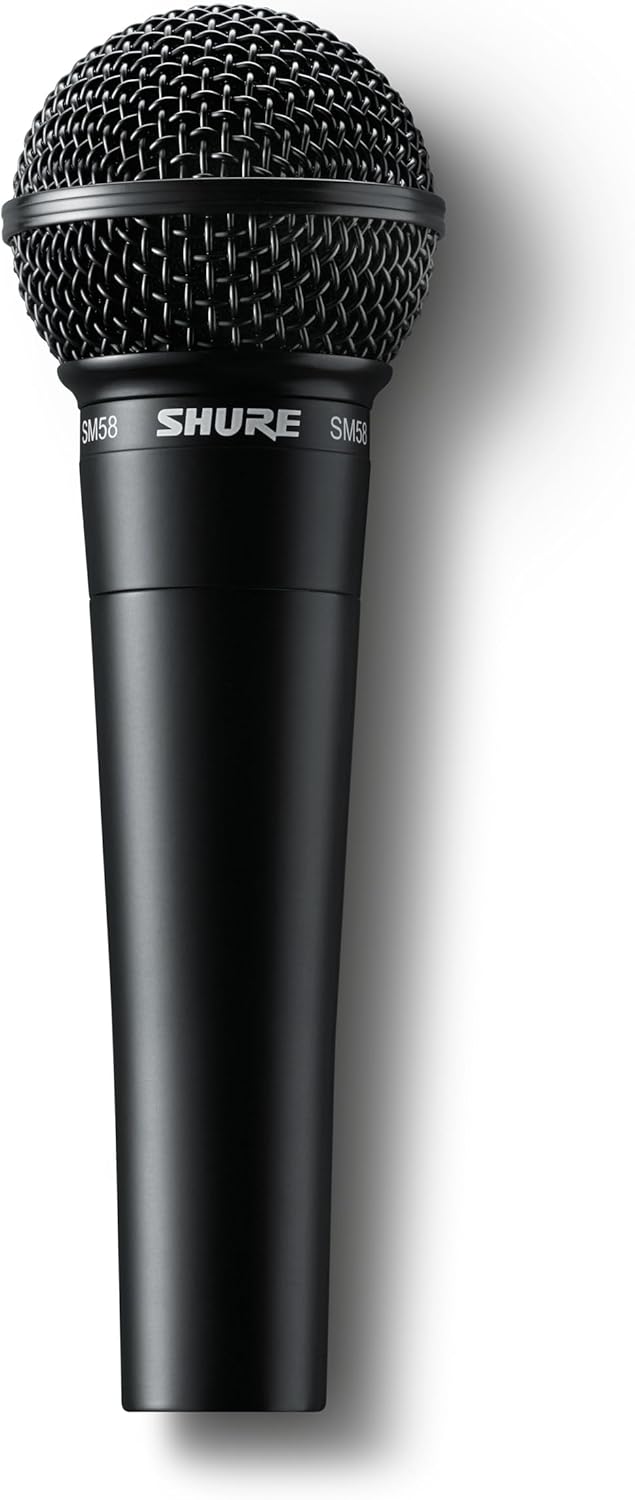


Shure SM58 Vocal Dynamic Microphone — Editorial Review & Independent Findings
The Shure SM58 is the world's most-shipped vocal microphone and the de facto live-vocal standard across nearly every type of stage performance — clubs, concert halls, churches, conferences, and broadcast studios. Per Shure's official SM58 product page, the microphone uses a cardioid polar pattern with a moving-coil dynamic element, tailored frequency response (50 Hz to 15 kHz with a presence bump for vocal intelligibility), internal pneumatic shock mount, built-in spherical wind-and-pop filter, and an all-metal chassis. The findings below aggregate independent coverage from Sound on Sound, SoundGuys, and MusicRadar.
Why the SM58 Became the World's Most-Shipped Vocal Mic
SoundGuys' Shure SM58 review calls the mic "a stellar performance mic" and documents the specific combination of characteristics that explain why nearly every working performer encounters the SM58 at some point in their career: a cardioid pattern with strong rear-rejection (essential for live monitor / floor-wedge feedback control), proximity effect that adds vocal warmth when close-mic'd, a frequency response specifically tailored to spoken / sung voice intelligibility, all-metal chassis durability that survives stage abuse, and a price point accessible to working musicians at every tier from amateur to professional.
The Build-Quality Claims Are Not Exaggerated
The SM58's legendary durability is well-documented in industry lore: per multiple reviewer coverage, the all-metal chassis has survived (and continued to function after) being dropped from stages, doused in water, run over by vehicles, and even used as an impromptu hammer. MusicRadar's SM58 review documents the same well-known build-quality consensus — for a stage performer choosing between "will-survive-the-tour" and "needs-careful-handling," the SM58's pedigree is the safer pick.
Cardioid Polar Pattern + Proximity Effect
The cardioid pickup pattern delivers strong off-axis rejection — particularly to the rear of the microphone, which faces stage monitors and floor wedges in typical live setups. This is the SM58's most-cited functional advantage: vocal capture without microphone-to-monitor feedback in the typical bar / club / coffeehouse stage configuration. The proximity effect (the low-frequency boost when the vocalist sings close to the windscreen, within 1-2 inches) is a feature the SM58 inherits from its dynamic-microphone architecture; experienced vocalists exploit it for intimate-sounding lead vocal capture, while less-experienced singers may need coaching on close-mic technique.
Studio Use — Not the Primary Design Target, But Useful
Sound on Sound's reader-question on SM58 vs condenser in lively rooms documents the SM58's specific advantage in untreated or acoustically-poor recording environments: the cardioid pattern's strong off-axis rejection picks up substantially less room reflection / reverb / HVAC / traffic noise than a large-diaphragm condenser at the same source distance. For home recordists in untreated spaces (apartment closets, bedrooms, garages), the SM58 often produces cleaner-sounding vocal tracks than a condenser despite the condenser's higher technical resolution.
Where the SM58 Specifically Fits
- Live vocal performance — the canonical use case. Bars, clubs, theaters, concert halls, performing-arts centers, houses of worship — the SM58 is the default that sound engineers reach for first
- Live podcast / event production — when podcast recording happens on a stage with audience present (live podcast tours), the SM58's feedback rejection is the right tool versus the more sensitive SM7B
- Karaoke and amateur performance setups — the build quality and price point are appropriate
- Pro touring rigs — even after decades, the SM58 remains in most major-act touring inventories because its sonic character is so well-known that engineers can EQ it from muscle memory
- Untreated home-studio vocal recording — when a vocalist is recording in an acoustically-poor room and a treated condenser setup is not available, the SM58 produces a usable vocal track without recording the room
- Voiceover work for podcasts and YouTube on a budget — the SM58 + an interface delivers broadcast-acceptable voice without the SM7B's gain requirements
Honest Limits Buyers Should Know
- Frequency response is voice-optimized, not flat. Per Sound on Sound's coverage, the SM58 has a presence bump in the 4-5 kHz region intended to push vocal intelligibility forward in dense live-music mixes. This same characteristic can sound "boxy" on female vocals with naturally bright timbre, and the presence bump may need EQ-correction in mixing. For neutral-frequency-response capture, a large-diaphragm condenser is the right tier
- 50 Hz - 15 kHz frequency range — narrower than condenser mics. The SM58 rolls off above 15 kHz; condenser mics extend to 20+ kHz. For acoustic instruments where the airy top end matters (cymbals, acoustic guitar harmonics), the SM58 won't capture those frequencies
- Off-stage / boom-arm / desk-mounted use feels awkward. The SM58 is hand-held by design — many sound engineers note the form factor encourages close-mic singing technique. For desk-mounted boom-arm podcast use, the SM7B or a dedicated podcast mic (Shure MV7+, Rode PodMic) is the more ergonomic choice
- Not the right tool for studio recording where time is unlimited. If the engineer can deploy a condenser in a treated room with appropriate signal chain, a condenser will deliver more detailed studio vocal capture. The SM58 wins in live and constrained-environment scenarios; the condenser wins in optimal studio scenarios
- Wireless / handheld preamp built-ins are absent. The SM58 ships as a passive dynamic mic; wireless capability requires Shure SLX-D / QLX-D / ULX-D wireless systems and is sold separately. Performers needing wireless should budget for the additional infrastructure
Where Buyers Should Look Elsewhere
- Broadcast / podcast studio vocals (desk-mounted) → Shure SM7B (covered separately) — the SM58's bigger-output broadcast sibling tuned for spoken word
- Wireless vocal performance → Shure SLX-D / QLX-D / ULX-D wireless systems with SM58 capsule, Sennheiser EW-D, Audio-Technica System 10 Pro
- Studio vocal recording in a treated environment → AKG C214, Neumann TLM 102 / TLM 103, Rode NT1, Lewitt LCT 440 large-diaphragm condensers
- Drum overheads and acoustic instruments → Shure SM81, Audio-Technica AT4040, AKG C214 (different mic class entirely)
- Beta-tier upgrade for live use → Shure Beta 58A (supercardioid, brighter, hotter output) for vocalists wanting more presence + tighter rear rejection on loud stages
Sources & Citations
- Shure, "SM58 Vocal Microphone product page," shure.com (accessed 2026-05-18)
- Sound on Sound, "Q. Will a Shure SM58 sound better on vocals than a condenser mic in a lively room?" soundonsound.com (accessed 2026-05-18)
- SoundGuys, "Shure SM58 review: A stellar performance mic," soundguys.com (accessed 2026-05-18)
- MusicRadar, "Shure SM58 review," musicradar.com (accessed 2026-05-18)
Last verified: 2026-05-18


