Shure

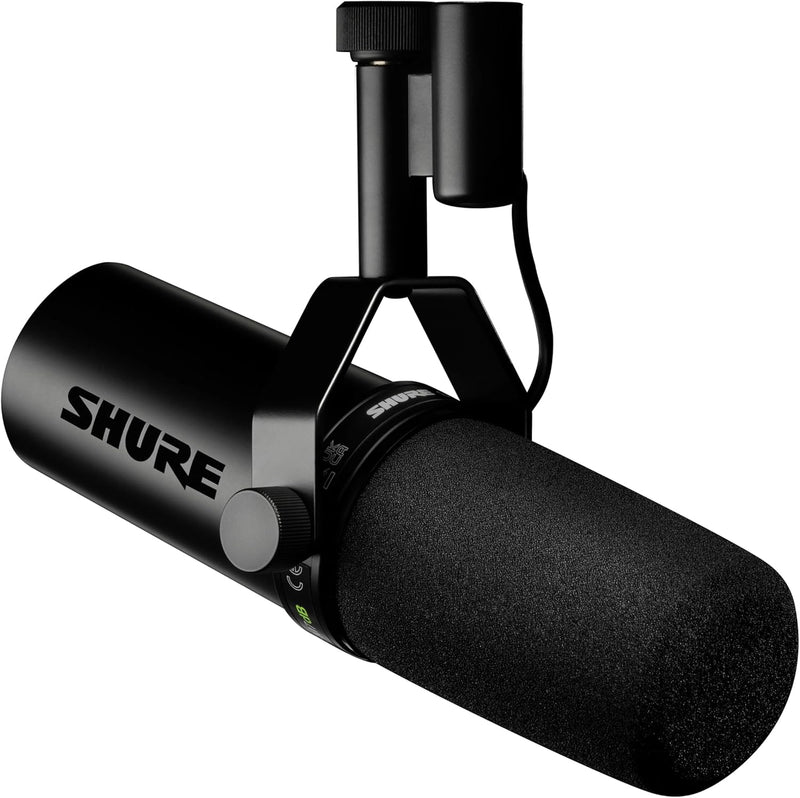
Shure SM7dB - Dynamic Vocal Microphone with Built-in Preamp

4.8 (11734 reviews)
XLR

Capture the Perfect Vocal with Legendary SoundThe Shure SM7dB Dynamic Vocal Microphone delivers the iconic sound of the SM7B, now with a built-in preamp for enhanced gain and convenience. Perfect for streaming, podcasting, and recording, this microphone captures warm, smooth vocals in any environ...

$549.00*
In Stock on Amazon.com
View on Amazon

*Price sourced from Amazon.com. Last updated:Jul 14, 2026.Price and availability are subject to change.

Affiliate Disclosure: Studio Supplies may earn a commission from qualifying purchases made through links on this page, at no additional cost to you. This helps support our editorial team.

Notice a mistake? Let Us Know

Overview

Capture the Perfect Vocal with Legendary Sound

The Shure SM7dB Dynamic Vocal Microphone delivers the iconic sound of the SM7B, now with a built-in preamp for enhanced gain and convenience. Perfect for streaming, podcasting, and recording, this microphone captures warm, smooth vocals in any environment.

Specifications:

  • Microphone Type: Dynamic
  • Polar Pattern: Cardioid
  • Frequency Response: 50 to 20,000Hz
  • Built-in Preamp: Up to +28 dB Gain
  • Connector: XLR
  • Special Features: Built-in Preamp
  • Color: Black

Key Features

ICONIC SOUND, SIMPLIFIED: Built on the same dynamic cartridge and frequency response as the SM7B, the SM7dB delivers the same warm, natural vocal character with a built-in preamp that eliminates the need for external gain boosters

FOCUSED VOCAL ISOLATION: A precision cardioid pickup pattern pairs with air suspension shock isolation to reject background noise, room reflections and handling vibrations to keep your voice clean and centered for podcasting, streaming, or recording.

BUILT-IN PREAMP CONTROL: Selectable +18 dB or +28 dB of clean onboard gain lets you drive virtually any XLR interface without a separate inline preamp, reducing your signal chain to just the mic, a cable, and your interface.

SHAPE YOUR TONE: Rear-panel EQ switches for bass-roll off and mid-range presence boost let you tailor the SM7dB to any voice or instrument, giving you studio-level tone shaping without reaching for outboard gear or software plugins

STUDIO-GRADE BUILD: Rugged all-metal construction with advanced electromagnetic shielding blocks hum and interference, while the included detachable windscreen and switch cover plate keep your setup clean, protected, and road-ready

Specifications

Microphone Type
Dynamic Vocal Microphone
Built-in Preamp
Yes
Gain Options
+18 dB or +28 dB
Polar Pattern
Cardioid
Included Accessories
Close-Talk Windscreen, 3/8” Thread Adapter
Noise Reduction
Air suspension shock isolation, precision pop filter
Shielding
Advanced electromagnetic shielding

Shure SM7dB vs SM7B — The Active-Preamp Decision

The Shure SM7dB is the 2023-launch active-preamp variant of the iconic SM7B broadcast / podcast dynamic microphone. Per Shure's official SM7dB product page, the SM7dB is functionally identical to the SM7B on the capsule + chassis side, but adds an integrated active preamp providing switchable +18 dB or +28 dB of clean gain at the microphone itself — eliminating the external inline preamp booster (Cloudlifter, FetHead, sE DM1) that the SM7B requires when paired with most consumer audio interfaces. This module walks through the decision between the two.

Sound on Sound — The Definitive Review

Sound on Sound's Shure SM7dB review documents the practical advantage of the integrated preamp: the SM7dB eliminates an entire signal-chain layer (the external Cloudlifter + its XLR cable + its phantom-power requirement) while delivering the same final-stage gain to the interface. For broadcast / podcast operators committing to the SM7B sound but uncomfortable with the external-preamp complexity, the SM7dB is the cleaner purchase.

Sound on Sound's specific finding: at the +28 dB gain setting, the SM7dB drives most audio interfaces to broadcast level without requiring the interface's preamp at maximum gain — which is where consumer interfaces typically introduce hiss. The result is a quieter signal chain than SM7B + Cloudlifter + interface, with one less point of failure / cable connection / phantom-power dependency.

Pricing Math: SM7B + Cloudlifter vs SM7dB

Per Shure's SM7B product page and current 2026 market pricing:

  • SM7B alone: approximately $400
  • SM7B + Cloudlifter CL-1: approximately $400 + $150 = $550
  • SM7dB: approximately $500

The SM7dB is roughly $50 cheaper than the SM7B + Cloudlifter combination — and eliminates one cable, one device requiring phantom power, and one mounting / cabling overhead point. For buyers committing to a Cloudlifter regardless, the SM7dB is the simpler / cheaper purchase. For buyers who plan to pair the SM7B with a high-gain interface (Mackie ProFX, Focusrite Scarlett 4i4, Audient EVO 8) where the additional Cloudlifter isn't strictly necessary, the SM7B alone is the right tier.

When the SM7dB Specifically Wins

  • Buyers already committing to a Cloudlifter purchase alongside the SM7B — the SM7dB is functionally equivalent at lower total cost
  • Buyers pairing with consumer-tier interfaces (Focusrite Scarlett 2i2 / Solo with 56 dB gain, PreSonus AudioBox iOne) where additional preamp gain is genuinely needed
  • Buyers wanting a simpler signal chain with one less device + cable
  • Mobile / location recording where carrying fewer accessories matters
  • Studios with multiple SM7B-equivalent stations where every Cloudlifter-eliminated reduces inventory complexity

When the SM7B Alone Specifically Wins

  • Buyers pairing with a high-gain interface or mixer (Mackie ProFX-series at 70 dB gain, Focusrite Scarlett 4i4 at 60 dB, Audient EVO 8) where the SM7B's low sensitivity is already handled by the interface's gain stage
  • Existing Cloudlifter / FetHead owners who don't need a second preamp stage
  • Buyers who want flexibility to use the mic with multiple signal chains — the SM7B's passive design allows pairing with everything from cheap interfaces to mid-tier mixers without compatibility considerations
  • Studios with high-end preamps (Universal Audio, Neve, API, Heritage Audio) where the preamp coloration is the entire point and an integrated active preamp would defeat the purpose
  • Buyers comfortable with the external-Cloudlifter signal chain who prefer the SM7B's $50-cheaper price point

Same Sound, Same Use Cases, Same Honest Cons

Per Sound on Sound's coverage, the SM7dB and SM7B sound functionally identical when matched-gain compared — the active preamp is transparent (clean gain stage, not coloration). Every use case appropriate for the SM7B (broadcast, podcasting, voiceover, untreated-room vocals, streaming) is also appropriate for the SM7dB. Every honest limitation also applies: cardioid pattern requires close-talk technique, frequency response is voice-optimized not flat, not appropriate for live stage use (use SM58), not appropriate for acoustic instrument capture (use large-diaphragm condensers). The choice between SM7dB and SM7B is purely about signal-chain architecture, not about microphone character or sound.

Where Buyers Should Look Elsewhere

  • Live vocal performance → Shure SM58 (covered separately) — the SM58 is designed for live use, the SM7B/SM7dB family is studio-only
  • Budget broadcast / podcast tier → Shure MV7+ (USB + XLR hybrid, podcast-tuned, $250 price tier), Rode PodMic, Samson Q2U
  • Acoustic instrument recording → AKG C214, Audio-Technica AT4040, Rode NT1 (large-diaphragm condensers)
  • Stereo recording / mid-side / drum overheads → matched-pair small-diaphragm condensers (Rode NT5, Shure SM81)
  • Multi-mic broadcast setups → Electro-Voice RE20 (similar voicing to SM7B, different character) pairs nicely with SM7B/SM7dB for variety

Sources & Citations

  1. Shure, "SM7dB Vocal Microphone with Built-in Preamp product page," shure.com (accessed 2026-05-18)
  2. Shure, "SM7B Vocal Dynamic Microphone product page," shure.com (accessed 2026-05-18)
  3. Sound on Sound, "Shure SM7dB review," soundonsound.com (accessed 2026-05-18)

Last verified: 2026-05-18

Shure SM7dB — Editorial Review

The Shure SM7dB takes the legendary SM7B broadcast dynamic microphone and adds a built-in active preamp, solving the SM7B's biggest practical headache: its very low output. For podcasters and streamers without a high-gain interface, that changes everything.

Featured Video Review

Shure SM7dB Review / Test (vs. Dynacaster, Sona, & More)
Podcastage · "Shure SM7dB Review / Test (vs. Dynacaster, Sona, & More)" · Watch on YouTube

The SM7B sound, minus the gain problem

Sound On Sound and MusicRadar note the integrated preamp — built on technology licensed from Cloud Microphones — adds a switchable +18dB or +28dB of clean gain, so you no longer need an external booster like a Cloudlifter. The warm, smooth SM7B voicing and strong off-axis rejection are unchanged, making it forgiving in untreated rooms. In Podcastage's review and test — featured above — it's compared head-to-head against other broadcast dynamics.

Honest cons

  • Requires phantom power. Uniquely for a dynamic mic, the active preamp needs +48V — so it won't run on gear that can't supply it.
  • Redundant for some SM7B owners. If you already own a capable preamp or Cloudlifter, you're paying for gain you don't need.
  • Heavy. At ~837g it needs a sturdy boom arm.
  • Cardioid dynamic limits. It won't match a condenser's airy detail or offer other polar patterns.

Where this microphone fits

  • Podcasters and streamers using interfaces or mixers that lack high clean gain.
  • Broadcasters and voice artists who want the iconic SM7B tone with plug-and-play levels.
  • Untreated-room recordists who benefit from strong background rejection.
  • Not existing SM7B-plus-preamp owners, condenser-detail seekers, or gear without phantom power.

Sources & Citations

  1. Sound On Sound, "Shure SM7dB," soundonsound.com (accessed 2026-05-26)
  2. MusicRadar, "Shure SM7dB review," musicradar.com (accessed 2026-05-26)

Last verified: 2026-05-26

Now that you've seen the details — ready to take a closer look?

View on Amazon

Pros & Cons

👍 Pros

  • Features a built-in preamp with selectable +18 or +28 dB of clean gain, eliminating the need for an external booster.
  • Designed with a dynamic cartridge and wide-range frequency response for capturing crystal-clear vocals and natural sound.
  • Incorporates air suspension shock isolation and a precision pop filter to block out rumbles, breath, and handling noise.
  • Boasts advanced electromagnetic shielding and rugged construction, ensuring a clean signal and durability.
  • Offers multiple sound signatures via switches on the back, allowing users to tailor the tone for various voices or instruments.

👎 Cons

  • As a dynamic microphone, it might require more gain than some condenser microphones, even with the built-in preamp.
  • The cardioid polar pattern, while excellent for isolation, may not be suitable for capturing broader ambient sounds or group recordings.
  • While durable, the physical size and weight of a studio-grade microphone may not be ideal for highly mobile or compact setups.
  • The requirement for XLR connectivity means it won't directly plug into standard USB ports without an audio interface.
  • The built-in preamp and shielding contribute to its overall cost, which might be higher than simpler dynamic microphones.

Frequently Asked Questions

No, the SM7dB features a built-in preamp with +18 or +28 dB of clean gain, so a separate booster is not required.
It is engineered with a dynamic cartridge and wide-range frequency response, making it ideal for crystal-clear vocal capture for both music and speech.
It includes air suspension shock isolation and a precision pop filter to block out rumbles, breath, and handling noise, providing broadcast-ready sound isolation.
Yes, like the SM7B, the SM7dB offers multiple sound signatures using switches on the back, allowing you to cut lows or boost presence to find your ideal tone.
The microphone has a cardioid polar pattern, which offers excellent rear-rejection to isolate your voice from background noise.
The box includes the SM7dB microphone itself, a Close-Talk Windscreen, and a 3/8” Thread Adapter.
Yes, it boasts rugged construction and advanced electromagnetic shielding, designed for studio-grade build and clear sound.