

Shure
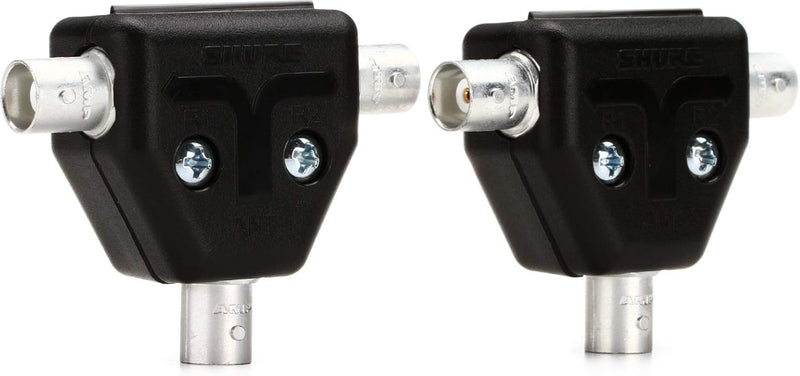
Shure UA221 Passive Antenna Splitter/Combiner Kit
38W
Split one remote antenna to feed two receivers — or combine two antennas into one receiver — without adding electronics to your signal chain.
$200.00*
View on Amazon
✓ In Stock on Amazon.com
*Price sourced from Amazon.com. Last updated:Aug 28, 2026.Price and availability are subject to change — details.
Affiliate Disclosure: As an Amazon Associate, Studio Supplies earns from qualifying purchases made through links on this page, at no additional cost to you. This helps support our editorial team.
Notice a mistake? Let Us Know
Overview
Key Features
Item Package Dimension: 11.019L x 5.38W x 3.38H inches
Item Package Weight - 1.15 Pounds
Item Package Quantity - 1
Product Type - ANTENNA
Specifications
Item Package Length
11.019 inches
Item Package Width
5.38 inches
Item Package Height
3.38 inches
Item Package Weight
1.15 Pounds
Item Package Quantity
1
Product Type
ANTENNA
Frequently Asked Questions
Does this splitter introduce signal loss, and how do I compensate for it?
Yes — the UA221 is passive, meaning it contains no active amplification. Splitting one antenna signal into two outputs introduces approximately 3.5 dB of insertion loss per output port. For installations where the antenna is already at the edge of its effective range, this loss budget matters. Shure recommends pairing the UA221 with a powered antenna distribution amplifier (such as the UA845) in those scenarios to restore signal level before or after the split.
Which Shure receiver models is the UA221 confirmed compatible with?
The UA221 is listed as compatible with UC4, SLX4, ULXS4, ULXP4, U4S, U4D, UR4S, and UR4D receivers. It is not designed for the newer Axient Digital or ULX-D series, which use active distribution systems with DC bias requirements that the passive UA221 does not support.
Can the UA221 be used to combine two transmitter antennas into a single cable run to a distant receiver?
Yes — in combiner mode (two-input, one-output), two antennas feed a single receiver input, extending spatial diversity coverage. This is useful when routing a single coax run to a remote receiver rack. Again, the passive combining introduces insertion loss, so cable run length and antenna gain should be factored into the overall link budget.
Does the UA221 require any power or phantom voltage to operate?
No — the UA221 is entirely passive and requires no power source, no phantom voltage, and no DC bias. This simplifies installation and eliminates any failure mode related to power supply, but it also means the unit cannot compensate for the signal loss it introduces.
What connector type does the UA221 use?
The UA221 uses BNC connectors, which is the standard for Shure's wireless antenna distribution ecosystem. BNC provides a secure bayonet lock and is the correct connector for RG8X or equivalent 50-ohm coaxial cable runs used in these installations.
Related Products


