



Sigma
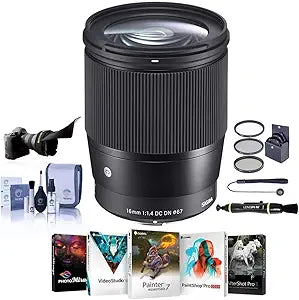
Sigma 16mm f/1.4 DC DN Lens Bundle
★★★★★
Wide open at f/1.4 in near-darkness, tack-sharp by f/2 in daylight — the Sigma 16mm DC DN delivers prime-quality environmental storytelling on mirrorless APS-C.
$439.00*
Check availability
*Price sourced from Amazon.com. Last updated:Jul 14, 2026.Price and availability are subject to change.
Affiliate Disclosure: Studio Supplies may earn a commission from qualifying purchases made through links on this page, at no additional cost to you. This helps support our editorial team.
Notice a mistake? Let Us Know
Overview
Key Features
Sigma lens
Specifications
Focal Length
16mm
Equivalent Focal Length (APS-C)
~24mm
Maximum Aperture
f/1.4
Lens Mount
Canon EF-M
Lens Construction
16 elements in 13 groups
Weather Sealing
Dust- and splash-proof
Autofocus Type
Stepping motor (video-optimized)
Pros & Cons
👍 Pros
- The f/1.4 maximum aperture enables confident shooting in ambient light conditions — candlelit venues, dusk exteriors, and dimly lit interiors — where f/2.8 zoom alternatives would require ISO compensation.
- The 24mm APS-C equivalent focal length is versatile enough for environmental portraits, architecture, street, and travel without changing lenses, covering a high percentage of real-world shooting scenarios.
- Dust- and splash-proof construction means you can keep shooting through light rain or dusty conditions without the lens becoming the reason you pack up early.
- Sigma's stepping motor autofocus is tuned for smooth, near-silent operation during video, allowing clean continuous AF pulls that don't appear in the final footage.
- The 16-element optical formula delivers center sharpness wide open that punches well above the lens's price point against competing fast wide-angle options.
👎 Cons
- EF-M mount limits the lens to Canon's APS-C mirrorless ecosystem only — it cannot be adapted to Canon's current RF-mount bodies with autofocus, which constrains its long-term usability as Canon's mirrorless lineup evolves.
- Corner sharpness wide open at f/1.4 is visibly softer than the center, which is an expected optical trade-off at this aperture but requires stopping down to f/2.8 for uniform edge-to-edge resolution.
- The lens hood and filter thread design require attention when shooting with a wide-angle filter stack — any added thickness at 52mm can introduce vignetting at 16mm, particularly at f/1.4.
- No optical image stabilization built into the lens — you're relying entirely on in-body stabilization if your body has it, or accepting camera shake at slower shutter speeds in low-light handheld work.
Frequently Asked Questions
Which Canon EF-M bodies is this lens compatible with?
This version of the Sigma 16mm DC DN is built specifically for the Canon EF-M mount, which fits Canon's APS-C mirrorless lineup — the M50, M50 Mark II, M6 Mark II, M200, and related bodies. It is not compatible with Canon's RF-mount full-frame or APS-C mirrorless cameras without an adapter, and it will not autofocus on EF-mount DSLRs even with an adapter.
What does the 16mm focal length actually look like on an APS-C sensor?
On APS-C, 16mm translates to approximately 24mm equivalent — a natural wide-angle that's wide enough for interiors, environmental portraits, and street work without the pronounced barrel distortion of ultra-wide lenses. It gives you breathing room in tight spaces while keeping subjects in frame with context around them.
How does the f/1.4 maximum aperture perform for video autofocus on the M50 or M6 II?
Sigma engineered the DC DN series with smooth, quiet stepping motor autofocus specifically for video shooting. Focus transitions are gradual rather than hunting, which makes it well-suited to video work on Canon's Dual Pixel CMOS AF bodies. You'll get confident continuous AF during movement rather than the focus-breathing or lurching that plagues third-party lenses not optimized for video.
Is this lens weather-sealed for outdoor shooting?
Yes — the 16mm DC DN features dust- and splash-proof construction, which means it can handle light rain and dusty environments with reasonable confidence. It is not rated for full submersion or torrential conditions, so keep a lens cloth handy for heavy weather, but it will survive the typical outdoor shoot.
How does the 16-element, 13-group optical design affect sharpness?
The 16/13 construction is designed to suppress chromatic aberration and field curvature — common weaknesses in fast wide-angle primes. Wide open at f/1.4, expect excellent center sharpness with some softness toward the corners; by f/2.8, the image is sharp edge-to-edge. This resolving power is why the lens is trusted for both stills and video where consistency across the frame matters.
Related Products


