Sigma

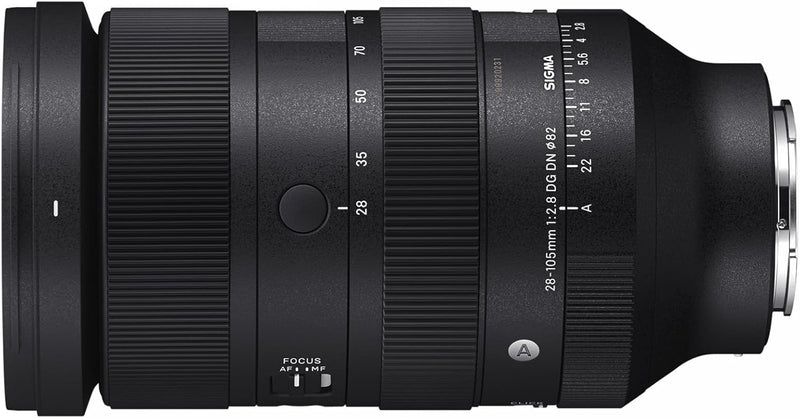
Sigma 636965 28-105mm F2.8 DG DN Sony E-Mount Lens

4.8 (8 reviews)

A constant F2.8 full-frame zoom covering 28-105mm — Sigma's versatile all-in-one lens for Sony E-mount.

$1,649.00*
In Stock on Amazon.com
View on Amazon

*Price sourced from Amazon.com. Last updated:Jun 19, 2026.Price and availability are subject to change.

Affiliate Disclosure: Studio Supplies may earn a commission from qualifying purchases made through links on this page, at no additional cost to you. This helps support our editorial team.

Notice a mistake? Let Us Know

Overview

The Sigma 28-105mm F2.8 DG DN is a full-frame mirrorless zoom lens built natively for the Sony E-mount system. Its standout feature is a constant F2.8 maximum aperture across the entire 28-105mm focal range — a specification that gives photographers consistent exposure control and the ability to achieve a pleasingly shallow depth of field whether shooting at the wide end or zoomed in for portraits. The "DG" designation confirms full-frame coverage, while "DN" signals a ground-up mirrorless design optimized for the shorter flange distance and electronic communication of Sony's mirrorless bodies.

The 28-105mm range is notably versatile, spanning from a useful wide angle for environmental shots and interiors through the classic 50mm perspective and out to 105mm — a focal length widely favored for portraiture and detail work. This makes the lens a compelling choice as a single walk-around optic for travel, events, weddings, and documentary work, reducing the need to carry and swap between multiple primes or zooms. For photographers invested in the Sony E-mount ecosystem, the Sigma 28-105mm F2.8 DG DN offers a combination of speed, range, and optical quality that is difficult to match in a single lens.

Key Features

Wide range including popular focal lengths for portraits

Specifications

Brand
Sigma
Model
636965
Mount
Sony E-mount
Focal Length
28-105mm
Maximum Aperture
F2.8 (constant)
Lens Type
Full-frame mirrorless zoom (DG DN)
Lens Format
Full Frame

Sigma 28-105mm F2.8 DG DN Art — Editorial Review

The Sigma 28-105mm F2.8 DG DN Art is an unusual and ambitious standard zoom: it holds a constant f/2.8 aperture across a longer-than-normal range, reaching 105mm instead of the typical 70mm or 75mm. As PetaPixel sums it up, it delivers that extra versatility "without (much) compromise" — one lens that covers wide-normal through short-telephoto at a bright aperture.

Featured Video Review

Sigma 28-105mm f/2.8 Lens Review
Gerald Undone · "Sigma 28-105mm f/2.8 Lens Review" · Watch on YouTube

Range and sharpness

Dustin Abbott measures outstanding sharpness wide open at f/2.8 across most of the frame, with extreme edges firming up by f/4 — though sharpness and contrast dip slightly at the 105mm end relative to the rest of the range. Digital Camera World frames the appeal plainly: more light and more reach for your money than a conventional f/2.8 standard zoom. In Gerald Undone's review — featured above — the precise reviewer weighs that versatility against the physical trade-offs below.

One-lens versatility

For event, wedding, documentary, and hybrid shooters, the 28-105mm range covers a huge share of real-world shooting without a lens swap, and the constant f/2.8 keeps it usable in low light and for subject separation throughout the zoom.

Honest cons

  • Big and heavy. At nearly 1kg it's roughly twice the weight of some comparable standard zooms — the price of extending the range at a constant f/2.8.
  • Distortion at both ends. Noticeable distortion appears at the wide and telephoto extremes, relying on profile correction.
  • Starts at 28mm, not 24mm. Some shooters will miss the extra wide reach a 24mm start would give.
  • Slightly softer at 105mm. The long end isn't quite as crisp as the rest of the zoom range.

Where this lens fits

  • Event, wedding, and documentary shooters who want one constant-f/2.8 lens covering wide-normal to short-telephoto without swapping glass.
  • Hybrid photo/video creators who value the extra 105mm reach and bright aperture in a single optic.
  • Travelers willing to carry a larger lens in exchange for not carrying several.
  • Not photographers who prioritize minimum size/weight, need a 24mm wide end, or want the absolute sharpest corners at the telephoto extreme.

Sources & Citations

  1. PetaPixel, "Sigma 28-105mm f/2.8 DG DN Art Review: Versatility Without (Much) Compromise," petapixel.com (accessed 2026-05-25)
  2. Dustin Abbott, "Sigma 28-105mm F2.8 DG DN ART Review," dustinabbott.net (accessed 2026-05-25)
  3. Digital Camera World, "Sigma 28-105mm F2.8 DG DN Art review," digitalcameraworld.com (accessed 2026-05-25)

Last verified: 2026-05-25

Now that you've seen the details — ready to take a closer look?

View on Amazon

Pros & Cons

👍 Pros

  • Constant F2.8 aperture provides consistent low-light performance and shallow depth of field across the full zoom range
  • The 28-105mm focal range covers wide-angle through portrait-length telephoto in a single lens
  • Native Sony E-mount design with DN mirrorless optimization for fast and accurate autofocus
  • Versatile enough to replace multiple prime lenses for travel, events, and everyday photography

👎 Cons

  • A constant F2.8 zoom in this range is likely larger and heavier than variable-aperture alternatives
  • The 28mm wide end is narrower than the 24mm starting point many photographers prefer for landscape and architecture work
  • Premium constant-aperture zoom commands a higher price than variable-aperture kit lenses

Frequently Asked Questions

Yes, the Sigma 28-105mm F2.8 DG DN features a constant F2.8 maximum aperture from 28mm all the way through 105mm, so you get consistent exposure and depth-of-field control at every focal length.
This is a full-frame lens (DG designation) built for Sony E-mount cameras. It can also be used on APS-C Sony bodies, where it will provide a tighter effective field of view.
The 28-105mm range covers wide-angle to medium telephoto, making it well suited for everyday shooting, portraits, events, street photography, and travel — often eliminating the need to carry multiple prime lenses.
The DN designation indicates this lens is designed specifically for mirrorless camera systems, optimized for shorter flange distances and mirrorless autofocus performance rather than being adapted from a DSLR design.