

Sigma
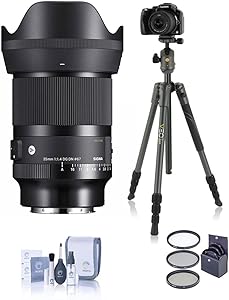
Sigma AF 35mm f/1.4 DG DN Art Sony E-Mount
f/1.4
Capture Stunning Imagery with Precision and Clarity Introducing the Sigma 35mm f/1.4 DG DN Art Lens, designed for Sony E-mount cameras. This bundle includes a Vanguard travel tripod, filter kit, and cleaning kit, providing everything you need for exceptional photography. Specifications: B...
$1,069.00*
Check availability
*Price sourced from Amazon.com. Last updated:Jul 14, 2026.Price and availability are subject to change.
Affiliate Disclosure: Studio Supplies may earn a commission from qualifying purchases made through links on this page, at no additional cost to you. This helps support our editorial team.
Notice a mistake? Let Us Know
Overview
Capture Stunning Imagery with Precision and Clarity
Introducing the Sigma 35mm f/1.4 DG DN Art Lens, designed for Sony E-mount cameras. This bundle includes a Vanguard travel tripod, filter kit, and cleaning kit, providing everything you need for exceptional photography.
Specifications:
- Brand: Sigma
- Model: AF 35mm f/1.4 DG DN ART
- Mount: Sony E
- Aperture: f/1.4
- Focusing: Stepping-type motor
- Controls: Focus mode switch, AFL button, aperture ring, aperture ring click switch, aperture ring lock
- Included: Vanguard VEO 2 GO 235CB Travel Tripod, 67mm Filter Kit, Cleaning Kit
Key Features
Improved optical performance and more compact size compared to conventional model (similar to SIGMA 85mm F1.4 DG DN | Art)
Minimized aberrations and exceptional sharpness from F1.4
At wide apertures, light points on the edge of the image are captured as points, making it ideal for astrophotography
Very close minimum focusing distance, allowing close-up photography, and beautiful separation between backgrounds and nearby subjects
11 rounded diaphragm blades for exceptionally smooth, appealing bokeh
Designed for minimal flare and ghosting thanks to SIGMA's anti-flare technology and team of experienced optical engineers
Stepping-type focus motor with single focusing element ensures speed, smoothness and accuracy with mirrorless systems
Superb build quality with both aluminum and Thermally Stable Composite components, contributing to its durability, lightness, and operational feel
Dust and splash-proof structure with a water and oil repellent front coating, plus additional sealing at the mount connection
Specifications
Focal Length
35mm
Aperture
f/1.4
Lens Mount
Sony E-Mount
Diaphragm Blades
11 (rounded)
Focus Motor Type
Stepping-type
Construction Materials
Aluminum, Thermally Stable Composite
Weather Resistance
Dust and splash-proof, water/oil repellent front coating, sealed mount
Specialty
Astrophotography, Close-up Photography
Pros & Cons
👍 Pros
- Features improved optical performance and a more compact size compared to previous models, enhancing portability and handling.
- Designed to minimize aberrations and deliver exceptional sharpness even at its wide F1.4 aperture, crucial for high-quality imaging.
- Capable of capturing light points at the edge of the image as distinct points when wide open, making it highly suitable for astrophotography.
- Offers a very close minimum focusing distance, allowing for detailed close-up photography with pleasing background separation.
- Equipped with 11 rounded diaphragm blades, which contribute to exceptionally smooth and appealing bokeh in out-of-focus areas.
- Benefits from SIGMA's anti-flare technology and optical engineering, effectively minimizing flare and ghosting in challenging lighting conditions.
- Incorporates a stepping-type focus motor with a single focusing element, ensuring fast, smooth, and accurate autofocus performance with mirrorless systems.
- Boasts superb build quality, utilizing both aluminum and Thermally Stable Composite components for durability, lightness, and a premium operational feel.
- Designed with a dust and splash-proof structure, including a water and oil repellent front coating and additional sealing at the mount, enhancing resilience in adverse environments.
👎 Cons
- While compact, the "Art" line of lenses from Sigma typically indicates a premium price point, which might be a consideration for budget-conscious photographers.
- The 35mm fixed focal length, while versatile, means photographers cannot zoom in or out, requiring physical movement to frame shots.
- Despite its advanced design, a prime lens may not be as universally adaptable as a zoom lens for photographers who need various focal lengths in one optic.
- The term "improved optical performance" is relative and might not quantify specific metrics like MTF charts without further detailed testing data.
- The focus on "mirrorless systems" for its stepping motor indicates it might not perform optimally or might require adapters for DSLR camera bodies, potentially impacting autofocus speed or features.
Frequently Asked Questions
What makes the Sigma AF 35mm f/1.4 DG DN Art lens suitable for astrophotography?
This lens is ideal for astrophotography because it captures light points on the edge of the image as points even at wide apertures, preventing distortion of stars.
How does this lens minimize aberrations and enhance sharpness?
The lens is designed with improved optical performance and experienced optical engineers to minimize aberrations and achieve exceptional sharpness from its F1.4 aperture.
What kind of bokeh can be expected from this Sigma lens?
This lens features 11 rounded diaphragm blades, which are specifically designed to produce an exceptionally smooth and appealing bokeh effect.
Is the Sigma AF 35mm f/1.4 DG DN Art lens built to withstand challenging environments?
Yes, it boasts a dust and splash-proof structure, a water and oil repellent front coating, and additional sealing at the mount connection for enhanced durability.
What is the benefit of the stepping-type focus motor in this lens?
The stepping-type focus motor, combined with a single focusing element, ensures speed, smoothness, and accuracy in autofocus, especially with mirrorless camera systems.
Can this lens be used for close-up photography?
Yes, it has a very close minimum focusing distance, which allows for detailed close-up photography with beautiful separation between subjects and backgrounds.
How does this lens handle flare and ghosting?
Thanks to SIGMA's anti-flare technology and expert optical engineering, the lens is designed for minimal flare and ghosting, maintaining image clarity in various lighting conditions.
Related Products


