

Sigma
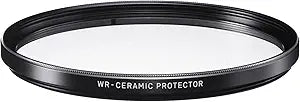
Sigma AFI9E0 86mm WR Ceramic Protector Filter
★★★★★
The world's first clear glass ceramic filter offers over 10× the impact resistance of standard protection glass — keep shooting confidently when conditions get rough.
$222.00*
Check availability
*Price sourced from Amazon.com. Last updated:Jul 14, 2026.Price and availability are subject to change.
Affiliate Disclosure: Studio Supplies may earn a commission from qualifying purchases made through links on this page, at no additional cost to you. This helps support our editorial team.
Notice a mistake? Let Us Know
Overview
Key Features
Its outstanding protective capability is leading to high reliability. By combining much greater hardness than chemically strengthened glass and greater flexibility than sapphire crystal glass.
Clear glass ceramic is the ideal material for protective filters that achieve over 10 times the strength of a conventional protective filter.
Worlds first Clear Glass Ceramic Protective lens filter
Specifications
Filter Diameter
86mm
Filter Material
Clear glass ceramic
Surface Coating
WR (Water Repellent)
Strength Rating
Over 10× conventional protective filter glass
Filter Type
Protector (clear, no color effect)
Brand
Sigma
Model
AFI9E0
Pros & Cons
👍 Pros
- Clear glass ceramic construction provides over 10x the scratch resistance of conventional glass protective filters, keeping the filter surface intact after contact with sand, grit, and accidental bumping against surfaces during active shooting.
- Glass ceramic construction rated at over 10× the strength of conventional filter glass provides genuine impact resistance during active location shoots where filters take bumps and drops
- Water repellent (WR) surface coating causes rain and spray to bead off the filter surface, maintaining a cleaner front element during wet-weather outdoor and coastal shooting without constant wiping
- WR water-repellent coating causes water to bead off the filter surface in rain and high-humidity conditions, reducing the frequency of lens cleaning interruptions during outdoor sessions.
- The 86mm size provides full front-element coverage for the large telephoto and wide-aperture zoom lenses that use this filter diameter, where a scratched or damaged front element would be extremely costly to replace.
- 86mm filter thread fits a wide range of large-diameter prime and zoom lenses that require protection without stepping down to smaller filter adapters
- The clear glass ceramic material maintains optical neutrality — designed to protect without introducing color cast, flare, or resolution degradation that cheaper protector filters can add
- Greater flexibility than sapphire crystal means this filter absorbs impact energy without catastrophic shattering — the structural integrity of the filter under a direct knock is meaningfully better than brittle high-hardness alternatives.
- As an optically neutral clear filter, it does not alter color rendering, contrast, or exposure when mounted — it is completely transparent to the image-making process while providing mechanical protection.
- As the world's first clear glass ceramic filter, this technology specifically addresses the limitation that conventional glass ceramic is typically opaque — Sigma's manufacturing achievement makes the material's strength available for optical use
👎 Cons
- The 86mm filter size is inherently expensive at any quality tier — this is a niche large-format filter size, and the ceramic material and premium manufacturing further increase cost relative to conventional glass 86mm protective filters.
- 86mm is a large-diameter thread primarily found on fast primes and large telephoto zooms — photographers whose lenses use 52mm, 58mm, or 67mm threads cannot use this specific size
- At this filter diameter, ceramic construction adds cost relative to standard optical glass protectors — the premium over conventional protection filters is meaningful for budget-conscious shooters
- Any filter in the optical path adds an additional air-to-glass surface, which introduces a marginal flare risk in high-contrast scenes with strong directional light — photographers who are strict about minimizing flare may prefer to shoot without any protective filter.
- The ceramic material, while harder and more flexible than standard glass, is still a finite-strength element — a sufficient impact will break it, and at 86mm the filter diameter means more surface area exposed to potential impact than smaller format filters.
- If the filter does crack under extreme impact, replacement cost is higher than a standard glass protector filter due to the specialized manufacturing process
- The filter adds a physical element at the front of the lens that can introduce additional lens flare in high-contrast shooting situations if the front surface picks up smudges during handling
- No multi-coating for anti-reflective performance is specified in the product data — a purely protective filter without anti-reflective multicoating may add slightly more reflective surface than coated alternatives in challenging lighting situations.
- Available only in 86mm — photographers who own multiple large-format lenses in different filter thread sizes (82mm, 95mm, 105mm) will need separate filters for each, as step rings at this size become optically and physically unwieldy.
- No stated transmission percentage is provided in the product data — optical transmission efficiency of the ceramic material is not formally published for comparison against conventional glass filters
Frequently Asked Questions
What makes clear glass ceramic harder than standard optical glass, and why does that matter for a lens filter?
Clear glass ceramic achieves its hardness through a controlled crystallization process that creates a polycrystalline structure denser than conventional glass. The result is a surface that resists scratching from sand, grit, and accidental contact significantly better than standard glass — Sigma claims over 10x the strength of conventional protective filters. For photographers working in dusty, sandy, or high-traffic environments, that resistance meaningfully reduces the likelihood of the filter surface being scratched during a day of shooting.
What makes the Sigma WR Ceramic Protector filter different from a standard optical glass protector?
This filter uses clear glass ceramic instead of conventional optical glass. Glass ceramic achieves its superior strength by combining crystalline and amorphous structures during a controlled crystallization process — the result is a material significantly harder than chemically strengthened glass and more flexible than sapphire crystal. Sigma rates it at over 10× the strength of a conventional protective filter, which directly addresses the most common failure mode: filter glass cracking on impact or under pressure.
Will this filter affect image sharpness or color rendition on a fast prime or L-series lens?
A well-manufactured protector filter should be optically neutral — no measurable impact on resolution, color, or contrast when clean and undamaged. Sigma's WR Ceramic Protector is designed with this in mind. That said, any filter adds a glass element to the optical path and should be kept scrupulously clean; water spots, fingerprints, or surface contamination degrade image quality regardless of filter material quality.
Does the WR (Weather Resistant) designation on this filter mean it has a coating, and what does it repel?
Yes — the WR designation indicates a water-repellent surface coating on the ceramic filter element. This coating causes water droplets to bead and roll off the front surface, keeping the optical path cleaner during rain or in high-humidity environments. It reduces the frequency of cleaning required during active shooting in wet conditions.
Will this 86mm filter introduce any color cast, flare, or light transmission reduction that would affect exposure or color accuracy?
Sigma designs the WR Ceramic Protector as an optically neutral protective filter — its purpose is protection, not optical effect. Light transmission should be essentially unaffected (the filter is clear and uncoated for color effect), and it should introduce negligible color cast. However, as with any glass element in the optical path, using a protective filter adds one more air-to-glass surface, which can marginally affect flare in high-contrast scenes with bright light sources at the edge of the frame.
Does the 86mm thread size fit all lenses with an 86mm filter thread?
Yes — 86mm refers to the standard filter thread diameter in millimeters. This filter fits any lens with an 86mm front filter thread regardless of manufacturer. Verify your lens's filter thread size (typically engraved on the front barrel near the ø symbol) before purchasing.
Does the "WR" designation mean this filter itself is weather resistant?
WR (Water Repellent) in Sigma's naming convention indicates that the filter's surface coating repels water droplets, which causes water to bead and run off rather than spreading into a film that obscures the image. It does not mean the filter is fully waterproof — but in rain or spray conditions, the WR coating keeps the front element cleaner between wipes than an uncoated filter.
Is the 86mm thread size compatible with Sigma's own large telephoto and zoom lenses, and will it fit non-Sigma lenses?
Yes — 86mm is a standard filter thread size used by several Sigma lenses, including large telephoto and high-speed zoom designs, as well as lenses from other manufacturers. The thread is universal; any lens with a 86mm front filter thread will accept this filter regardless of brand.
How does the ceramic material compare to sapphire crystal glass, and why was ceramic chosen?
Sigma's filter achieves greater hardness than chemically strengthened glass while also offering greater flexibility than sapphire crystal glass, according to their product documentation. Sapphire is extremely hard but brittle — it resists scratching but can shatter under point impact. The ceramic formulation is engineered to balance hardness (scratch resistance) with enough structural flexibility to absorb impact energy without catastrophic failure, which makes it more suitable as a lens-mounted filter.
Can this filter be stacked with other filters, such as a polarizer?
Physically yes — the 86mm thread allows another filter to be threaded onto the front of the protector. However, stacking filters increases the risk of vignetting at wide focal lengths and adds additional glass elements to the optical path. For most shooting, a protector filter is used alone or swapped out when a polarizer or ND is needed rather than stacked.
Related Products


