



Sigma
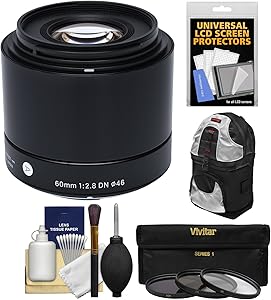
Sigma K-93336-02 60mm f/2.8 DN Art Lens Micro 4/3 Kit
f/2.8
Render tack-sharp 120mm-equivalent portraits and detail work on Micro 4/3 with a lens built to Art-series optical standards.
Check availability
Affiliate Disclosure: As an Amazon Associate, Studio Supplies earns from qualifying purchases made through links on this page, at no additional cost to you. This helps support our editorial team.
Notice a mistake? Let Us Know
Overview
Key Features
KIT INCLUDES 5 PRODUCTS -- All BRAND NEW Items with all Manufacturer-supplied Accessories + Full USA Warranties:
[1] Sigma 60mm f/2.8 DN ART Lens (for Olympus / Panasonic Micro 4/3 Cameras) +
[2] 46mm (UV/CPL/ND8) Filters +
[3] PD DSLR Sling Backpack +
[4] PD 6pc Complete Cleaning Kit + [5] LCD Screen Protectors
Specifications
Lens
Sigma 60mm f/2.8 DN ART
Mount
Micro Four Thirds
Focal Length
60mm (120mm full-frame equivalent)
Maximum Aperture
f/2.8
Filter Thread
46mm
Included Filters
46mm UV, CPL, ND8 (multi-coated HD)
Included Accessories
Sling backpack, 6-piece cleaning kit, LCD screen protectors
Compatibility
Olympus and Panasonic Micro 4/3 cameras
Frequently Asked Questions
What focal length does the 60mm DN Art deliver on a Micro 4/3 body, and what shooting situations does that suit?
On any Micro 4/3 sensor, the 60mm focal length produces a 120mm full-frame equivalent field of view. That puts it squarely in short telephoto portrait and detail territory — flattering compression for headshots, product photography, and tight environmental shots where you want subject separation without going full telephoto.
Does the f/2.8 aperture give meaningful background separation on a Micro 4/3 sensor?
Yes, though depth of field is shallower than f/2.8 on a full-frame body. At portrait distances, f/2.8 at 120mm equivalent renders backgrounds into smooth, recognizable bokeh. It won't match a 85mm f/1.4 on full-frame, but for the format and price tier, subject isolation is genuinely usable in controlled shooting conditions.
What does the kit include beyond the lens itself?
The kit bundles a 46mm three-piece filter set (UV, CPL, ND8), a sling-style camera backpack, a six-piece lens and sensor cleaning kit, and LCD screen protectors — all brand new with manufacturer warranties. The filters thread directly onto the 46mm front element of the lens.
Does this lens support autofocus on Olympus and Panasonic Micro 4/3 bodies?
Yes. The DN designation indicates the lens is designed specifically for mirrorless systems and communicates electronically with compatible Olympus and Panasonic Micro 4/3 bodies, supporting autofocus via the lens-body protocol.
How does the Art-series optical construction compare to Sigma's standard lineup?
The Art designation means this lens was engineered with the priority on optical performance rather than size or cost reduction. Sigma applies higher-grade glass elements, stricter MTF targets, and more thorough multi-layer coating to Art-series lenses — you'll see the difference most clearly in corner sharpness and resistance to chromatic aberration wide open.
Related Products


