



Sigma
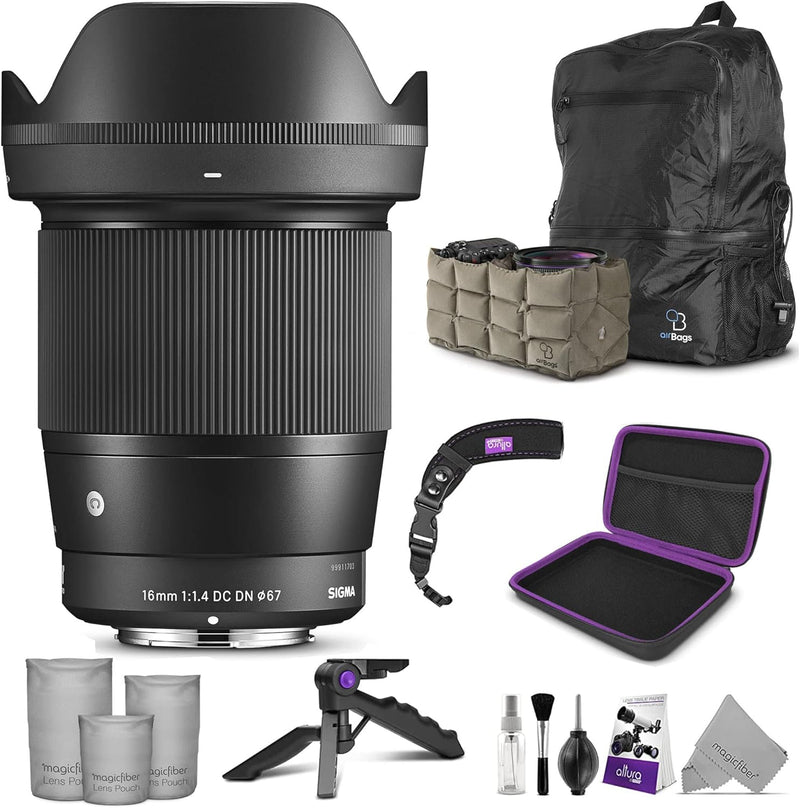
Sigma 16mm f/1.4 Canon EF-M Lens Bundle
★★★★★
Tack-sharp wide-angle primes and f/1.4 low-light capability make this Sigma 16mm a creative powerhouse for Canon EF-M mirrorless shooters.
$429.00*
Check availability
*Price sourced from Amazon.com. Last updated:Jul 14, 2026.Price and availability are subject to change.
Affiliate Disclosure: Studio Supplies may earn a commission from qualifying purchases made through links on this page, at no additional cost to you. This helps support our editorial team.
Notice a mistake? Let Us Know
Overview
Specifications
Focal Length
16mm
Maximum Aperture
f/1.4
Minimum Aperture
f/16
Mount
Canon EF-M
Minimum Focusing Distance
9.8 inches
Filter Thread
67mm
Maximum Magnification
1:9.9
Dimensions
2.8" x 3.6"
Weight
14.3 oz
Pros & Cons
👍 Pros
- f/1.4 maximum aperture enables sharp, natural-light frames in dim venues, stage environments, and candlelit interiors without relying on flash
- The f/1.4 maximum aperture gathers enough light for handheld shooting in dim indoor venues — candlelit receptions, gallery openings, dimly lit stages — where slower zoom lenses would require a performance-degrading ISO push.
- A 9.8-inch minimum focus distance allows intimate wide-angle compositions with surprising subject proximity, producing environmental portraits that feel immersive rather than distant.
- 24mm full-frame equivalent field of view is ideal for environmental portraiture, architecture, and street photography on APS-C Canon EF-M bodies
- Sigma's Contemporary optical formula delivers edge-to-edge sharpness that outresolves many native Canon EF-M prime lenses, especially in the corners at f/2 and beyond
- The non-rotating 67mm front element makes circular polarizer use practical in the field — set your angle once and it stays put through the full focus throw.
- At 14.3 oz, the lens is substantial enough to feel balanced on an M-series body without being fatiguing during a multi-hour event or travel shoot.
- 67mm filter thread accepts standard ND, polarizer, and UV filters without step-up rings — a clean, straightforward filter system for a working kit
- Stepping motor AF system enables quiet, smooth continuous focus during video recording — critical for avoiding AF motor noise on the audio track
- The Contemporary series optical formula controls lateral chromatic aberration and distortion well for a fast wide-angle prime, keeping correction work in post to a minimum.
👎 Cons
- No optical image stabilization means handheld video without IBIS on the camera requires disciplined technique or external stabilization to avoid shaky footage
- The EF-M mount is a dead-end system — Canon has discontinued EF-M development in favor of RF-M, meaning this lens has no upgrade path to future Canon mirrorless bodies without a system change.
- At 14.3 oz for an APS-C prime lens, the 16mm is noticeably front-heavy on the smaller M-series bodies, making single-handed shooting less comfortable over long sessions.
- At 14.3 oz, the lens is notably front-heavy on compact Canon EF-M bodies, creating an unbalanced feel during extended handheld sessions
- Minimum focusing distance of 9.8 inches limits close-subject versatility — tight product detail shots and macro-style work are outside this lens's practical range
- EF-M autofocus relies on contrast detection, so the lens cannot leverage phase-detect speed even if the camera body supports it — tracking fast-moving subjects in live view is less reliable than on a native phase-detect system.
- The bundle accessories (mini tripod, wrist strap, hard case) are third-party items of variable quality and add weight to the overall kit without contributing to optical performance.
- Canon has discontinued EF-M lens development in favor of the RF mount system, making this a lens investment in a platform with no announced future expansion
- Wide-open f/1.4 performance shows mild field curvature and edge softness at close focus distances — stopping down to f/2 or f/2.8 is necessary for flat-field sharpness across the frame
- No optical image stabilization is built into this lens, requiring reliance on the camera body's stabilization — which Canon EF-M bodies largely lack, making handheld shots at very slow shutter speeds riskier.
Frequently Asked Questions
Is this lens designed exclusively for Canon EF-M mirrorless bodies, or will it mount on EF-mount DSLRs?
This version is built specifically for the Canon EF-M bayonet mount used on Canon's M-series mirrorless cameras — M50, M50 Mark II, M6 Mark II, M200, and similar bodies. It will not physically mount on Canon EF or EF-S DSLR bodies without an adapter, and even with an EF-M to EF adapter (which doesn't exist as a standard product), the optical formula is optimized for the shorter flange distance of mirrorless systems. This is an EF-M native lens.
Which Canon mirrorless cameras is this lens compatible with?
This lens is built for the Canon EF-M mount, fitting Canon M-series APS-C mirrorless cameras such as the EOS M50, M50 Mark II, M6 Mark II, and M200. It is not compatible with Canon RF-mount cameras (EOS R series) without an adapter, and even then, EF-M to RF adapters are not officially supported by Canon.
On an APS-C Canon EF-M body, what is the effective field of view of this 16mm focal length?
Multiply by Canon's 1.6x crop factor and you get approximately 25.6mm equivalent — a classic street and environmental wide-angle perspective. It's wide enough for environmental portraits and architecture without the distortion of an ultra-wide, making it versatile across genres.
How does the f/1.4 aperture render subject separation on an APS-C sensor?
On APS-C, a 16mm f/1.4 gives you the field of view of a 24mm full-frame lens but with depth-of-field characteristics closer to a 24mm f/2.1 equivalent — meaningful subject separation at portrait distances, especially when focusing close and allowing the background to fall into a soft, diffuse blur. It won't render the creamy bokeh of an 85mm f/1.4 on full frame, but for wide environmental portraiture where you want context and separation simultaneously, it's a compelling creative tool.
What is the minimum focusing distance, and does it work for close-up editorial or product detail work?
The minimum focusing distance is 9.8 inches (25cm), which is useful for close-up contextual detail shots but is not suited for macro or tight product photography requiring life-size or near-life-size reproduction. The maximum magnification ratio of 1:9.9 confirms this is a wide prime optimized for environmental work, not close-up detail capture.
Does the f/1.4 aperture produce smooth bokeh, or does the wide focal length limit background separation?
At f/1.4 and the minimum focusing distance of 9.8 inches, the 16mm does render pleasing bokeh for a wide-angle lens — particularly when the subject is close and the background is distant. The separation is less dramatic than a 50mm f/1.4, but it's genuinely useful for environmental portraits where context matters as much as subject isolation.
How does the lens handle autofocus on Canon EF-M bodies?
The Sigma 16mm DC DN is designed with native electronic AF communication for the EF-M mount, supporting the camera's contrast-detection autofocus. Focus is smooth and accurate in good light; in very low light or fast-moving subjects, AF hunting can occur since EF-M bodies lack the phase-detect AF performance of newer mirrorless systems.
Does the Sigma 16mm DC DN include optical image stabilization?
No — this lens has no optical stabilization. On Canon EF-M bodies that also lack in-body stabilization (which is most of them), stabilization relies entirely on your shooting technique. For stills, the f/1.4 aperture largely compensates by allowing higher shutter speeds; for video, a gimbal or careful handheld technique is advisable for smooth footage.
How does the stepping motor autofocus perform during video on Canon EF-M bodies?
The stepping motor (STM-equivalent) design provides quiet, smooth focus transitions during video recording — important for run-and-gun shooting where AF noise would otherwise bleed into the audio track. On Canon EF-M bodies, continuous autofocus during video is reliable for slow to moderate subject movement, though fast lateral motion or sudden close-to-far transitions may produce momentary hunting before locking.
Does the 67mm filter thread accept standard circular polarizers and ND filters?
Yes — the 67mm front thread is a common size that accepts a wide range of filters without proprietary adapters. The front element does not rotate during focusing, which is a significant practical advantage when using polarizing filters that require precise angle alignment.
Related Products


