



SmallRig
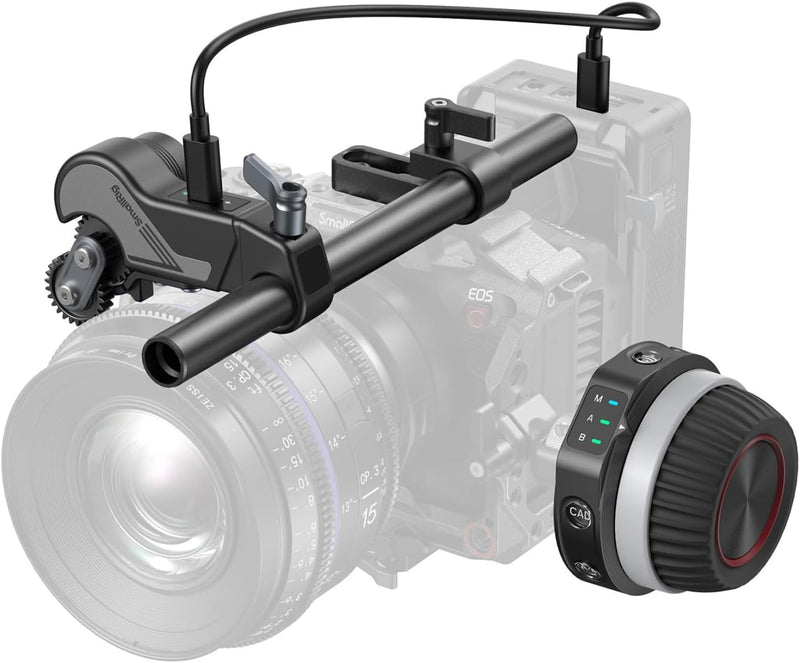
SmallRig 4296 Wireless Follow Focus Kit (Lite) Handwheel Controller
USB 3.01400mAh
Precise wireless focus control with 4.3 kgf·cm torque and 21-hour battery life for cinema lens rigs.
$144.49*$169.99Save 15%
Check availability
*Price sourced from Amazon.com. Last updated:Aug 27, 2026.Price and availability are subject to change — details.
Affiliate Disclosure: As an Amazon Associate, Studio Supplies earns from qualifying purchases made through links on this page, at no additional cost to you. This helps support our editorial team.
Notice a mistake? Let Us Know
Overview
Key Features
Widely Compatible Lenses: SmallRig Wireless Follow Focus Kit (Lite) 4296 is designed to provide a precise and low-latency focusing experience for video shooting. It is compatible with a wide range of cinema and zoom lenses with high damping, such as CP. 3 35mm for ZEISS, Arles 50 / 75mm F1.4 FF / VV for DZOFilm, CN-R35 T1.5 L F for Canon, FE C 16 - 35mm T3.1 G for Sony lens, etc
Peak Torque of 4.3 kgf.cm: The receiver motor adopts a variable speed gear set design, which can provide a high torque output of 4.3 kgf.cm. Compared with the previous generation product, the torque peak is increased by more than 2 times, and the response efficiency is increased by 35%, making it easy to drive the zoom lens
Up to 21H Battery Life: The handwheel is equipped with a built-in 1400mAh battery and adopts smart sleep tech for long-lasting power, which can provide about 21h of ultra long battery life. The Receiver Motor supports a wide voltage input range of 5V-18V, compatible with PD and QC fast charging protocols. Please use the provided power cord or a USB 3.0 cable to avoid insufficient torque issues
User-Friendly Design: The wireless follow focus kit uses two light colors, red and blue, to indicate the connection status and channel (blue light-F00-1; green light-F15-1), and provides intuitive operation instructions. The control is simple and efficient, making it easy for beginners to get started
One-Click Lens Calibration: The Handwheel supports one click A/B dotting, and you can adjust the appropriate A/B focal length according to your shooting needs. The kit features a memory storage function, eliminating the need to recalibrate lens travel and AB point settings in case of power loss, enhancing shooting efficiency
Specifications
Brand
SmallRig
Model
4296
Type
Wireless Follow Focus Kit (Lite)
Motor Peak Torque
4.3 kgf·cm
Handwheel Battery Capacity
1400mAh
Handwheel Battery Life
Up to 21 hours
Receiver Motor Input Voltage
5V–18V
Fast Charging Support
PD and QC protocols
Wireless Channels
2 (F00-1, F15-1)
Lens Compatibility
Cinema and zoom lenses with high damping
Frequently Asked Questions
What lenses are compatible with the SmallRig 4296 Wireless Follow Focus Kit?
It works with a wide range of cinema and zoom lenses that have high damping, including models from ZEISS, DZOFilm, Canon, and Sony. The motor's 4.3 kgf.cm torque is designed to drive heavier zoom lens rings.
What types of lenses is this follow focus kit compatible with?
The kit is designed for cinema and zoom lenses with high damping, including models from Zeiss, DZOFilm, Canon, and Sony. It is not intended for lightweight still photography lenses with minimal focus resistance.
What types of lenses is this follow focus compatible with?
It's designed for cinema and zoom lenses with high damping, including models from Zeiss, DZOFilm, Canon, and Sony. It may not provide optimal performance with lightweight photo lenses that have very low focus resistance.
What types of lenses are compatible with the SmallRig 4296 Wireless Follow Focus Kit?
It works with a wide range of cinema and zoom lenses that have high damping, including models from ZEISS, DZOFilm, Canon, and Sony. It is designed primarily for video shooting setups rather than lightweight photo lenses.
How long does the handwheel battery last on a single charge?
The built-in 1400mAh battery provides up to 21 hours of use thanks to a smart sleep mode that conserves power when the handwheel is idle.
How long does the handwheel battery last on a single charge?
The handwheel features a built-in 1400mAh battery with smart sleep technology that delivers up to 21 hours of use per charge.
How does the one-click A/B point calibration work?
You set a focus position as point A and another as point B on the handwheel. The system memorizes these positions, allowing you to rack focus between two precise distances repeatedly. The settings are retained even if the unit loses power.
How long does the handwheel battery last on a single charge?
The built-in 1400mAh battery provides up to 21 hours of use thanks to a smart sleep mode that conserves power when the handwheel is idle.
Do I need to recalibrate the lens every time I power the kit back on?
No. The handwheel has a memory storage function that retains your lens travel range and A/B point settings even after a power loss, so you can resume shooting without recalibration.
What power source does the receiver motor use?
The receiver motor accepts a wide voltage range of 5V to 18V and is compatible with PD and QC fast charging protocols. It connects via USB, and SmallRig recommends using the provided power cord or a USB 3.0 cable to ensure sufficient torque output.
Do I need to recalibrate the lens travel every time I power on?
No. The kit includes a memory storage function that retains your lens calibration and A/B point settings even after power loss, so you can pick up right where you left off.
Does the kit remember my lens calibration settings if it loses power?
Yes, the handwheel features a memory storage function that retains your lens travel range and A/B point settings even after a power loss, so you don't need to recalibrate each time.
What power source does the receiver motor require?
The receiver motor accepts a wide voltage input range of 5V–18V and supports PD and QC fast charging protocols. SmallRig recommends using the included power cord or a USB 3.0 cable to ensure sufficient torque.
What power source does the receiver motor require?
The receiver motor accepts 5V–18V input and is compatible with PD and QC fast charging protocols. Use the included power cord or a USB 3.0 cable to ensure sufficient torque output.
How do I know which channel the system is connected to?
The system uses color-coded LED indicators: blue light indicates channel F00-1, and green light indicates channel F15-1, so you can visually confirm the active connection at a glance.
What power source does the receiver motor require?
The receiver motor accepts 5V–18V input and supports PD and QC fast charging protocols. SmallRig recommends using the included power cord or a USB 3.0 cable to ensure sufficient torque.
How do I know which channel the handwheel and motor are connected on?
The kit uses color-coded LED indicators — blue light for channel F00-1 and green light for channel F15-1 — so you can quickly confirm your connection status.
Does the handwheel need to be recharged frequently?
No. The built-in 1400mAh battery with smart sleep technology provides up to 21 hours of continuous use, which comfortably covers even extended multi-day shoots between charges.
How do I know which channel the system is connected to?
The system uses color-coded LED indicators — blue light for channel F00-1 and green light for channel F15-1 — so you can confirm your connection status at a glance.
How do I know which channel the handwheel is connected to?
The kit uses color-coded LED indicators — blue light for channel F00-1 and green light for channel F15-1 — so you can quickly identify the active connection.
Related Products


