



Sony
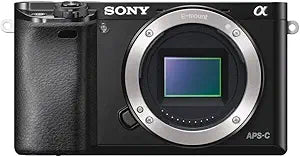
Sony a6000 Mirrorless Camera 24.3MP Body Only Renewed
39 in3MP24 MP
The a6000's 179-point phase-detection AF and 11 FPS burst rate still deliver fast, reliable tracking that earns its place as a capable travel body or E-mount entry point at renewed pricing.
$586.56*
View on Amazon
✓ In Stock on Amazon.com
*Price sourced from Amazon.com. Last updated:Oct 21, 2026.Price and availability are subject to change — details.
Affiliate Disclosure: As an Amazon Associate, Studio Supplies earns from qualifying purchases made through links on this page, at no additional cost to you. This helps support our editorial team.
Notice a mistake? Let Us Know
Overview
Key Features
24 MP APS-C CMOS sensor and Focus Sensitivity Range :EV 0 to EV 20 (at ISO 100 equivalent)
ISO 100-25600 (expandable to 51200). Lens compatibility- Sony E-mount lenses
Hybrid AF with 179-point focal plane phase-detection and 25 contrast detect points
Up to 11 FPS continious shooting - 3-inch tilting LCD with 921,000 dots.Viewfinder Type:0.39 in-type electronic viewfinder (color)
Specifications
Sensor
24.3MP APS-C CMOS
ISO Range
100–25600 (expandable to 51200)
Autofocus System
179-point phase-detection + 25 contrast-detect
Focus Sensitivity
EV 0 to EV 20 (ISO 100)
Continuous Shooting
Up to 11 FPS
LCD
3-inch tilting, 921,000 dots
Viewfinder
0.39-inch color EVF
Lens Mount
Sony E-mount
Condition
Renewed
Frequently Asked Questions
What lenses work with the Sony a6000, and is there a meaningful selection available?
The a6000 uses Sony E-mount, which supports one of the deepest native lens libraries in APS-C mirrorless photography — from affordable primes like the 35mm f/1.8 and 50mm f/1.8 OSS to professional zooms and telephoto options. Full-frame FE lenses also mount and function with a slight crop factor consideration. Third-party support from Sigma, Tamron, and Samyang adds further options at various price points.
How well does the 179-point AF system actually perform in real sessions — not just spec-sheet descriptions?
The hybrid AF system acquires focus quickly and tracks moving subjects reliably in good to moderate light. For portraits, street work, and action at reasonable distances, it performs well within its generation. It struggles in very low light and on subjects with low contrast — in those conditions, you'll experience occasional hunting before lock. Continuous AF during burst shooting holds tracking better than many contemporary APS-C competitors at the time of its release, and it remains competitive for the use cases this camera was built for.
What does buying a renewed a6000 mean in practice versus new?
Renewed units are professionally inspected and tested to confirm full functionality — the camera fires, autofocus operates correctly, the sensor is clean, and all controls respond as expected. Cosmetic condition varies; light wear marks from prior use are common. The operational guarantee is there; the appearance guarantee is not. For photographers who plan to shoot rather than display, this is a practical trade-off.
Does the a6000 produce usable images at high ISO for indoor or low-light shooting?
At base ISO (100–800), the 24.3MP APS-C sensor resolves clean, detailed files with good dynamic range for retouching. Noise becomes visible but manageable through ISO 3200–6400 — usable for documentary, event, or indoor work with modest noise reduction in post. Above ISO 6400, grain is pronounced and fine detail softens; ISO 25600 is an emergency setting, not a working one.
Is the a6000 suitable as a travel camera for someone who also owns a full-frame Sony body?
It's a well-suited second body for exactly this scenario. The E-mount means your full-frame lenses transfer directly, the compact body reduces bag weight significantly, and the 11 FPS burst and fast AF provide capability that doesn't feel compromised on a travel or backup role. The lack of IBIS and limited battery life (plan for a spare) are the two practical considerations to build your travel kit around.
Related Products


