



Sony
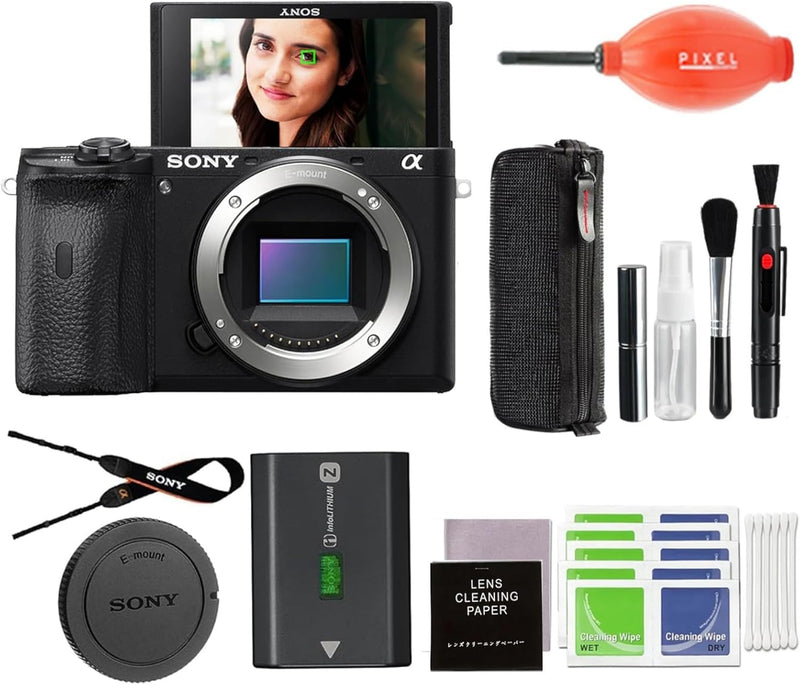
Sony ILCE6600/B a6600 Mirrorless Camera Bundle
2 MP
The Sony a6600 delivers 24.2MP APS-C resolution, Real-time Eye AF, and 5-axis in-body stabilization in a weather-resistant magnesium body built for photographers who won't slow down.
$1,198.00*
Check availability
*Price sourced from Amazon.com. Last updated:Oct 25, 2026.Price and availability are subject to change — details.
Affiliate Disclosure: As an Amazon Associate, Studio Supplies earns from qualifying purchases made through links on this page, at no additional cost to you. This helps support our editorial team.
Notice a mistake? Let Us Know
Overview
Key Features
Advanced performance - Sony a6600 digital camera is equipped with high speed Bionz x image processing engine, fast hybrid af with phase & contrast detection, 180 tiltable display makes it perfect photography camera.
A signature confirmation is required upon delivery of this item. The delivery personnel may ask for verification with a photo id as well. Shipping to addresses where an adult is available to sign for the package is highly recommended to avoid any potentials delays.
Advanced Tech - Sony a6600 realizes the level of image quality that surpasses the expectation, 24.2 MP resolution, wide sensitivity range, real time tracking and real time eye af enables to attain expressive prowess.
Durability and Weather Resistance - The a6600 brings you further enhanced body durability, with full use of lightweight, high rigidity magnesium alloy for covers and internal frame, keeping the camera highly rigid and light.
Bundle Accessories - Sony a6600 bundle includes dust off blower, cleaning kit that makes it a perfect camera bundle for digital camera users.
This package is a curated bundle of popular items frequently purchased together. It is not a complete, all-in-one solution. Depending on your specific setup, additional items or accessories may be required. Please review the included components carefully before purchasing.
Specifications
Sensor
24.2MP APS-C Exmor CMOS (23.5 x 15.6mm)
Processor
BIONZ X
Autofocus
425-point phase/contrast hybrid; Real-Time Eye AF; Real-Time Tracking
ISO Range
100–32000 (expandable 50–102400)
Continuous Shooting
11 fps
Video
4K HDR (HLG)
Stabilization
5-axis optical in-body (sensor-shift)
LCD
3.0-inch tilting TFT, capacitive touch
Viewfinder
0.39-inch OLED EVF
Battery Life
Approx. 720 shots (EVF) / 810 shots (LCD)
Mount
Sony E-mount
Connectivity
Wi-Fi, USB 2.0, HDMI, 3.5mm mic input
Memory
Single SDXC slot
Body
Magnesium alloy
Frequently Asked Questions
Which E-mount lenses get the most out of the a6600's autofocus system?
Sony G Master and G-series lenses are the optimal pairing — the a6600's phase-detection AF with Real-Time Tracking performs best with lenses that have fast linear AF motors, like the 85mm f/1.4 GM or 70-200mm f/2.8 GM. That said, virtually all native E-mount lenses benefit from the 425-point phase-detection system, and you'll see strong Eye AF performance even with older A-mount lenses via LA-EA adapter.
What lens mount does the Sony a6600 use, and what lenses are compatible?
The a6600 uses Sony's E-mount with an APS-C sensor. It is compatible with Sony's full APS-C E-mount lens lineup (16–50mm kit, 18–105mm, 18–135mm, and third-party options from Sigma, Tamron, etc.). Full-frame FE-mount lenses also mount and work natively, though the APS-C crop factor of 1.5x applies — a 50mm FE lens behaves like a 75mm equivalent on the a6600.
How effective is the 5-axis optical image stabilization on the a6600?
The a6600's 5-axis IBIS (in-body image stabilization) compensates for pitch, yaw, roll, and both horizontal and vertical shift — the same axes of movement that cause motion blur from handholding. It's particularly effective for slower shutter speeds with adapted lenses or non-OSS glass where there's no lens-based stabilization. The system works in concert with Sony OSS lenses for additional compensation on supported combinations.
How does the 5-axis in-body stabilization hold up during handheld video?
In real-world shooting, the 5-axis IBIS is one of the a6600's most impressive capabilities for video — handheld footage at walking pace looks smooth enough for documentary and social media use without gimbal assistance. Combined with a stabilized lens, you get a compounded effect that allows usable slow-motion and interview footage straight from the hand.
Is the a6600 practical for professional event and wedding photography?
Yes, with one caveat. The autofocus, 11 fps burst, and 720-shot battery life give you genuine professional capability during reception coverage, portraits, and ceremony shooting. The caveat is the single memory card slot — most working wedding photographers prefer dual slots for in-camera backup, so an external backup workflow is important.
What is the autofocus system like, and how does Real-time Eye AF perform?
The a6600 uses a Fast Hybrid AF system with 425 phase-detection points covering approximately 84% of the sensor area, with 0.02-second acquisition speed. Real-time Eye AF detects and locks on human (and animal) eyes in real time — even through movement, partial obstruction, and changing distance. For portrait, wedding, and event photographers, this makes keeper rates significantly higher in active shooting situations.
Does the a6600 shoot 4K video, and what are the limitations?
Yes — it records 4K HDR (HLG) video. The limitation to be aware of is that 4K recording on the a6600 uses a slight 1.02x oversampling crop from the APS-C sensor, which is minimal. There is no 4K/120fps mode — the maximum slow motion is 1080p at 120fps for 5x slow motion. There is also no HDMI clean output on this body.
How does the a6600 handle high-ISO noise in practical low-light scenarios?
The 24.2MP Exmor CMOS sensor and BIONZ X processor produce clean, well-detailed files at ISO 3200 — usable for print and editorial work — and ISO 6400 retains acceptable grain structure for web delivery. Above ISO 12800, luminance noise increases noticeably, though shadow recovery still outperforms most APS-C competitors in this price range.
Does the a6600 support tethered shooting for studio work?
Tethered shooting is supported via USB, but the USB 2.0 interface limits transfer speeds compared to newer cameras with USB-C/USB 3.2. For controlled studio work this is workable; for high-volume commercial sessions where immediate file delivery matters, the slower tether speed is worth factoring into your workflow.
What is the battery life, and is it adequate for a full day's shooting?
Sony rates the a6600 at approximately 720 shots per charge (viewfinder) or 810 shots (LCD). The larger NP-FZ100 battery — the same used in the a7 full-frame series — is a significant upgrade over the NP-FW50 in previous a6xxx bodies and makes full-day event and travel shooting realistic without carrying multiple spares, though heavy video recording will reduce that count.
Related Products


