Sony

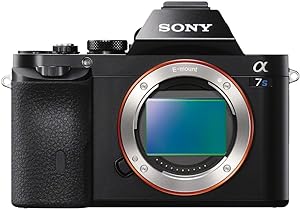
Sony ILCE7S/B Alpha a7S Full-Frame Mirrorless Camera

4.0 (114 reviews)

Shoot at ISO 409,600 and still pull usable images — the a7S was built for light that would stop any other camera cold.

$589.99*
In Stock on Amazon.com
View on Amazon

*Price sourced from Amazon.com. Last updated:Jun 04, 2026.Price and availability are subject to change.

Affiliate Disclosure: Studio Supplies may earn a commission from qualifying purchases made through links on this page, at no additional cost to you. This helps support our editorial team.

Notice a mistake? Let Us Know

Overview

The Sony Alpha a7S carries a 12.2MP 35mm full-frame Exmor CMOS sensor — a deliberate engineering choice that prioritizes pixel size over pixel count. Fewer pixels on the same sensor area means each photosite is physically larger, collecting more photons per exposure and generating less noise at any given ISO. The result is a camera rated to ISO 409,600 (expanded) with a native sensitivity ceiling that redefines what "available light" means in practice: nightclub floors lit by a single candle, backstage corridors in arena venues, and moonlit landscape compositions become viable shooting environments rather than deal-breakers. The 15.3-stop dynamic range compounds this advantage — in a single RAW file, you carry recoverable detail from blown-out windows and crushed dark corners simultaneously.

The a7S was designed for the video-first hybrid shooter and photojournalist operating in controlled chaos. Its uncompressed 4:2:2 HDMI output was revolutionary at launch and remains a professional-grade delivery pipeline for documentary and broadcast work. The 2.4-million dot OLED EVF gives accurate real-time exposure feedback that is indispensable in rapidly changing light conditions. The absence of IBIS means this is a tool that rewards skill — lens stabilization selection and ergonomic support matter here in ways they don't on the a7S II. It fits into a Sony E-mount system without friction, adapts A-mount glass with full AF via the LA-EA4, and serves as the core body for any photographer or filmmaker whose primary battlefield is darkness.

Specifications

Sensor
12.2MP 35mm Full-Frame Exmor CMOS
ISO Range
100–102400 native (expandable to 409600)
Dynamic Range
15.3 stops
Video Output
Uncompressed 4:2:2 Full HD and 4K QFHD via HDMI
Autofocus
Fast Intelligent AF
Viewfinder
2.4-million dot XGA OLED Tru-Finder EVF
LCD
3.0" 1.23M dot tilting
Mount
Sony E-mount
Connectivity
Wi-Fi, NFC
IBIS
None

Pros & Cons

👍 Pros

  • ISO range extending to 409,600 (expanded) enables usable images in near-darkness — candlelit venues, night exteriors, and concert work that would render other cameras unusable.
  • 15.3 stops of dynamic range captures simultaneous highlight and shadow detail in extreme contrast scenes — a direct advantage in event, wedding, and documentary work.
  • 12.2MP full-frame Exmor sensor uses large pixel pitch to capture more light per pixel than higher-resolution sensors — the engineering foundation for the exceptional high-ISO performance.
  • Uncompressed 4:2:2 HDMI output delivers broadcast-grade color depth to external recorders, making this a serious professional video tool at its price point.
  • 2.4-million dot XGA OLED Tru-Finder EVF provides high-resolution electronic preview that accurately represents the final image's exposure and color in real time.

👎 Cons

  • 12.2MP resolution limits aggressive cropping — wildlife and sports photographers accustomed to cropping to 50% of a 24MP+ frame will find the pixel budget constraining.
  • No in-body image stabilization means handheld slow-shutter and video work requires stabilized lenses or external rigs — a notable absence that the a7S II addressed.
  • In-camera 4K recording is not available on the original a7S — clean 4K requires an external recorder connected via HDMI, adding cost, bulk, and battery complexity to a video kit.
  • Fast Intelligent AF, while functional, predates Sony's more advanced phase-detect Eye-AF systems — subject tracking and moving AF performance is notably behind current Sony mirrorless generation.
  • The original a7S lacks weather sealing at the level of the a7R or a9 series — shooting in rain or dusty environments introduces risk without additional body protection.

Frequently Asked Questions

The a7S uses Sony E-mount, which is natively incompatible with A-mount lenses. The LA-EA4 adapter (sold separately) allows A-mount lenses to mount on the a7S with autofocus functionality preserved — a critical consideration for photographers migrating from Sony's DSLR lineup.
15.3 stops means the a7S can simultaneously retain detail in the brightest highlights and the deepest shadows in a single exposure — a range that covers high-contrast scenes like interiors with bright windows, backlit subjects, and nighttime cityscapes that would force other cameras to choose between blown highlights or crushed shadows.
12.2MP delivers files of approximately 4000x3000 pixels — adequate for prints up to 13x19 inches at 300dpi, but limiting for photographers who regularly crop heavily or deliver images at 24MP+ for stock licensing. The sensor's pixel size is the trade-off: larger pixels are the engineering reason for the exceptional high-ISO performance.
The a7S outputs 4K QFHD (3840x2160) via HDMI to a compatible external recorder in 4:2:2 uncompressed format, which preserves full color information for professional color grading. This was a groundbreaking specification at the time of this camera's release and remains relevant for videographers who need clean 4K without the codec compression of in-camera recording.
No. The original a7S does not include in-body image stabilization — that feature was introduced in the a7S II. For handheld low-light video or slow-shutter photography, users rely on optically stabilized lenses or external stabilization rigs.