



Sony
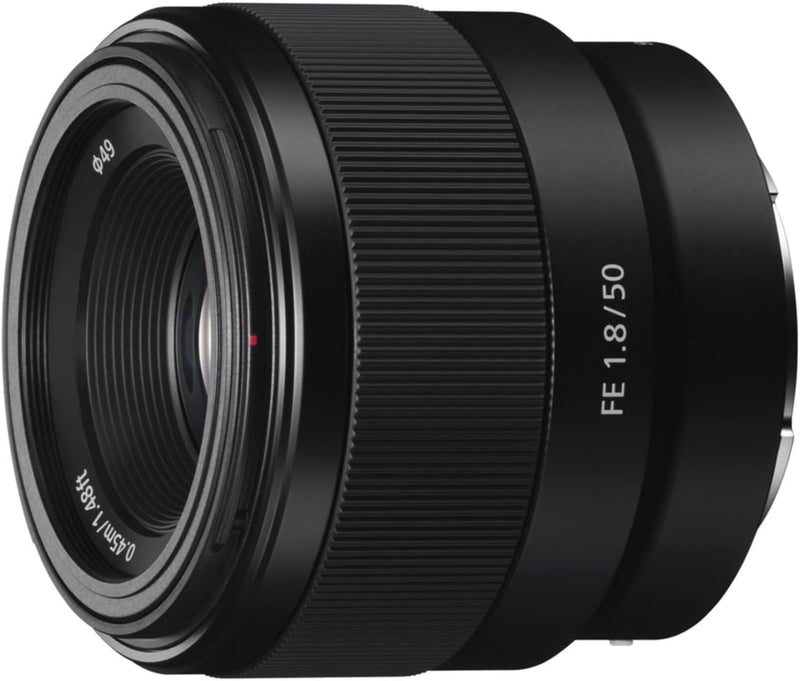
Sony SEL50F18F FE 50mm F1.8 Standard Prime Lens
★★★★★
The Sony FE 50mm F1.8 puts full-frame bokeh and street-sharp rendering into one of the lightest prime packages in the E-mount lineup.
$228.00*$245.95Save 7%
View on Amazon
✓ In Stock on Amazon.com
Price history
*Price sourced from Amazon.com. Last updated:Jul 15, 2026.Price and availability are subject to change.
Affiliate Disclosure: Studio Supplies may earn a commission from qualifying purchases made through links on this page, at no additional cost to you. This helps support our editorial team.
Notice a mistake? Let Us Know
Overview
Key Features
Large F1.8 maximum aperture enables beautiful defocusing effects, 7-blade circular aperture creates beautiful defocused bokeh
Compact, lightweight design ideal for full-frame E-mount cameras, Aspherical element controls spherical aberration and coma
Double-gauss configuration suppresses field curvature & distortion, Metal mount adds solid durability as well as a sophisticated feel, Fast DC motor focus actuator system drives all lens groups
75mm (35mm equivalent) focal length with APS-C sensor. Angle of View (APS-C) : 32 degree
In-the-box: Hood (ALC-SH146), Lens front cap (ALC-F49S), Lens rear cap (ALC-R1EM)
Specifications
Maximum Aperture
F1.8
Aperture Blades
7-blade circular
Design
Compact, lightweight
Optical Elements
Aspherical element, Double-gauss configuration
Mount Material
Metal
Focus Actuator
Fast DC motor
Focal Length (APS-C)
75mm (35mm equivalent)
Angle of View (APS-C)
32 degrees
Included Accessories
Hood (ALC-SH146), Lens front cap (ALC-F49S), Lens rear cap (ALC-R1EM)
Pros & Cons
👍 Pros
- F1.8 maximum aperture delivers genuine subject-background separation at typical portrait distances on full-frame, producing clean bokeh from the 7-blade circular aperture
- Compact, lightweight construction makes it a natural everyday carry prime on full-frame bodies — significantly lighter than F1.4 alternatives in the same focal length
- Aspherical element visibly controls spherical aberration and coma, keeping point light sources rendered cleanly wide open rather than blooming
- Metal mount construction adds durability confidence and a premium tactile connection to the camera body compared to plastic-mount alternatives
- Full-frame E-mount coverage doubles as a 75mm equivalent portrait focal length on APS-C Sony bodies, extending its versatility across the Sony ecosystem
👎 Cons
- DC motor autofocus lacks the speed and tracking precision of Sony's linear motor lenses — a limitation that becomes apparent in challenging or fast-moving subject scenarios
- No optical image stabilization means handheld performance in low light depends entirely on body IBIS, which is absent on older or entry-level Sony cameras
- Minimum focus distance of 45cm limits its utility for close-up detail or product work without supplementary close-up tools
- Corner sharpness at F1.8 on full-frame is softer than center performance — acceptable for portraits but noticeable in flat-field or architectural work
- No weather sealing, which limits confidence when shooting in light rain or dusty environments common in outdoor portrait or street work
Frequently Asked Questions
Is the SEL50F18F compatible with APS-C Sony bodies as well as full-frame?
Yes — the lens covers full-frame E-mount sensors natively, and on APS-C bodies it produces a 75mm equivalent field of view (32° angle of view) with no vignetting. The crop factor makes it a natural short telephoto portrait focal length on cameras like the a6000 series, while full-frame shooters get the classic 50mm perspective.
How does the DC motor autofocus perform for moving subjects?
The DC motor focus actuator is adequate for controlled portrait sessions and street work with predictable subjects, but it lags behind Sony's linear motor lenses when tracking erratically moving subjects. For still portraits, product work, and moderate street photography, it is responsive and quiet. For sports or fast-moving children, the focus speed will show its limits compared to G Master or G series alternatives.
Does the SEL50F18F have optical image stabilization?
No — the lens has no built-in OSS (Optical SteadyShot). On Sony bodies with in-body image stabilization (IBIS), such as the a7 III and later, the body's stabilization compensates effectively. On older or entry-level Sony bodies without IBIS, handheld shooting in low light at slower shutter speeds will require attention to technique.
How does the 7-blade aperture affect bokeh rendering at F1.8?
The 7-blade circular aperture produces near-circular out-of-focus highlights when shooting wide open, which renders as smooth, rounded bokeh balls in backgrounds. Stopped down to F2.8–F4, the aperture shape becomes slightly heptagonal, which is typical of this blade count. For portrait work at F1.8–F2, background separation is smooth and visually clean.
What is the minimum focus distance, and does it affect close-up subject work?
Minimum focus distance is 45cm (approximately 1.5 feet). This limits close-up work — it is not a macro lens, and at typical portrait distances the working space is comfortable. For product or detail photography requiring close focus, a dedicated macro lens would be more appropriate.
Related Products


