

Tamron
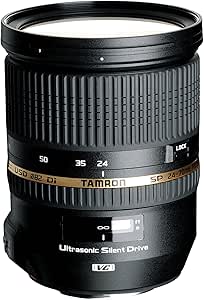
Tamron A007-N SP 24-70mm f/2.8 Di VC USD Lens, Nikon Mount
96 inchf/2.8
Vibration Compensation at a constant f/2.8 makes this the 24-70 that stays sharp in the low-light venues and fast-paced event work where most standard zooms lose their footing.
$423.00*
View on Amazon
✓ In Stock on Amazon.com
*Price sourced from Amazon.com. Last updated:Aug 30, 2026.Price and availability are subject to change — details.
Affiliate Disclosure: As an Amazon Associate, Studio Supplies earns from qualifying purchases made through links on this page, at no additional cost to you. This helps support our editorial team.
Notice a mistake? Let Us Know
Overview
Key Features
Fast F/2.8 aperture throughout the zoom range
Top-in-class quality images with 3 LD, 3 Glass Molded Aspheric, 1 Hybrid Aspheric and 2 XR (Extra Refractive Index) elements
New VC anti-shake mechanism with 4-stop advantage
USD (Ultrasonic Silent Drive) powers a speedy AF drive together with continuous manual focus control (Full-Time Manual/FTM)
Moisture-resistant construction helps prevent water from penetrating the lens
Specifications
Model
A007-N
Mount
Nikon F (FX)
Focal Length
24–70mm
Maximum Aperture
f/2.8
Minimum Aperture
f/22
Lens Construction
17 elements, 12 groups
Angle of View
84°04' – 34°21' (full frame)
Minimum Focus Distance
0.38m / 15"
Maximum Magnification
1:5 (at 70mm)
Filter Diameter
82mm
Diaphragm Blades
9 (rounded)
Overall Length
4.3"
Maximum Diameter
3.5"
Weight
29.1 oz
Image Stabilization
VC (Vibration Compensation)
Autofocus
USD (Ultrasonic Silent Drive)
Frequently Asked Questions
Does the VC system work on all Nikon F-mount bodies including the D750, D800, and D850?
Yes. The VC system functions on all Nikon F-mount bodies that support CPU-lens communication. It operates independently of any in-body stabilization — no special menu settings required. On bodies without IBIS, the VC provides tangible sharpness improvement at slower handheld shutter speeds.
How does the 82mm filter diameter affect my existing filter collection?
It's a larger-than-average thread for a 24-70. Most circular polarizers and ND filters sized for 72mm or 77mm lenses won't thread on directly — you'll need 82mm-specific filters or a step-up ring. Budget for this if you don't already own 82mm accessories.
Is the USD autofocus quiet enough for video work or shooting in quiet venues?
The USD (Ultrasonic Silent Drive) motor is fast and near-silent. It's audible in a very quiet studio with a camera-mounted mic pointed at the lens, but for event work, run-and-gun video, and portrait sessions, it's quiet enough to be a non-issue.
Can the A007 be used on APS-C Nikon bodies like the D7500 or D500?
Yes. On APS-C bodies, the effective focal length becomes approximately 36–105mm — a slightly tighter range that works well for portrait and mid-telephoto work. Full-frame coverage means no vignetting penalty on crop bodies.
How close does this lens focus, and can it produce useful subject separation at 70mm?
Minimum focus distance is 0.38m (approximately 15 inches). At 70mm, the maximum magnification reaches 1:5 — not macro territory, but sufficient for detailed close-ups with genuine background separation at f/2.8. Environmental portraits and product details both benefit.
Related Products


