



Tascam
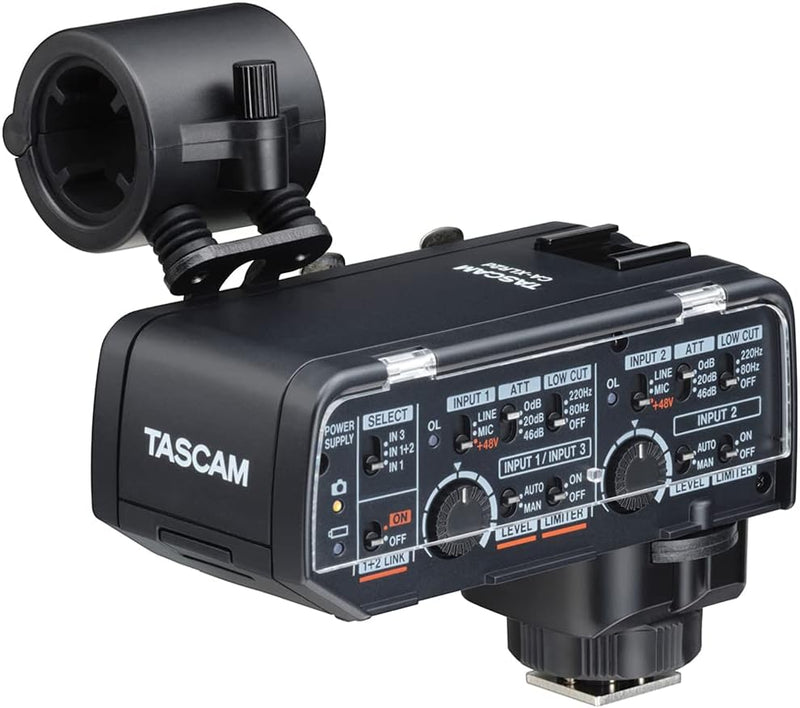
Tascam CA-XLR2d-F Fujifilm XLR Microphone Adapter for Cameras
XLR48Vphantom power
Bring broadcast-grade dual-XLR audio into your FUJIFILM mirrorless workflow without a separate recorder or mixer in the bag.
$399.00*
View on Amazon
✓ In Stock on Amazon.com
*Price sourced from Amazon.com. Last updated:Oct 21, 2026.Price and availability are subject to change — details.
Affiliate Disclosure: As an Amazon Associate, Studio Supplies earns from qualifying purchases made through links on this page, at no additional cost to you. This helps support our editorial team.
Notice a mistake? Let Us Know
Overview
Key Features
Microphone adapter with XLR input expansion for mirrorless cameras
Equipped with 2 XLR/TRS input terminals, you can use the optimum microphone according to the set and environment
Equipped with a high-performance AD converter, it can directly transmit digital audio without deterioration to the camera via a accessory shoe. (Compatible manufacturers: Canon, FUJIFILM)
Power can be supplied from the camera body via the corresponding accessory shoe (Compatible manufacturers: Canon, FUJIFILM)
Equipped with a high-performance HDDA mic preamplifier for high sound quality, low noise, and wide dynamic range (microphone / line level switching, + 48V phantom power supply compatible)
Specifications
Product Type
Microphone Adapter
Inputs
2 XLR/TRS terminals
Digital Audio Transmission
Direct via accessory shoe
Power Supply
From camera body via accessory shoe
Preamplifier Type
HDDA mic preamplifier
Phantom Power
+48V compatible
Level Switching
Microphone / Line
Compatible Camera Manufacturers
Canon, FUJIFILM
Frequently Asked Questions
Which FUJIFILM camera bodies are compatible with the CA-XLR2d-F?
The CA-XLR2d-F is designed for FUJIFILM mirrorless cameras equipped with a data-communication accessory shoe — models like the X-H2S, X-H2, and X-T5 that support digital audio transmission over the hot shoe. Check your specific body's compatibility list, as older FUJIFILM bodies with a standard cold shoe won't support the digital audio pathway.
Does the adapter draw power from the camera, or does it need its own battery?
Power comes directly from the camera body via the compatible accessory shoe — no batteries required in the adapter itself. This keeps the rig light and eliminates the inconvenience of managing a separate power source during a shoot.
Can I use dynamic microphones as well as condensers requiring phantom power?
Yes. The CA-XLR2d-F supplies +48V phantom power to each XLR/TRS input independently, so you can run a condenser mic on one channel and a dynamic on the other simultaneously. Each channel also has microphone/line level switching built in.
How does the digital audio reach the camera — is there any quality loss in transmission?
Audio is transmitted digitally over the accessory shoe connection, bypassing the analog signal path entirely after the adapter's own AD conversion stage. The HDDA mic preamp converts the signal once and hands it to the camera as a clean digital stream, which means there's no analog cable run introducing noise between the adapter and the recording medium.
Can the CA-XLR2d-F be used with Canon cameras as well?
Yes — Tascam designed the CA-XLR2d series in collaboration with both FUJIFILM and Canon. The CA-XLR2d-F is the FUJIFILM-specific variant with the matching hot shoe geometry. Canon users should use the CA-XLR2d-C variant designed for their system.
Related Products


