



Tascam
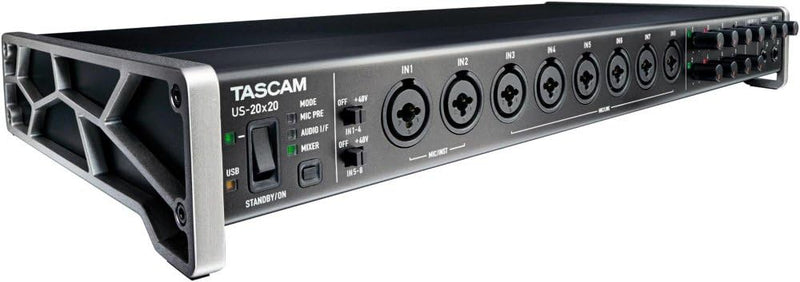
Tascam US-20X20 USB 3.0 Audio MIDI Interface Mixer
USB 3.0
Tascam US-20x20 packs 20 channels of I/O, eight Ultra-HDDA preamps, and onboard DSP mixing into a single rackspace via USB 3.0.
Check availability
Affiliate Disclosure: As an Amazon Associate, Studio Supplies earns from qualifying purchases made through links on this page, at no additional cost to you. This helps support our editorial team.
Notice a mistake? Let Us Know
Overview
Key Features
Packs 20 channels of analog and digital I/O into a single rackspace with great sounding preamps and USB 3.0/2.0 connectivity
Eight Ultra-HDDA microphone preamps provide 56dB of gain and high headroom to make microphones sound their best
MIDI I/O allows use with controllers and synthesizers, and sample rates up to 192kHz/24-bit are supported
The first USB 3.0 interface to use class-compliant drivers for future-proof use with computers and tablets
A built-in DSP mixer includes parametric EQ and compression on every channel and a stereo reverb send for great-sounding monitor mixes
The US-20x20 has three operation modes-–audio interface, digital mixer, and 8-channel digital mic preamp–-for maximum flexibility
Two instrument-level inputs are provided for direct input of guitar or bass
Specifications
Brand
Tascam
Model
US-20x20
Type
USB 3.0 Audio/MIDI Interface
Total I/O
20 in / 20 out
Mic Preamps
8 Ultra-HDDA (56dB gain)
Instrument Inputs
2
Max Sample Rate
192kHz / 24-bit
MIDI I/O
Yes
DSP Mixer
Parametric EQ, Compression, Stereo Reverb (per channel)
Connectivity
USB 3.0 / USB 2.0
Operation Modes
Audio Interface, Digital Mixer, 8-Channel Mic Preamp
Frequently Asked Questions
How many simultaneous inputs and outputs does the US-20x20 support?
It provides 20 channels of input and 20 channels of output, combining analog and digital I/O in a single rackspace unit.
How many simultaneous inputs and outputs does the US-20x20 provide?
It provides 20 inputs and 20 outputs total, combining analog mic/line inputs, instrument inputs, and digital I/O (ADAT and S/PDIF) in a single unit.
Does the US-20x20 require proprietary drivers?
No. It is the first USB 3.0 audio interface to use class-compliant drivers, meaning it works without proprietary driver installation on supported operating systems and is designed for long-term compatibility.
Does the US-20x20 require proprietary drivers, or is it class-compliant?
It uses class-compliant USB 3.0 drivers, meaning it works without proprietary driver installation on supported operating systems and is designed for long-term compatibility with future computers and tablets.
What are the three operation modes?
The US-20x20 can function as a USB audio interface for recording, a standalone digital mixer without a computer, or an 8-channel digital microphone preamp for expanding another interface's input count.
What are the three operation modes?
The US-20x20 can function as a USB audio interface for recording, a standalone digital mixer without a computer, or an 8-channel mic preamp for expanding another interface or mixer's input count.
Does the built-in DSP mixer add latency to recordings?
The DSP mixer processes monitoring separately from the recorded signal, so you can use EQ, compression, and reverb in your headphone or monitor mix without adding latency or affecting what gets recorded to your DAW.
Can I plug a guitar or bass directly into this interface?
Yes. Two dedicated instrument-level inputs are provided on the front panel for direct connection of guitar or bass without needing an external DI box.
What DSP processing is available in the built-in mixer?
The onboard DSP mixer includes parametric EQ and compression on every channel plus a stereo reverb send, allowing you to build low-latency monitor mixes without taxing your computer's CPU.
What is the maximum supported sample rate?
The US-20x20 supports sample rates up to 192kHz at 24-bit resolution.
Related Products


