



Tascam
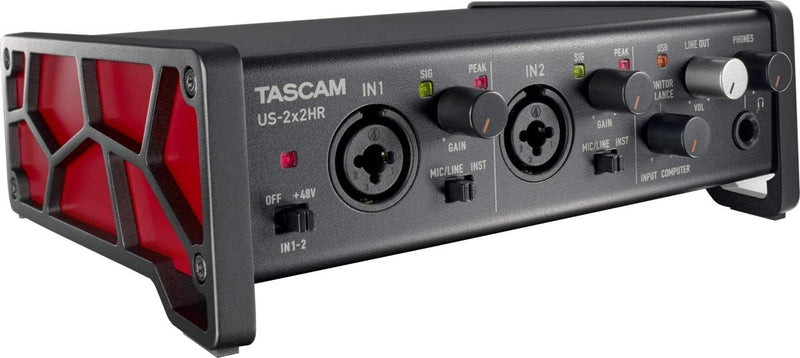
Tascam US2X2HR USB Audio Interface for Recording
XLR48Vphantom power
Ultra-HDDA preamps and 24-bit/192kHz resolution give vocalists and instrumentalists a signal chain clean enough to reveal the detail that cheap interfaces smear.
$199.00*
Check availability
*Price sourced from Amazon.com. Last updated:Aug 28, 2026.Price and availability are subject to change — details.
Affiliate Disclosure: As an Amazon Associate, Studio Supplies earns from qualifying purchases made through links on this page, at no additional cost to you. This helps support our editorial team.
Notice a mistake? Let Us Know
Overview
Key Features
2-in/2-out USB audio interface
Supports up to 24-bit/192 kHz audio formats
Improved TASCAM driver with selectable buffer size from 4 samples provides low-latency and stability (Windows: TASCAM native driver)
2 Combo (XLR) combo inputs equipped with Ultra-HDDA mic preamps and +48V phantom power
2 Combo (TRS) line inputs with guitar input support
Specifications
Brand
TASCAM
Model
US-2x2HR
Channel Count
2-in / 2-out
Connection
USB
Audio Resolution
Up to 24-bit / 192kHz
Mic Preamps
2x Ultra-HDDA (XLR combo inputs)
Phantom Power
+48V (both inputs)
Line Inputs
2x TRS combo (with Hi-Z guitar mode)
MIDI
MIDI IN / MIDI OUT
Loopback
Yes
Minimum Buffer Size
4 samples (Windows TASCAM native driver)
Frequently Asked Questions
How low is the latency on the US-2x2HR, and does the 4-sample buffer actually work?
The TASCAM native driver for Windows supports buffer sizes down to 4 samples, which at 192kHz translates to sub-millisecond round-trip latency — below the threshold where most performers perceive monitoring delay. On macOS, the Core Audio driver handles latency management differently, so real-world monitoring latency depends on your DAW buffer settings and sample rate. For direct monitoring without DAW processing, the US-2x2HR provides a zero-latency direct monitor path via the front panel mix knob.
Do both XLR inputs supply phantom power for condenser microphones?
Yes. Both combo XLR inputs provide +48V phantom power, switchable to power condenser microphones, DI boxes, and active ribbon mics that require it. If you are running a dynamic mic and a condenser simultaneously, confirm your dynamic mic's tolerance for phantom before enabling it — most modern dynamics are unaffected, but vintage ribbon mics can be damaged.
What does the Ultra-HDDA preamp design mean for recording quality?
HDDA (High Definition Discrete Architecture) refers to TASCAM's discrete transistor preamp topology, as opposed to op-amp-based designs. In practice, this translates to a lower noise floor and greater gain headroom before the preamp begins to color the signal. For vocals, acoustic instruments, and other sources that rely on clean amplification rather than preamp character, a lower noise floor means quieter passages are captured with more usable detail.
Can the US-2x2HR handle guitar input directly without a separate DI box?
Yes. The combo TRS line inputs include a Hi-Z guitar input mode, allowing you to plug a passive guitar or bass directly into the interface without loading down the pickup — which would cause the high-frequency roll-off and tonal thinning that occurs when a passive pickup drives a low-impedance input. Select the instrument input mode on the front panel before plugging in.
Does the US-2x2HR include MIDI connectivity?
Yes. The US-2x2HR includes dedicated MIDI IN and MIDI OUT ports on the rear panel, allowing direct connection of MIDI keyboards, controllers, and outboard gear without a separate MIDI interface. This is increasingly uncommon at this interface price tier, making it a meaningful value-add for producers who work with hardware synths.
Related Products


