



Tiffen
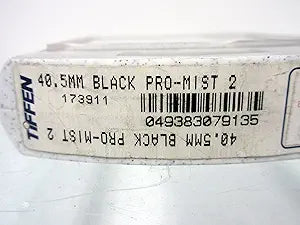
Tiffen 405BPM2 82mm Black Pro-Mist 2 Filter
The Black Pro-Mist 2 tames digital harshness with controlled highlight bloom and gentle contrast rolloff that reads as film on screen.
$79.99*
View on Amazon
✓ In Stock on Amazon.com
*Price sourced from Amazon.com. Last updated:Aug 28, 2026.Price and availability are subject to change — details.
Affiliate Disclosure: As an Amazon Associate, Studio Supplies earns from qualifying purchases made through links on this page, at no additional cost to you. This helps support our editorial team.
Notice a mistake? Let Us Know
Overview
Key Features
Offers all the benefits of the Pro-Mist filter in a more subtle form.|Highlight flares are controlled.|Contrast is lowered but with less lightening of shadows for a more delicate effect|Creates a soft light "pastel" effect|Delicate effect with contained highlight flare|Also available in DV Select Kit 3 and DV ”Film Look” Kit|Made in the U.S.A. |10 Year Warranty
Specifications
Filter Type
Black Pro-Mist 2
Filter Diameter
82mm
Ring Size
40.5mm
Effect
Softens highlights, lowers contrast, subtle halation bloom
Shadow Handling
Reduced shadow lightening vs. standard Pro-Mist
Manufacturing
Made in the U.S.A.
Warranty
10 Years
Frequently Asked Questions
How does the Black Pro-Mist 2 differ from the standard Pro-Mist and the Black Pro-Mist 1?
The Black Pro-Mist series uses dark particles in the filter matrix rather than white, which controls highlight flare while keeping shadow regions relatively dark — unlike the standard Pro-Mist which lightens shadows more aggressively. The "2" grade is a step subtler than the "1," delivering a more restrained halation effect that's easier to remove in post if needed and less likely to feel over-processed on faces.
Will this filter cause any sharpness loss in the image center at standard shooting apertures?
The Black Pro-Mist 2 introduces a measurable but controlled softening — predominantly in specular highlights rather than across the full frame. At f/4–f/8 on standard focal lengths, fine detail in mid-tones remains largely intact. The effect is most visible around point light sources and skin highlight transitions, which is precisely where the filter is designed to work.
Does the 82mm size mean I need step-up rings to use this on smaller lenses?
Yes. At 82mm this filter is sized for large professional lenses. For smaller filter thread diameters (72mm, 77mm, 67mm), you'll need step-up rings to mount it. The trade-off is that one large filter can serve multiple lenses via step-up rings, avoiding the cost of buying multiple filter sizes.
Is the Black Pro-Mist 2 suitable for skintone work in portrait or narrative filmmaking?
It's particularly well-suited for it. The filter's reduced shadow lift (compared to white mist variants) means skin tones retain their depth and warmth while specular highlights on cheekbones and foreheads gain a subtle, flattering bloom. It avoids the washed-out look that heavier mist filters can create on high-contrast faces.
Can this filter be effectively replicated in post-production?
Partially — highlight bloom plugins can approximate the luminance spread, but the optical interaction between the filter's particles and the lens's actual light path creates a quality of halation that post-processing diffusion glow doesn't fully match. Many colorists use the filter on set precisely because the optical result integrates more naturally into the image than a composited effect.
Related Products


