



Tiffen
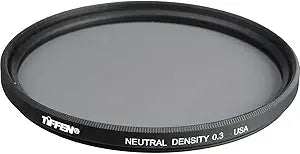
Tiffen 49ND3 49mm Neutral Density Filter
★★★★★
One stop of light reduction that opens your aperture wide and slows your shutter in bright sun — keeping your 49mm lenses shooting wide open when it matters.
$18.95*$19.99Save 5%
View on Amazon
✓ In Stock on Amazon.com
*Price sourced from Amazon.com. Last updated:Jul 14, 2026.Price and availability are subject to change.
Affiliate Disclosure: Studio Supplies may earn a commission from qualifying purchases made through links on this page, at no additional cost to you. This helps support our editorial team.
Notice a mistake? Let Us Know
Overview
Key Features
Eliminates overly bright, washed out images
Balances exposure
Controls depth of field
49 millimeters in diameter
For use with F-stop 1 on a manual camera; for all film types, color or black and white
Specifications
Filter Type
Neutral Density
Diameter
49 millimeters
Compatibility
F-stop 1 manual camera, all film types
Pros & Cons
👍 Pros
- Precisely calibrated ND 0.3 density delivers a reliable one-stop reduction, allowing fine-tuned exposure control without guessing at filter factor conversions.
- Color-neutral filtration preserves the scene's white balance and tonal relationships in both color and black-and-white work.
- 49mm thread size fits a wide range of compact prime lenses commonly used for portrait and street photography where wide aperture shooting matters most.
- Solid ND construction provides consistent density across the full filter surface — no graduated falloff or uneven exposure in the frame.
- Broad film stock compatibility (all types, color and B&W) makes it a universal tool regardless of the camera system or recording medium.
👎 Cons
- One stop of reduction is modest — in harsh midday sunlight requiring 4-6 stops of ND, this filter alone is insufficient and additional ND filtration would be needed.
- Solid ND design means the entire frame receives equal density reduction — it cannot balance a bright sky against a darker foreground the way a graduated ND filter would.
- 49mm is a small thread diameter, and at this size vignetting becomes a potential concern when stacking with other filters on wide-angle lenses.
- No information provided on multi-coating, which affects flare and ghost control when shooting with the filter in high-contrast or backlit scenes.
- At only 1 stop, the filter does not enable dramatically slower shutter speeds for motion blur effects in typical daylight conditions.
Frequently Asked Questions
What does ND 0.3 / 1-stop actually mean for my exposure settings?
An ND 0.3 filter cuts the light reaching your sensor by exactly one stop — half the light. In practice: if your unfiltered exposure is 1/500s at f/1.8, the filter lets you open to 1/500s at f/1.4, or maintain f/1.8 and drop to 1/250s. It's a modest but precise reduction, most useful when you're one stop away from a workable exposure rather than dealing with extreme midday brightness that requires 3-6 stops of reduction.
Will the Tiffen 49ND3 introduce a color cast on my images?
Tiffen designs its solid ND filters to be optically neutral — the filter uniformly reduces all wavelengths equally and should not introduce a color cast. Real-world performance is consistent with this: users shooting in both color and black-and-white report clean tonal rendering without warm or cool shifts that require post-correction.
Which lenses use a 49mm filter thread?
49mm is a common thread size on compact prime lenses. Canon EF 50mm f/1.8 STM, Sony E 50mm f/1.8 OSS, and various Nikon 50mm and wide-angle primes use this diameter. Always verify your specific lens's filter thread diameter (printed on the lens barrel or in the lens specs) before ordering — the 49mm designation is non-negotiable.
Can I stack this filter with a UV or circular polarizer?
Physically, yes. Functionally, stacking adds the optical density of each filter together and introduces vignetting risk, particularly on wide-angle lenses. For most 49mm primes (typically 35mm to 85mm equivalent), moderate stacking is manageable. At wider focal lengths, check for corner vignetting before shooting, as the smaller filter diameter is more susceptible to edge clipping than larger diameters.
Is this filter useful for video work as well as stills?
Yes. On video-capable cameras, the 180-degree shutter rule requires your shutter speed to be double your frame rate — at 24fps, your shutter should be around 1/50s. In bright conditions, achieving that shutter speed while maintaining a cinematic aperture often requires ND filtration. A 1-stop ND like this one addresses mild overexposure scenarios; for bright outdoor video work, a stronger ND (3-6 stops) may be more practical.
Related Products


