



Tiffen
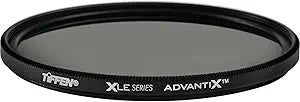
Tiffen 58IRND30 XLE Series 58mm IRND Filter - Advantix
★★★★★
Ten stops of infrared-corrected neutral density in a 58mm thread — shoot wide open at noon without IR-induced color cast corrupting your carefully exposed frame.
$42.75*
View on Amazon
✓ In Stock on Amazon.com
*Price sourced from Amazon.com. Last updated:Jul 14, 2026.Price and availability are subject to change.
Affiliate Disclosure: Studio Supplies may earn a commission from qualifying purchases made through links on this page, at no additional cost to you. This helps support our editorial team.
Notice a mistake? Let Us Know
Overview
Key Features
ND 3.0 filter darkens the image allowing you to photograph with a longer shutter speed or wider aperture than normally required.|Providing a 10 stop exposure reduction this filter allows you to control depth of field and convey movement more easily.|Attenuates infrared light as well as visible wavelengths to maintain color neutrality and suppress color casts due to increased exposure lengths.
Specifications
Model
58IRND30
Filter Type
IRND (Infrared Neutral Density)
Optical Density
ND 3.0 (10-stop exposure reduction)
Thread Size
58mm
Construction
ColorCore (optical resin between glass elements)
Series
XLE advantiX
Effect
Attenuates visible light and infrared wavelengths for color-neutral extended exposures
Pros & Cons
👍 Pros
- 10-stop exposure reduction enables true long-exposure creative control — silky water, motion blur, and wide-aperture outdoor portraits in full sunlight
- 10-stop ND 3.0 density enables wide-aperture shooting at f/1.8 or f/2.8 in direct sunlight without blowing highlights, preserving subject separation and background bokeh in daylight conditions
- Infrared attenuation corrects the warm color cast that plagues standard ND filters on digital sensors, preserving accurate white balance and color rendition at extended exposure times
- Infrared attenuation eliminates the reddish IR color cast that standard ND filters produce on digital sensors, preserving accurate color rendition
- ColorCore technology bonds the optical coating within the glass, preventing delamination and coating degradation over time
- ColorCore construction between two glass elements provides a uniform optical medium that resists delamination and distributes density evenly across the full filter surface
- Combined ND and IR attenuation in a single filter eliminates the need to stack a standard ND with a separate IR-cut filter, avoiding the vignetting and optical degradation of dual-filter stacking
- Precision metal rings provide a solid, smooth thread that seats correctly without cross-threading — important when attaching and removing in the field
- Works across both stills and video, including cinematic 180-degree shutter compliance in bright outdoor conditions
- Precision metal ring threads smoothly onto compatible 58mm lenses without cross-threading — consistent with Tiffen's manufacturing tolerances that photographers have relied on for decades
👎 Cons
- At ND 3.0 (10 stops), this is a single fixed-density filter — it cannot be adjusted for varying light levels the way a variable ND can
- 10 stops of density makes the optical viewfinder effectively unusable while the filter is attached — compose and focus before mounting, or use live view with exposure simulation enabled
- At 58mm thread, this filter is tied to the smaller-thread lens ecosystem — photographers with 77mm or 82mm filter systems must purchase separate IRND filters at those thread sizes
- A 10-stop reduction is extreme for general use; bright overcast conditions may require a lower-density filter instead for moderate long exposures
- At 58mm thread diameter, it does not fit larger telephoto or wide-angle lenses without a step-up ring, which adds cost and potential vignetting risk
- Fixed ND 3.0 density does not adapt to changing light conditions — moving from shade to full sunlight mid-scene requires removing the filter or accepting underexposure, unlike variable ND alternatives
- Accurate manual metering through 10 stops of density is impractical — correct exposure requires metering without the filter, calculating the 10-stop shift, then reattaching before shooting
- Extreme exposure lengths (several minutes) can still reveal subtle color shifts even on well-made IRND glass
- The flat, non-graduated design means it cannot balance exposure between a bright sky and darker foreground — a graduated ND handles that scenario
- Fixed screw-in design cannot be swapped quickly between lenses of different thread sizes during fast-paced shooting — a variable ND or square filter system provides faster field adaptation
Frequently Asked Questions
What does "IRND" mean, and why does it matter on a digital camera?
IRND stands for Infrared Neutral Density. Digital sensors are sensitive to infrared light beyond the visible spectrum, and standard ND filters only block visible wavelengths — allowing IR light to pass through and create a reddish or magenta cast, especially at longer exposures. This filter blocks both visible and infrared wavelengths simultaneously, keeping colors neutral when you're using extended shutter speeds.
What does the IRND designation mean, and why does it matter for digital sensors?
IRND means the filter attenuates both visible light and infrared wavelengths simultaneously. Standard ND filters block visible light but transmit infrared — on digital sensors, which are more sensitive to infrared than film, this causes a warm magenta or red color cast that becomes increasingly visible at longer exposures. The IRND construction eliminates that IR contamination.
What is the practical exposure impact of ND 3.0 / 10-stop density?
An ND 3.0 filter allows 1/1000th the light through versus no filter. If your metered exposure at noon is 1/1000s at f/1.8, the 10-stop reduction extends that exposure to approximately 1 second — enabling wide-aperture shooting in full sunlight, long-exposure motion blur in running water, or pedestrian disappearance in architectural shots.
The filter is rated ND 3.0 — how many stops of light does that represent?
ND 3.0 equals a 10-stop exposure reduction. In practical terms: if your metered exposure is 1/1000s, this filter brings it to approximately 1 second under the same conditions. That's enough to shoot silky water or streaked clouds in full midday sunlight, or to open your aperture wide for shallow depth of field in bright outdoor portraits.
Will this filter cause a color cast in my images?
Properly designed IRND filters shouldn't — the ColorCore technology in the Tiffen XLE Series sandwiches the optical coating between layers of glass to provide consistent color neutrality. However, at extreme exposures (multiple minutes) even well-made IRND filters can introduce subtle shifts, which is normal for any ND glass under maximum stress.
Will this filter cause a color cast, and how does ColorCore construction address it?
Tiffen's ColorCore process bonds optical resin directly between two glass elements rather than applying a surface coating — preventing delamination and distributing the optical medium uniformly across the filter. Combined with the IRND formulation, this construction is specifically designed to minimize the warm color cast that conventional surface-coated ND filters produce on digital sensors.
Can this filter be used with step-up or step-down rings?
Step-up rings can adapt this 58mm filter to larger-thread lenses. However, vignetting risk increases on ultra-wide lenses when using step-up rings, as the larger filter diameter may intrude into the frame at the extreme corners. Do not use step-down rings to smaller thread lenses — front element coverage will be insufficient.
What thread size does this filter fit, and can it be used with step-up rings?
This filter is threaded for 58mm filter diameter lenses. It can be used with a step-up ring to fit larger lenses (e.g., a 58–67mm step-up ring), though vignetting at wide angles is possible depending on the ring depth and lens focal length.
Is the Tiffen 58IRND30 suitable for video as well as stills?
Yes — it's well-suited to video work where the 180-degree shutter rule requires a slow shutter speed regardless of ambient brightness. Videographers shooting in bright conditions use ND filters to achieve the correct shutter speed for natural-looking motion blur, and the IR correction is especially important for video where a magenta cast is immediately obvious in footage.
Is this filter suitable for video work to maintain a cinematic 180° shutter angle?
Yes — this is precisely the use case IRND filters are designed for. Cinematographers use ND filtration to maintain a 180° shutter angle in daylight, controlling motion blur aesthetically. The IRND construction ensures color temperature of the scene is preserved on sensor, critical for consistent color grading across footage shot at varying times of day.
Related Products


