

Tiffen
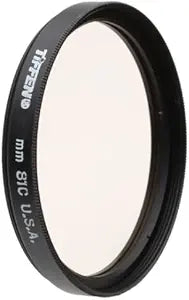
Tiffen 6781C 67mm 81C Warming Filter
Rescue portraits and landscapes from flat, cold overcast light with the Tiffen 81C — the warmest correction filter in the 81-series lineup.
$49.99*
View on Amazon
✓ In Stock on Amazon.com
*Price sourced from Amazon.com. Last updated:Aug 28, 2026.Price and availability are subject to change — details.
Affiliate Disclosure: As an Amazon Associate, Studio Supplies earns from qualifying purchases made through links on this page, at no additional cost to you. This helps support our editorial team.
Notice a mistake? Let Us Know
Overview
Key Features
Creates warmer tones and brighter colors on overcast days or when shooting with an electronic flash
Great for improving flesh tones
Warmer than the 81B filter
67mm diameter
Specifications
Filter Diameter
67mm
Filter Type
81C Warming / Light Balancing
Effect
Adds warm amber tone; corrects cool/overcast light
Primary Use
Overcast daylight, electronic flash correction, flesh tone improvement
Series Comparison
Warmer than 81B filter
Brand
Tiffen
Model
6781C
Frequently Asked Questions
How much warmer is the 81C compared to the 81A or 81B, and when should I choose it?
The 81C is the strongest warming correction in the standard 81-series, adding more amber shift than either the 81A or 81B. Reach for the 81C when shooting in deeply overcast conditions, heavy open shade, or with an electronic flash that skews noticeably blue-white. For slightly cool but not harsh conditions, the 81B or 81A may be sufficient — the 81C is the choice when the light needs a meaningful push toward warmth, not just a nudge.
Can this filter improve skin tones in portrait work with flash?
Yes — this is one of its primary use cases. Electronic flash tends to render cool and slightly clinical on skin, and the 81C counteracts that shift by adding amber warmth that brings flesh tones closer to natural, incandescent-adjacent rendering. On a real portrait shoot, the 81C over the lens (or gelled over the flash) can eliminate the need to correct for skin tones extensively in post.
Does the 81C affect exposure, and do I need to compensate?
The 81C has a small but real filter factor — typically around 1/3 to 2/3 of a stop depending on the specific color temperature of your light source. In manual exposure, this is worth accounting for, especially in low-light scenarios. With metering through the lens, your camera will compensate automatically.
Will this filter still be useful if I shoot digitally and correct white balance in Lightroom?
It depends on your workflow. Digital white balance correction can replicate warming in post, but shooting with the 81C on the lens produces a different result — the warm tone is captured in the raw optical data rather than applied as a global color grade later. Many film photographers and hybrid shooters who value in-camera accuracy prefer the filter approach for its consistency across an entire roll or set of frames in matched lighting.
Is this filter compatible with other filters for stacking?
The 67mm thread accepts standard filter stacks. Pairing with a circular polarizer is a common combination for outdoor landscape work — the polarizer controls reflections and saturation while the 81C corrects the cool light temperature. Vignetting can be an issue at focal lengths wider than 24mm on a full-frame equivalent, so test your specific lens/stack combination before committing to it on a shoot.
Related Products


