

Tiffen
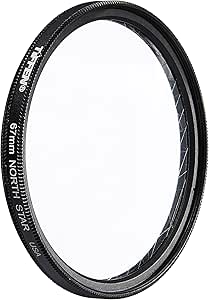
Tiffen 67NSTR 67mm North Star Effect Filter
★★★★★
Turn streetlights and candle flames into radiant, asymmetrical star bursts with the Tiffen 67mm North Star filter.
$69.99*$75.00Save 6%
View on Amazon
✓ In Stock on Amazon.com
*Price sourced from Amazon.com. Last updated:Jul 14, 2026.Price and availability are subject to change.
Affiliate Disclosure: Studio Supplies may earn a commission from qualifying purchases made through links on this page, at no additional cost to you. This helps support our editorial team.
Notice a mistake? Let Us Know
Overview
Key Features
Limitless creative options.
Rotating mount allows exact positioning of light rays.
Can be used in combination with other filters for remarkably creative effects.
Precision metal mounting ring.
Specifications
Brand
Tiffen
Model
67NSTR
Filter Type
North Star Effect
Filter Diameter
67mm
Mounting Ring Material
Precision Metal
Mount Type
Rotating
Pros & Cons
👍 Pros
- Rotating mount lets you precisely angle the asymmetrical rays relative to your composition, giving you real creative control on location.
- Produces a distinctly organic, irregular star pattern that reads more natural than geometric multi-point filters — ideal for moody nightscapes and event work.
- Pairs well with other filters for layered in-camera effects, letting you build complex looks without post-processing.
- Precision metal mounting ring threads smoothly and holds firm without the wobble you get from cheaper plastic-ringed filters.
- Effective across a wide range of light sources — from street lamps to candlelit table settings — making it a versatile addition to an event or fine-art kit.
👎 Cons
- Effect only activates with specular point light sources — broad, soft lighting setups won't produce visible rays, limiting its usefulness in controlled studio work.
- At 67mm, the filter is specific to that thread size and won't cross-thread to smaller or larger lenses without step rings, adding to the kit you need to carry.
- Strong star effects can look dated or over-processed if used without restraint; it's a filter that rewards editorial judgment and can be easy to overuse.
- Stacking with other filters risks vignetting on wide-angle lenses, so some creative combinations are off the table depending on your glass.
Frequently Asked Questions
How does the North Star filter differ from a standard 4-point or 6-point star filter?
Unlike symmetrical star filters, the North Star produces asymmetrical, naturally irregular ray patterns — giving light sources a more organic, painterly sparkle rather than a geometric starburst. It's a subtler, more atmospheric effect that reads beautifully in nighttime cityscapes and candlelit portraits.
Can I rotate the effect to control where the rays fall in the frame?
Yes — the precision metal mounting ring allows full rotation, so you can dial in exactly where the light rays extend across your composition. This is especially useful when a light source is near the edge of the frame and you want to pull rays inward rather than clipping them.
Does stacking this filter with a polarizer or ND affect the star effect?
Stacking is possible and can yield creative results — pairing with a light ND can help control exposure in bright scenes while retaining the star effect. However, stacking adds glass surfaces and can introduce vignetting on wider lenses, so test at your working focal lengths before committing on a shoot.
What kinds of light sources produce the strongest effect?
Small, specular point sources work best — street lamps, neon signs, candle flames, sun glinting off water, and catchlights in eyes during portraits. Broad, diffuse light sources won't produce a defined star ray; you need contrast and a tight highlight.
Will this filter affect overall image sharpness or color neutrality?
The Tiffen optical glass maintains good color neutrality and reasonable sharpness across the frame. Like any additional glass element, very critical sharpness tests may show a marginal softening wide open, but in practice the filter's effect is the dominant visual element and sharpness impact is rarely noticeable in finished images.
Related Products


