

Tiffen
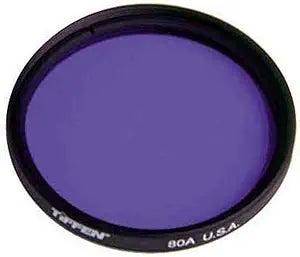
Tiffen 7280A 72mm 80A Color Correction Filter
Shoot under tungsten lights with daylight film and get accurate, neutral colors — the Tiffen 80A makes mixed-light correction as simple as screwing on a filter.
$49.99*$50.00Save 0%
Check availability
*Price sourced from Amazon.com. Last updated:Aug 29, 2026.Price and availability are subject to change — details.
Affiliate Disclosure: As an Amazon Associate, Studio Supplies earns from qualifying purchases made through links on this page, at no additional cost to you. This helps support our editorial team.
Notice a mistake? Let Us Know
Overview
Key Features
Achieve correct colors in image with daylight film
Adjusts for lighting variations
72mm diameter
Primarily for color imaging
Specifications
Filter Type
80A Color Conversion
Filter Diameter
72mm
Color Shift
Tungsten (3200K) to Daylight (5500K)
Application
Daylight film in tungsten lighting
Construction
ColorCore (dye laminated between glass)
Primary Use
Color imaging / color correction
Frequently Asked Questions
When exactly would I reach for the 80A filter on a shoot?
Any time you're shooting daylight-balanced film (or a daylight white balance preset) under standard tungsten lighting — incandescent bulbs, stage lighting, or older studio hot lights. Without correction, tungsten sources render with a strong orange/amber cast on daylight-balanced stock. The 80A shifts the color temperature from roughly 3200K (tungsten) up toward 5500K (daylight), giving you neutrally rendered skin tones and whites in the final image.
Does this filter work for digital cameras, or is it strictly a film filter?
The 80A is primarily a film-era correction filter designed for use with daylight-balanced film stock in tungsten light. On a digital camera, your white balance menu achieves the same correction electronically and without the 2-stop light loss the 80A imposes. That said, photographers shooting RAW under tungsten sometimes use it to get a corrected image in-camera or for live monitoring on-set with a video assist.
How much light does the 80A filter absorb?
The 80A has a filter factor of approximately 4x, which translates to a 2-stop exposure compensation. In practical terms — if your meter reads f/8 at 1/125s without the filter, you'll need to open to f/4 or slow to 1/30s with it mounted. This is a significant light penalty and limits its utility in lower-light tungsten environments.
Will this 72mm filter fit my lens?
The Tiffen 7280A is specifically sized for 72mm filter thread lenses. Confirm your lens's front filter thread diameter — usually printed on the lens barrel near the front element (e.g., ⌀72). If your lens is a different diameter, step-up or step-down rings can adapt it, though vignetting risk increases on wide-angle lenses.
Can the 80A be stacked with other filters?
Technically yes — it can be threaded onto another filter's front ring. In practice, stacking a thick correction filter with a polarizer or ND introduces vignetting risk at wider focal lengths and adds glass surfaces that degrade sharpness slightly. For multi-filter setups, a matte box with gel slots is a cleaner solution.
Related Products


