



Tiffen
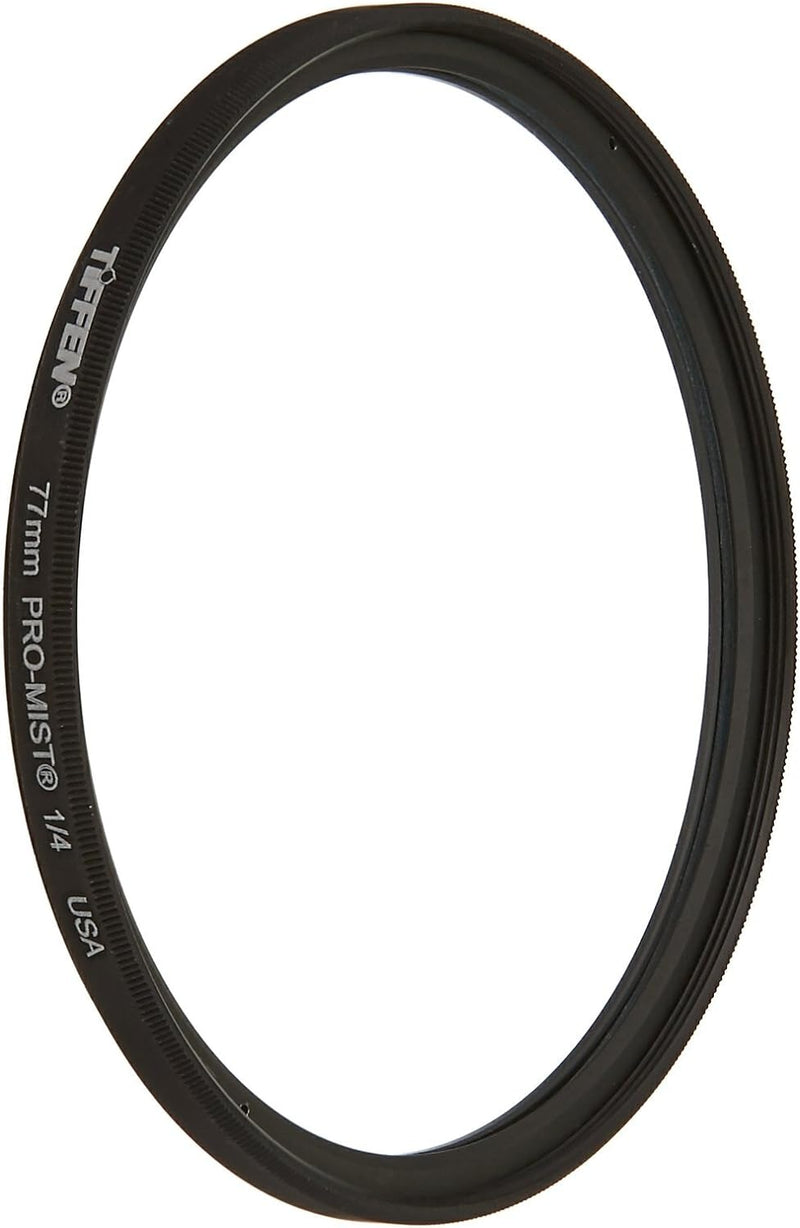
Tiffen 77PM14 77mm Pro-Mist 1/4 Camera Lens Filter
★★★★★
The Tiffen Pro-Mist 1/4 in 77mm gives portraits a film-era glow — lifting highlights and softening skin without destroying edge sharpness.
$84.39*$125.00Save 32%
View on Amazon
✓ In Stock on Amazon.com
*Price sourced from Amazon.com. Last updated:Jul 15, 2026.Price and availability are subject to change.
Affiliate Disclosure: Studio Supplies may earn a commission from qualifying purchases made through links on this page, at no additional cost to you. This helps support our editorial team.
Notice a mistake? Let Us Know
Overview
Key Features
REDUCES Highlights and Lowers Contrast
CREATES a Soft Quality of Light
SOFTENS Wrinkles and Blemishes
COLOR-CORE Technology
Specifications
Model
Tiffen 77PM14
Filter Diameter
77mm
Filter Type
Pro-Mist Diffusion
Strength
1/4
Construction
COLOR-CORE (diffusion embedded in glass)
Effect
Reduces highlights, lowers contrast, softens skin texture
ND Density
None
Brand
Tiffen
Pros & Cons
👍 Pros
- Highlight bloom at 1/4 strength is subtle enough to survive close editorial scrutiny — the effect reads as beautiful light, not obvious filtration.
- COLOR-CORE glass construction minimizes color cast compared to coating-based diffusion filters, preserving accurate white balance in-camera.
- Softens specular highlights and skin texture simultaneously without the global resolution loss of a soft-focus filter.
- 77mm thread covers the majority of professional zoom and prime lenses in common shooting rigs without step rings.
- The diffusion effect is optical and in-camera — it interacts with your sensor's highlight clipping in ways that are difficult to fully replicate in post-production.
👎 Cons
- The 1/4 strength effect is subtle enough that it may not be visible at smaller print sizes or compressed web resolutions — evaluating the effect requires viewing at 1:1 or in large-format output.
- At very wide focal lengths (sub-20mm), stacking the Pro-Mist with a polarizer or ND filter risks vignetting at the corners.
- The glass requires careful cleaning — the diffusion element's micro-texture can trap fine dust particles that are more visible at smaller apertures (f/11+) than on clear glass.
- The filter does not provide any ND density — it cannot be used to manage exposure or allow wider apertures in bright conditions on its own.
- Once the filter is on, adjusting the strength requires swapping to a different density (1/2, full) — there is no in-field adjustment range within a single filter.
Frequently Asked Questions
How does the 1/4 strength differ from the 1/2 or full Pro-Mist, and which is right for portrait work?
The 1/4 is the most subtle option in the Pro-Mist line — it reduces contrast and lifts highlights gently enough that the effect reads as a quality-of-light improvement rather than an obvious filter. The 1/2 produces a more visible bloom on highlights and stronger skin softening. For photographers who want the effect to hold up to scrutiny in editorial or commercial work, the 1/4 is the most versatile starting point.
Does the Pro-Mist 1/4 degrade sharpness or autofocus performance?
The filter does not meaningfully impair edge sharpness or autofocus operation. Pro-Mist works by scattering light around highlight areas rather than globally softening the optical path — your subject's eyes and fine detail retain definition while specular highlights gain a gentle halo.
Can this filter be combined with a circular polarizer?
It can be stacked with a thin-ring CPL, though stacking any two filters on a 77mm thread introduces some vignetting risk at ultra-wide focal lengths (below ~20mm full-frame equivalent). At standard portrait focal lengths (50mm–135mm), stacking is generally vignette-free.
Does the Pro-Mist 1/4 shift color balance?
Tiffen's COLOR-CORE construction embeds the diffusion medium within the glass rather than as a coating, which minimizes color cast. There is a very slight warming tendency in the highlight rolloff characteristic of Pro-Mist filters, but it is typically correctable in post and is not a significant color balance shift under standard white balance settings.
Is the 77mm thread size compatible with my lens?
77mm is the filter thread diameter — confirm your lens's front element filter thread size (printed on the lens barrel, typically preceded by a ⌀ symbol) before purchasing. 77mm is a common thread size for mid-to-large aperture lenses in the 24–105mm range across Canon, Nikon, and Sony systems.
Related Products


