



Tiffen
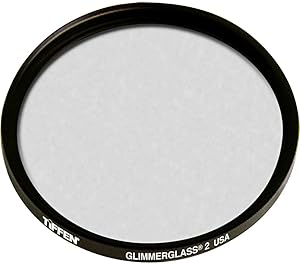
Tiffen 82mm Glimmerglass 2 Filter Beauty
The Tiffen 82mm Glimmerglass 2 diffuses skin texture and blooms highlights without destroying resolution — a beauty filter built for portraiture, not post-production workarounds.
$119.00*$165.00Save 27%
Check availability
*Price sourced from Amazon.com. Last updated:Aug 30, 2026.Price and availability are subject to change — details.
Affiliate Disclosure: As an Amazon Associate, Studio Supplies earns from qualifying purchases made through links on this page, at no additional cost to you. This helps support our editorial team.
Notice a mistake? Let Us Know
Overview
Key Features
ULTRA-SLIM AND DURABLE FRAME: The Glimmerglass Filter ultra-slim 82mm ring design ensures there’s no vignetting on wide-angle and telephoto lenses, keeping your image sharp and clean from edge to edge. Tiffen Glimmerglass Non-Slip ring allows for easy installation and removal, offering both durability and convenience for photographers and videographers.
DREAMY LOOK: This Glimmerglass filter helps create glowing highlight flares and reduce harsh contrast, enhancing your photos and videos with a smooth, dreamy, and professional appearance. It diffuses light without losing the sharpness of your image, creating a glowing atmosphere and dreamy feel on your projects.
IDEAL FOR PHOTOGRAPHY AND VIDEOGRAPHY: Tiffen diffusion filters are ideal for all types of photography and video projects. This filter softens skin imperfections such as wrinkles and blemishes, giving your subjects a delicate, smooth, and glowing look. The Tiffen Glimmerglass filter adds a dreamlike quality to your photos and video, making the subject appear more elegant and polished by giving you a cinematic look and feel.
OPTICAL QUALITY GLASS WITH ADVANCED ColorCore TECHNOLOGY: Tiffen filters offer high quality optics achieving maximum flatness and parallelism. Tiffen ColorCore technology allows for consistent and lasting color and effects on every Tiffen filter.
WATER RESISTANT AND EASY TO MAINTAIN: This Camera Filter is water-resistant, providing extra protection in different weather conditions, especially during outdoor shoots. Its surface is easy to clean and maintain, ensuring it stays in top condition during frequent use.
Specifications
Filter Size
82mm
Technology
ColorCore
Protection Features
Water-resistant
Frequently Asked Questions
What strength is the Glimmerglass 2, and how does it compare to the rest of the Glimmerglass range?
The Tiffen Glimmerglass range runs from Grade 1 (most subtle) to Grade 5 (most pronounced). Grade 2 sits toward the subtle end — it softens skin texture and adds a gentle highlight bloom without visibly degrading sharpness, making it a practical choice for run-and-gun portrait work where you can't stop to add diffusion in post.
How does the Glimmerglass 2 differ from a standard diffusion or soft focus filter?
Standard soft focus filters reduce overall sharpness uniformly. The Glimmerglass 2 works differently — it preserves underlying image resolution while adding a specific glow to highlight areas and reducing contrast slightly. The effect targets skin details and bright specular points rather than globally blurring the frame, which is why it reads as a beauty treatment rather than camera softness.
Is the strength "2" noticeable in a wide shot, or does it primarily show in close-ups?
The effect scales with subject proximity. In tight portrait and beauty close-ups, the highlight glow and skin softening are the primary visual effect and will read clearly on screen. In wider shots at typical environmental portrait distances, the effect is more subtle — it's a tool calibrated for close work, not a general-purpose diffuser for full-length or architectural shots.
Does the 82mm Glimmerglass 2 affect overall image sharpness and focus accuracy?
The filter reduces micro-contrast across the image, which creates a softer appearance without actually defocusing the lens. Edge definition and autofocus performance are not affected — your camera focuses on the same plane it would without the filter. The softness is a rendering quality, not an optical aberration.
Can the Glimmerglass 2 be used for video work, or is it primarily a stills filter?
It's excellent for video — in fact, the Glimmerglass line was developed with motion picture and broadcast applications in mind. For portrait videography, beauty content, and narrative work where a cinematic, flattering skin rendering is desirable without heavy post-grading, the Grade 2 is a natural fit.
Does the Glimmerglass 2 affect focus or autofocus acquisition?
The filter does not prevent the camera from achieving focus, but the reduced micro-contrast near the focal plane can make it slightly harder to confirm critical focus on a monitor or EVF — particularly at very wide apertures where depth of field is already shallow. Focus acquisition via phase or contrast detection is not meaningfully impaired.
Can the effect of the Glimmerglass 2 be replicated in post-production?
Approximately — high-end retouchers can simulate some of the highlight glow and skin softening in DaVinci Resolve or Adobe Lightroom. However, the in-camera Glimmerglass captures halation and bloom that originates in the optical path before the sensor, producing a rendering quality that is difficult to replicate precisely in post without overcooking the effect.
Does this filter require any exposure compensation?
The Glimmerglass 2 has a minimal effect on exposure — it does not function as an ND filter and does not require meaningful compensation in most shooting conditions. Any light transmission reduction is negligible at this grade.
Is 82mm compatible with most professional portrait lenses, or will I need step-down rings?
82mm is a large front element diameter — it's the native filter thread size for many premium telephoto and wide-aperture primes, including several Canon L and Nikon G lenses commonly used for portrait work. For lenses with smaller front elements, step-down rings can adapt the filter, though vignetting risk increases at the shorter end of zoom ranges.
What thread size is this filter, and is it compatible with common portrait lenses?
This is an 82mm filter — one of the larger standard thread sizes, typically found on full-frame portrait and telephoto lenses like the Canon 85mm f/1.2L, Sigma 85mm Art, Nikon 85mm f/1.4G, and similar large-front-element primes. Check your lens's filter thread specification before ordering.
Related Products


