



Tilta
Tilta Nucleus-M Wireless Follow Focus Lens Control
Tilta Nucleus-M wireless follow focus delivers brushless motor precision with up to 1,000 feet of wireless range for cinema lens control.
$359.00*
Check availability
*Price sourced from Amazon.com. Last updated:Oct 21, 2026.Price and availability are subject to change — details.
Affiliate Disclosure: As an Amazon Associate, Studio Supplies earns from qualifying purchases made through links on this page, at no additional cost to you. This helps support our editorial team.
Notice a mistake? Let Us Know
Overview
Key Features
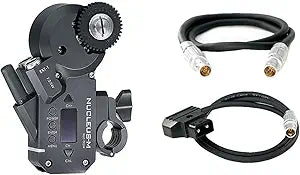
This Nucleus-M motor kit allows you to add a motor to your Nucleus-M kit along with the 7-pin to 7-pin power cable that allows you to power the motor from a daisy-chained connection to another Nucleus-M motor.
This P-tap to 7-pin cable for the Nucleus-M allows you to power the motors from a P-tap power output port. Simply plug this cable into one of the motors and then daisy chain power to the other motors using the Nucleus-M 7-pin to 7-pin power cables.
[MANUAL CALIBRATION] Supports Lenses With and Without Hard Stops [COMPATIBLE] with Most Cinema Lenses via the Motor's 0.8 Gear Pitch or Included Gear Rings
[NO MDR NEEDED] Wirelessly Control the Motors Up to 1000 Feet[RUN STOP CAPABLE] via Optional Camera Specific Run Stop Cables
[UNIVERSAL ROD MOUNT] Supports 15mm and 19mm Rods
Specifications
Motor Type
Brushless Wireless Follow Focus Motor
Communication
Direct motor-to-hand unit (no MDR required)
Wireless Range
Up to 1,000 feet
Gear Size
0.8 mod, 35 tooth, 32 pitch
Torque
2.5 N·m at 14.8V
Rod Compatibility
15mm and 19mm (with included bushings)
Power Cable
P-tap to 7-Pin Motor Power Cable
Motor Cable
7-Pin to 7-Pin Motor to Motor Cable
Run/Stop
Supported via optional camera-specific cables
Calibration
Manual — supports lenses with and without hard stops
Frequently Asked Questions
What gear pitch does the Nucleus-M motor use, and is it compatible with most cinema lenses?
The motor uses a 0.8 mod (32 pitch) gear with 35 teeth, which is the standard pitch for cinema lenses. For lenses without a gear ring, Tilta includes lens gear rings in the kit so you can add compatibility.
Does the Nucleus-M require a separate MDR (Motor Driver Receiver) unit?
No. The Nucleus-M motors communicate directly with the hand unit or hand grips wirelessly, eliminating the need for a separate MDR box. This simplifies the rig and reduces cable clutter.
Can the Nucleus-M motors be daisy-chained for multi-axis control?
Yes. You can connect multiple motors using the included 7-pin to 7-pin cables to daisy-chain power between them. This allows you to control focus, iris, and zoom from a single hand unit.
How is the Nucleus-M motor powered?
The motor can be powered via the included P-tap to 7-pin cable connected to any P-tap power output, such as a V-mount or Gold-mount battery. Additional motors in the chain receive power through the daisy-chain connection.
Does the Nucleus-M work with lenses that lack hard stops?
Yes. The system supports manual calibration, so it can be configured to work with both cinema lenses that have hard stops and photo lenses that do not.
Related Products


