

Universal Audio
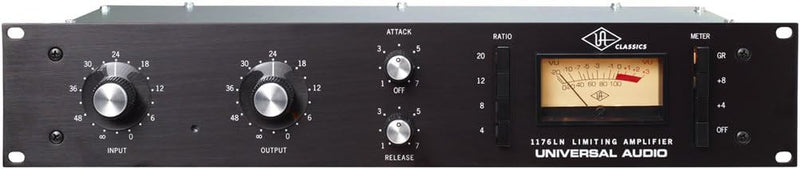
Universal Audio 1176LN Classic Compressor Limiter
Achieve Legendary Compression with a Classic Experience the unparalleled sound shaping capabilities of the Universal Audio 1176LN Compressor. Rooted in the legacy of Bill Putnam Sr., this compressor delivers the same innovative performance that has made Universal Audio a staple in recording studi...
$2,999.00*
View on Amazon
✓ In Stock on Amazon.com
*Price sourced from Amazon.com. Last updated:Aug 28, 2026.Price and availability are subject to change — details.
Affiliate Disclosure: As an Amazon Associate, Studio Supplies earns from qualifying purchases made through links on this page, at no additional cost to you. This helps support our editorial team.
Notice a mistake? Let Us Know
Overview
Achieve Legendary Compression with a Classic
Experience the unparalleled sound shaping capabilities of the Universal Audio 1176LN Compressor. Rooted in the legacy of Bill Putnam Sr., this compressor delivers the same innovative performance that has made Universal Audio a staple in recording studios since 1958.
Evolved from the popular Universal Audio 175 and 176 vacuum tube limiters, the 1176LN retained the proven qualities of these industry leaders and set the standard for all limiters to follow
- Faithful to the original design, manufacturing, and performance
- Modeled after 1176LN blackface, D and E revisions
- F.E.T. gain reduction for precise dynamic control
- Pushbutton selection of compression ratios: 4:1, 8:1, 12:1, 20:1
- Ultrafast attack time: 20 microseconds to 800 microseconds
- Adjustable release time: 50 milliseconds to 1.1 second
- Class A line level output amplifier for pristine signal quality
- Custom-built Putnam-designed output transformer
- Stereo interconnect operation for versatile configurations
Key Features
True to the original in design, manufacture, and performanceModeled after 1176LN blackface, D and E revisionsF.E.T. gain reductionPushbutton selection of compression ratios: 4:1, 8:1, 12:1, 20:1Ultrafast attack time20 microseconds to 800 microsecondsAdjustable release time50 milliseconds to 1.1 secondClass A line level output amplifierCustom-built Putnam-designed output transformerStereo interconnect operationContemporary styling and eye-pleasing industrial design
Evolved from the popular Universal Audio 175 and 176 vacuum tube limiters, the 1176LN retained the proven qualities of these industry leaders and set the standard for all limiters to follow
Today, the 1176LN is new again
While it certainly would have been possible-and much simpler-to modernize and "improve" the 1176LN, Universal Audio made every effort to remain faithful to Putnam's design and intentions
Carefully trained staff hand-wire and test each unit to uncompromising standards
Specifications
Model
1176LN Classic Compressor Limiter
Design Heritage
True to original 1176LN, modeled after blackface D and E revisions
Gain Reduction Technology
F.E.T.
Compression Ratios
4:1, 8:1, 12:1, 20:1 (pushbutton selectable)
Attack Time Range
20 microseconds to 800 microseconds
Release Time Range
50 milliseconds to 1.1 second
Output Amplifier
Class A line level
Output Transformer
Custom-built Putnam-designed
Operation Mode
Stereo interconnect
Frequently Asked Questions
What makes the Universal Audio 1176LN a "classic" compressor limiter?
This 1176LN is true to the original in design, manufacture, and performance, having evolved from popular vacuum tube limiters and setting the standard for subsequent limiters.
Which specific revisions of the 1176LN is this model based on?
This unit is modeled after the 1176LN blackface, D and E revisions, aiming to replicate their distinct sonic characteristics.
What kind of gain reduction technology does this compressor use?
The 1176LN features F.E.T. gain reduction, which is a key component of its classic and highly regarded compression sound.
What are the available compression ratios on this device?
You can select compression ratios of 4:1, 8:1, 12:1, and 20:1 via pushbutton.
How fast is the attack time on the 1176LN?
The attack time is ultrafast, adjustable from 20 microseconds up to 800 microseconds, allowing for precise control over transients.
Can this unit be used for stereo processing?
Yes, it supports stereo interconnect operation, meaning two units can be linked together to process stereo audio signals effectively.
Related Products


