

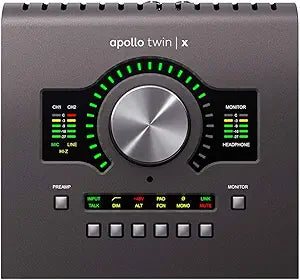


Universal Audio
Universal Audio APLTWXQ-HE Apollo Twin X QUAD Heritage Edition
QUAD-core UAD processing and elite-class conversion in a desktop interface — built for professional tracking, mixing, and sonic excellence.
$1,499.00*
Check availability
*Price sourced from Amazon.com. Last updated:Aug 27, 2026.Price and availability are subject to change — details.
Affiliate Disclosure: As an Amazon Associate, Studio Supplies earns from qualifying purchases made through links on this page, at no additional cost to you. This helps support our editorial team.
Notice a mistake? Let Us Know
Overview
Key Features
A special edition of UA's acclaimed Apollo Twin X interface — with a premium suite of 5 award-winning plug-in titles from Teletronix, Pultec, and UA — a $1,300 value
Elite-class A/D and D/A conversion derived from Apollo X rackmount interfaces paired with 2 Unison mic preamps deliver stunning models of classic tube and transformer-based mic preamps and guitar amps
2 Unison mic preamps offer stunning models of classic tube and transformer-based mic preamps and guitar amps
UAD QUAD Core Processing for tracking through vintage compressors, EQs, tape machines, mic preamps, and guitar amp plug-ins with near-zero latency
Produce with LUNA Recording System — a fully-integrated recording application made for Apollo (Mac only)
Runs UAD Powered Plug-Ins via VST, AU, and AAX 64 formats in all major DAWs, including Logic Pro, Pro Tools, Cubase, Ableton Live, and more
Front-panel Unison-enabled Hi-Z instrument input and headphone out Built-in Talkback mic for communication with studio talent and recording slate cues
Dedicated monitor functionality including monitor remote functions and Mono, Mute, DIM, and ALT monitor controls
Up to 8 channels of additional digital input via optical ADAT/SPDIF input
Also includes “Realtime Analog Classics” UAD plug-in bundle featuring UA 610-B Tube Preamp Legacy Pultec EQ, LA-2A and 1176 compressors, Marshall Plexi Classic, Ampeg SVT-VR Classic, and more
Specifications
Interface Type
Audio Interface
Connection
Thunderbolt
Mic Preamps
2 × Unison-enabled
DSP Processing
QUAD Core UAD
Digital Expansion
Optical ADAT/SPDIF (up to 8 additional channels)
Instrument Input
Front-panel Hi-Z (Unison-enabled)
Headphone Output
1 × front-panel
Talkback Mic
Built-in
Plug-in Formats
VST, AU, AAX 64
Included Plug-in Bundle Value
Over $1,300
Model
APLTWXQ-HE
Brand
Universal Audio
Frequently Asked Questions
Does the Apollo Twin X QUAD require phantom power from an external source, or does it supply its own?
The Apollo Twin X QUAD supplies 48V phantom power from the unit itself through both Unison mic preamp inputs — no external power source required. You can safely run condenser microphones and ribbon mics with phantom-power-tolerant designs directly from the interface.
What does "Unison" preamp technology actually change about how a microphone sounds going in?
Unison creates a hardware-software feedback loop between the Apollo's physical preamp circuit and the UAD plug-in model running on it. The result is that the impedance, gain staging behavior, and saturation characteristics of classic preamps — like the UA 610-B or Neve 1073 — are reflected back into the analog gain stage before the signal is converted. You're not just applying DSP coloration after the fact; you're shaping the signal at the point of capture.
How much UAD DSP headroom does the QUAD core provide for a typical session?
The QUAD core offers roughly double the DSP capacity of the DUO version. In practice, this means you can comfortably run three to five DSP-heavy UAD plug-ins — an 1176, an LA-2A, a Neve EQ, and a tape machine simultaneously — on a live monitoring chain with near-zero latency while still reserving overhead for additional instances during mixdown.
Can I use UAD plug-ins in Pro Tools, Ableton Live, and Logic Pro with this interface?
Yes. UAD plug-ins run as VST, AU, and AAX 64 formats, so they integrate with all major DAWs. LUNA Recording System is Mac-only and provides the tightest Apollo integration, but Pro Tools, Ableton, Logic, and Cubase all support UAD plug-ins via their native plug-in formats without restriction.
What is the optical input used for, and does it add noticeable latency to a tracking session?
The ADAT/SPDIF optical input expands the interface to up to 10 inputs total — useful for adding a dedicated preamp expander like a Focusrite OctoPre or a digital mixer. When used within the Apollo's Thunderbolt low-latency monitoring path, the optical inputs add no perceptible latency to a performer's headphone mix.
Related Products


