



Warm Audio
Warm Audio WA-87 R2B Large Diaphragm Condenser Mic - Black
Condenser
Vintage 87-style warmth and three-pattern versatility built for serious studio tracking and broadcast work.
$661.75*$699.00Save 5%
View on Amazon
✓ In Stock on Amazon.com
*Price sourced from Amazon.com. Last updated:Aug 27, 2026.Price and availability are subject to change — details.
Affiliate Disclosure: As an Amazon Associate, Studio Supplies earns from qualifying purchases made through links on this page, at no additional cost to you. This helps support our editorial team.
Notice a mistake? Let Us Know
Overview
Key Features
FAITHFUL REPRODUCTION OF THE ORIGINAL VINTAGE 87-STYLE CIRCUIT
ALL DISCRETE PREMIUM COMPONENTS, INCLUDING A NOS FAIRCHILD TRANSISTOR AND WIMA/NICHICON CAPACITORS
THREE POLAR PATTERNS: CARDIOID, FIGURE-OF-EIGHT, AND OMNIDIRECTIONAL
-10DB PAD AND 80HZ HIGH PASS FILTER
Specifications
Type
Large Diaphragm Condenser
Circuit
Discrete, vintage 87-style
Key Components
NOS Fairchild transistor, Wima/Nichicon capacitors
Output Transformer
Custom-wound Cinemag USA
Polar Patterns
Cardioid, Figure-of-Eight, Omnidirectional
Pad
-10dB
High-Pass Filter
80Hz
Connectivity
XLR
Body Material
Nickel-plated Brass
Finish
Black
Included Accessories
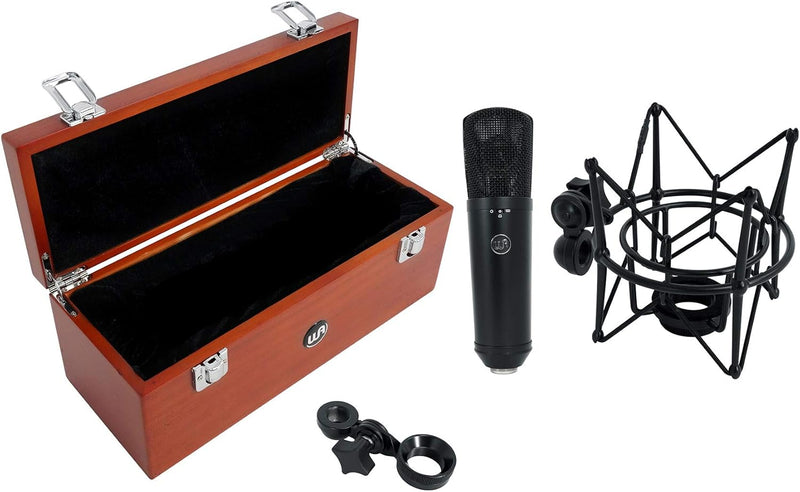
Hard mount, shock mount, wooden presentation box
Brand
Warm Audio
Model
WA-87 R2B
Frequently Asked Questions
Does the WA-87 R2B require phantom power, and how much current does it draw?
Yes — like all large diaphragm condensers using a discrete transistor circuit, the WA-87 R2B requires 48V phantom power from your interface or console. Ensure your preamp supplies a stable 48V rail; unstable phantom can introduce noise into the signal chain.
When should I engage the -10dB pad on the WA-87 R2B?
Engage the pad when placing the mic close to loud sources — kick drum beaters, guitar amp cones, brass instruments — where the input SPL would push the capsule into distortion. The pad preserves transient integrity and keeps your gain staging clean without having to back the mic far off the source.
How does the WA-87 R2B's figure-of-eight pattern perform for mid-side or stereo room recording?
The figure-of-eight pattern on the R2B has a pronounced rear lobe that captures room reflections symmetrically, making it well-suited as the side element in an M-S pair or for Blumlein stereo setups. Null rejection at 90 degrees is tight, which helps isolate bleed when used in close-quarter sessions.
What does the NOS Fairchild transistor actually contribute to the sound of this microphone?
The NOS Fairchild transistor is central to the WA-87 R2B's sonic character — it contributes to the open, slightly forgiving top end and the smooth low-mid body that defines vintage 87-style mics. Modern replacement transistors often introduce a harder, more clinical edge; the Fairchild helps the mic sit in a mix rather than cut aggressively.
How does the 80Hz high-pass filter affect proximity effect when tracking close vocals?
The 80Hz HPF rolls off the low-frequency buildup caused by proximity effect in cardioid mode, cleaning up chest resonance and room rumble without touching the body of a voice. It's a gentle slope — not a surgical cut — so it tightens the low end while preserving warmth in the 100–200Hz range.
Related Products


