



Warm Audio
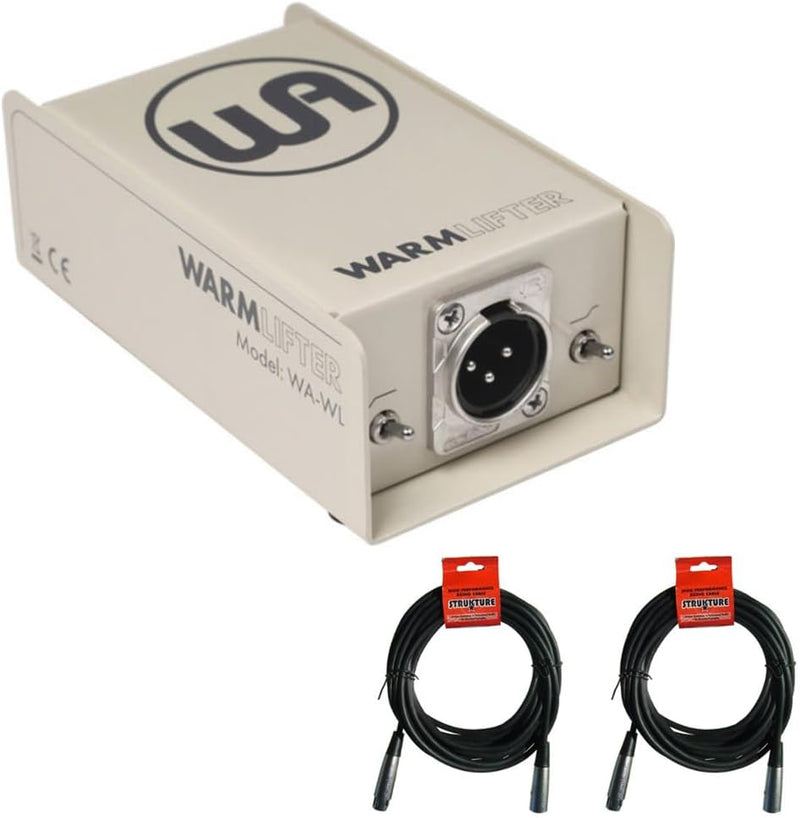
Warm Audio WA-WL Warm Lifter Mic Preamp Bundle
The Warm Audio WA-WL Warm Lifter adds 26dB of transparent inline gain to passive and low-output mics, rescuing quiet signals before they hit the noise floor of your interface.
$159.99*
Check availability
*Price sourced from Amazon.com. Last updated:Aug 27, 2026.Price and availability are subject to change — details.
Affiliate Disclosure: As an Amazon Associate, Studio Supplies earns from qualifying purchases made through links on this page, at no additional cost to you. This helps support our editorial team.
Notice a mistake? Let Us Know
Overview
Key Features
For Passive or Low-Output Microphones : 26 dB of Clean Gain
100 Hz HPF and 3 kHz Shelving Boost : Automatic Impedance Matching Transformer
Ultra Low-Noise JFET Input : Balanced I/O
Highly Durable Build Quality : Hand Tested and Inspected in Austin, TX
Specifications
Gain
26 dB (fixed)
Input Type
Ultra low-noise JFET
I/O
Balanced XLR (inline)
High-Pass Filter
100 Hz (fixed)
Shelving Boost
3 kHz (fixed)
Impedance Matching
Automatic transformer
Phantom Power Required
48V
Ribbon Safe
Yes (transformer-isolated input)
Build
Hand tested and inspected, Austin TX
Bundle Includes
WA-WL unit + pair of XLR cables
Frequently Asked Questions
What types of microphones benefit most from the Warm Lifter, and which don't need it?
The WA-WL is designed for passive ribbon microphones and dynamic mics with low output sensitivity — typically anything measuring below -56 dBV/Pa. Moving-coil dynamics like the SM7B or RE20 produce signal levels that many budget and mid-tier interfaces struggle to amplify cleanly at high gain settings; the Warm Lifter inserts 26dB of gain before the interface, allowing the interface's preamp to operate at a lower, quieter gain position. Active condensers with built-in FET output stages generally have sufficient output that the Warm Lifter is unnecessary and may cause clipping.
Does the Warm Lifter require phantom power, and will it damage ribbon mics?
Yes — the WA-WL requires 48V phantom power from the connected preamp to operate its JFET gain stage. The transformer-coupled balanced input and output isolate phantom power from the microphone side, making it safe for use with passive ribbon microphones. Do not apply phantom power directly to passive ribbons via any other path.
What does the automatic impedance matching transformer do for ribbon microphone tone?
Passive ribbon microphones are highly sensitive to the input impedance they see — loading a ribbon into a low-impedance preamp (below ~1500 ohms) compresses the ribbon's frequency response and kills low-frequency extension. The WA-WL's transformer presents an appropriate impedance to the microphone, allowing the ribbon's natural frequency response and transient character to come through fully before gain is applied.
Does the 100 Hz high-pass filter affect the audio quality of instruments above that frequency?
The 100Hz HPF is a fixed-slope shelving rolloff — it attenuates rumble, stand vibration, and low-frequency handling noise below 100Hz with minimal phase impact on the program material above. For voice, acoustic guitar, and most instruments, it is a useful always-on filter. For kick drum or bass instruments where the fundamental sits below 100Hz, bypass is not available — this is an inline device with no switching.
Will this work transparently with any XLR preamp or interface, or are there compatibility issues?
The WA-WL is a standard balanced XLR inline device — it inserts between the microphone and any XLR-equipped preamp or interface input that supplies 48V phantom power. There are no known compatibility issues with standard studio gear. Gain and level matching should be verified when first inserting it into a signal chain, as the additional 26dB may require reducing the interface's preamp gain to avoid clipping.
Related Products


