

Whirlwind
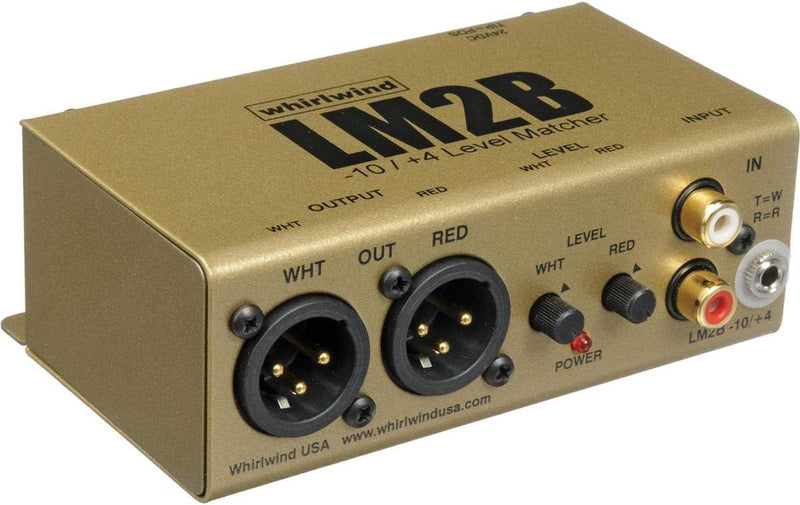
Whirlwind LM2B 2-Channel Unbalanced to Balanced Converter
20Hz-20kHz
Bring consumer gear onto a professional console without audible compromise — the Whirlwind LM2B converts unbalanced -10dBV to balanced +4dBm with active circuitry across the full audio band.
$219.00*
Check availability
*Price sourced from Amazon.com. Last updated:Aug 28, 2026.Price and availability are subject to change — details.
Affiliate Disclosure: As an Amazon Associate, Studio Supplies earns from qualifying purchases made through links on this page, at no additional cost to you. This helps support our editorial team.
Notice a mistake? Let Us Know
Overview
Key Features
2-channel line level converter
20Hz-20kHz frequency response
100 Ohms balanced output impedance
Specifications
Type
2-Channel Unbalanced to Balanced Line Level Converter
Frequency Response
20Hz – 20kHz
Output Impedance
100 Ohms (Balanced)
Input Level
-10dBV Unbalanced
Output Level
+4dBm Balanced
Unbalanced Inputs
Gold-Plated RCA, 3.5mm Stereo Mini
Balanced Outputs
Gold-Plated XLR
Gain Control
Individual per channel
Circuitry
Active
Power Supply
External 24VDC (included)
Dimensions
8.7 x 3.7 x 2.8 inches
Weight
1.25 lbs
Frequently Asked Questions
What does the Whirlwind LM2B actually solve in a professional audio signal chain?
Active conversion from unbalanced -10dBV to balanced +4dBm. Consumer and prosumer gear — DJ controllers, laptops, synths, media players — operates at -10dBV unbalanced. Professional consoles and studio interfaces expect +4dBm balanced on XLR. Without conversion, you get a level mismatch and an unbalanced signal prone to noise pickup over cable runs. The LM2B bridges both gaps: it actively lifts the level and converts to balanced differential output simultaneously.
Does the active circuitry in the LM2B add coloration or noise to the signal?
The active design uses a 24VDC external power supply and is specified across the full 20Hz–20kHz band with 100 Ohm balanced output impedance. Active designs can introduce some noise floor contribution from the conversion circuitry, but the tradeoff is a driven, low-impedance balanced output that rejects common-mode noise over long cable runs — which in most real-world setups is a net gain in signal cleanliness compared to running unbalanced.
What are the input and output connector options on the LM2B?
Inputs accept unbalanced signals via gold-plated RCA connectors and a 3.5mm stereo mini connector, covering the most common consumer device outputs. Outputs are gold-plated XLRs carrying the balanced +4dBm signal. Per-channel gain controls allow individual level trim, so you can match disparate sources before they hit the console.
Does the LM2B require phantom power from the console?
No. The LM2B uses an included external 24VDC power supply — it is not phantom-powered and should not have phantom power applied. This is an active line-level converter, not a DI box or microphone device. It must be powered by its dedicated supply to operate.
Is the LM2B suitable for broadcast or installed sound applications where the converter runs continuously?
Yes. Whirlwind builds gear for touring and installed applications, and the LM2B is designed for continuous duty. Its external power supply means it runs stably without thermal stress from internal components, and the gold-plated connectors hold up to permanent installation or frequent venue changes.
Related Products


