



Whirlwind
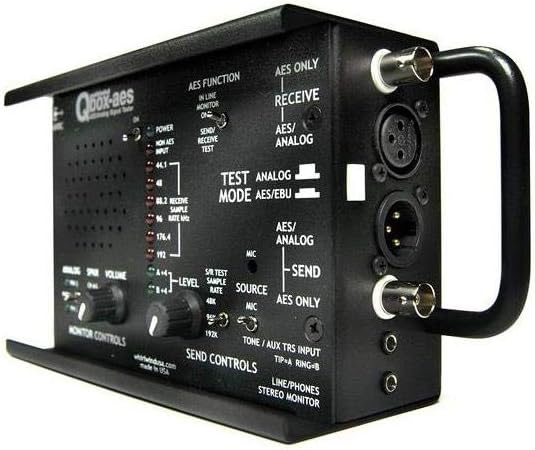
Whirlwind Qbox-AES AES/EBU Tester 96/192kHz
Whirlwind Qbox-AES: the field-ready AES/EBU signal tester that catches digital audio faults before they reach your mix.
$868.68*
Check availability
*Price sourced from Amazon.com. Last updated:Aug 28, 2026.Price and availability are subject to change — details.
Affiliate Disclosure: As an Amazon Associate, Studio Supplies earns from qualifying purchases made through links on this page, at no additional cost to you. This helps support our editorial team.
Notice a mistake? Let Us Know
Overview
Key Features
Tester AES/EBU
96 & 192KHZ
48
Specifications
Function
AES/EBU Signal Tester
Supported Sample Rates
48 kHz, 96 kHz, 192 kHz
Power Source
Battery
Dimensions
10.7" x 5.3" x 3.3"
Weight
2.1 lbs
Brand
Whirlwind
Model
Qbox-AES
Frequently Asked Questions
What sampling rates does the Qbox-AES support, and why does that matter on a modern digital audio rig?
The Qbox-AES reads AES/EBU signals at 48, 96, and 192 kHz — the three rates you'll encounter across broadcast, high-resolution studio sessions, and live digital snake systems. If your console or interface is locked to 96k and a cable run or format converter is silently dropping or corrupting the stream, this tester will catch it before it becomes an audible dropout or a dead-air moment on air.
Does the Qbox-AES require phantom power or an external supply?
No — it is battery powered, which is the critical advantage for location work and live touring. You can pull it out mid-show or mid-session without hunting for a power source, making it a natural fit for a snake tech's kit bag or a broadcast engineer's go-bag.
Can I use the Qbox-AES to verify signal polarity and channel integrity on an AES/EBU pair?
Yes. The unit is designed to verify signal presence and integrity on AES/EBU connections — letting you quickly confirm that both channels of a digital pair are carrying valid audio and that the signal path is intact end-to-end. This is the test you run when a digital input is showing signal on the meter but something still sounds wrong.
Is the Qbox-AES suitable for troubleshooting dSNAKE or MADI systems?
The Qbox-AES is specifically designed for standard AES/EBU (IEC 60958-4) connections using XLR cabling. Proprietary digital snake formats like dSNAKE or MADI over coax/fiber require their own diagnostic tools. Use the Qbox-AES at the AES/EBU input and output ports of converters, interfaces, and stage boxes where standard AES handshakes occur.
How does the Qbox-AES fit into a pre-show signal chain verification workflow?
During line check, patch it inline between your stage box AES output and the console input to confirm the digital handshake is clean at the target sample rate. A failed lock or missing signal here tells you immediately whether the fault is in the cable, the converter, or the console input card — before the room fills with audience.
Related Products


