

Yamaha
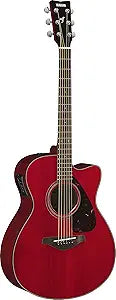
Yamaha FSX800C RR Acoustic-Electric Guitar Ruby Red
★★★★★
A solid Sitka spruce top and onboard System 66 electronics give this compact cutaway guitar studio-ready tone and stage-ready control at an entry-to-mid price point.
$419.99*
View on Amazon
✓ In Stock on Amazon.com
*Price sourced from Amazon.com. Last updated:Jun 04, 2026.Price and availability are subject to change.
Affiliate Disclosure: Studio Supplies may earn a commission from qualifying purchases made through links on this page, at no additional cost to you. This helps support our editorial team.
Notice a mistake? Let Us Know
Overview
Key Features
Solid Sitka Spruce Top
Nato Back & Sides
Rosewood Fingerboard & Bridge
Diecast Tuners
System 66 feature an under-saddle piezo pickup with a 3-band EQ, an adjustable mid-range frequency control, and a precision chromatic tuner for optimum sound tailoring.
this guitar has an adjustable truss rod
Specifications
Top
Solid Sitka Spruce
Back & Sides
Nato
Fingerboard
Rosewood
Bridge
Rosewood
Tuners
Diecast
Electronics
System 66 (under-saddle piezo pickup)
EQ
3-band with adjustable mid-range frequency control
Tuner
Precision chromatic (onboard)
Truss Rod
Adjustable
Body Style
Cutaway Folk/Concert
Color
Ruby Red
Model
FSX800C RR
Pros & Cons
👍 Pros
- Solid Sitka spruce top produces complex harmonic overtones and clear transient response that improve noticeably with playing hours — a tonal advantage laminate tops cannot replicate.
- System 66 onboard electronics deliver 3-band EQ with adjustable mid-range sweep, giving the player direct control over the amplified tone without an external preamp in the signal chain.
- Integrated chromatic tuner in the System 66 preamp means stage tuning requires no additional pedal or clip-on device, reducing signal chain complexity.
- Cutaway body design grants full access to upper frets above the 14th position — essential for lead passages and chord voicings in upper register.
- Adjustable truss rod allows the neck to be set up for individual playing preferences or string gauge changes without specialized tools beyond a hex key.
👎 Cons
- Under-saddle piezo pickup captures a compressed, slightly thin version of the acoustic tone — the characteristic piezo "quack" is present at high transient peaks and may require EQ correction for critical studio recording.
- The smaller folk/concert body with cutaway produces less low-end volume than a full dreadnought — players who rely on acoustic projection for unplugged performance in larger rooms will feel the limitation.
- Nato back and sides, while tonally competent, lack the resonance complexity and visual character of genuine mahogany — a noticeable difference in feel and aesthetics for players stepping up from higher-end instruments.
- Ruby Red finish, while distinctive, is a limited color option — players who later want a neutral-finish instrument for video or studio work may find the color reads as stylized rather than professional.
- Diecast tuners are functional but lack the smooth, precise feel of higher-ratio tuning machines — fine-tuning in string bends and extended passages may require more frequent rechecks.
Frequently Asked Questions
What does the System 66 electronics system include, and how does it affect gain staging into a PA or interface?
The System 66 consists of an under-saddle piezo pickup feeding a preamp with a 3-band EQ (bass, mid, treble), an adjustable mid-range frequency control, and a precision chromatic tuner. The onboard preamp outputs a line-level signal suitable for direct injection into a PA's DI channel or an audio interface's instrument input — no external preamp is required, though running through a dedicated DI box will improve impedance matching and reduce noise floor in critical recording situations.
How does the solid Sitka spruce top affect the acoustic sound compared to laminate-top guitars in this price range?
Solid wood tops vibrate more freely than laminate, producing a more complex harmonic response and richer transient detail — you hear more of the pick attack and more sustain in the upper partials. On the FSX800C, the Sitka spruce specifically contributes a clear, articulate top-end and a focused midrange that reads well through a microphone or pickup in a mix, as opposed to the compressed, homogenous tone typical of laminate tops.
Is the Nato back and sides tonally equivalent to mahogany?
Nato is frequently substituted for mahogany in entry-to-mid instruments. It produces a warm, slightly dark low-mid character similar to mahogany, with less pronounced open grain. In a live or studio context, the tonal difference between Nato and genuine mahogany at this price point is minimal through a pickup system.
Does the cutaway body shape reduce bass response compared to a full-dreadnought or full-body jumbo?
Yes. The FSX series is a smaller, folk/concert-adjacent body with a cutaway, which limits the internal air volume relative to a full dreadnought. The result is a slightly leaner low end — less boom in the 80–120Hz range — which can be an advantage in band or ensemble contexts where a guitar needs to sit in a mix without muddying the bass frequencies. The onboard EQ can compensate modestly, but cannot fully replicate dreadnought bass volume.
Does the adjustable truss rod allow action and neck relief to be set for different playing styles?
Yes. The adjustable truss rod allows a technician or experienced player to dial in neck relief — the amount of forward bow — to match string gauge and playing style. Lower relief settings favor lower action for lead playing and fast runs; slightly more relief suits heavier-handed strummers. This adjustability is a meaningful advantage over fixed-neck instruments at similar price points.
Related Products


