



Zoom
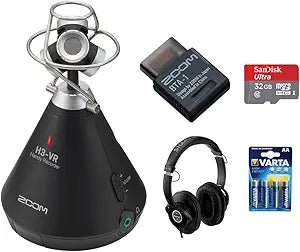
Zoom H3-VR Handy Audio Recorder - 360° VR Sound Recording Bundle
Capture true 360° spatial audio anywhere — the Zoom H3-VR is the most self-contained Ambisonics recorder built for VR, film, and immersive production.
$369.99*
Check availability
*Price sourced from Amazon.com. Last updated:Sep 05, 2026.Price and availability are subject to change — details.
Affiliate Disclosure: As an Amazon Associate, Studio Supplies earns from qualifying purchases made through links on this page, at no additional cost to you. This helps support our editorial team.
Notice a mistake? Let Us Know
Overview
Key Features
For Video, Audio, VR & AR Production
Ambisonics, Binaural & Stereo Modes
Export to 5.1 Surround via Computer
Ambisonics Array with Four Microphones
On-Board Ambisonics A-to-B Conversion
Specifications
Recording Modes
Ambisonics, Binaural, Standard Stereo
Microphone Configuration
4-capsule Ambisonics Array
Ambisonics Conversion
Onboard A-to-B (A-format to B-format)
Surround Export
5.1 Surround via Computer
Storage
microSD / microSDHC
Wireless Control
Zoom BTA-1 Bluetooth Adapter (included)
Power
2 x AA Batteries
Applications
VR, AR, 360° Video, Audio Production
Bundle Includes
H3-VR recorder, foam windscreen, dual mounting bracket, BTA-1 Bluetooth adapter, SanDisk 32GB microSDHC, microSD adapter, AA batteries (2+4), Senal SMH-500 headphones, 1/4" adapter
Frequently Asked Questions
What recording modes does the H3-VR offer and when would I use each?
The H3-VR records in three modes: Ambisonics (full 360° spatial field, essential for VR/AR work), Binaural (two-channel spatial audio optimized for headphone listening, ideal for podcasts and documentary audio), and Standard Stereo (conventional two-channel output for everyday video and broadcast). Ambisonics mode captures the full soundfield and gives you the most flexibility in post; Binaural is your fastest path to a compelling headphone mix without post-processing.
Does the H3-VR handle A-to-B Ambisonics conversion internally, or do I need a plugin in my DAW?
It handles it internally. The onboard A-to-B conversion is one of the H3-VR's strongest workflow features — raw Ambisonics (A-format) is decoded directly to B-format on the recorder, which is what most spatial audio software and NLEs like Premiere and Resolve expect. That eliminates an entire decode step in post and keeps your session clean.
What is the self-noise level of the H3-VR's mic array, and how does it perform in quiet environments?
Zoom rates the mic array at approximately 74 dB SPL maximum input and designs it for field and location use rather than dead-quiet studio tracking. In reverberant or outdoor environments the self-noise is unobtrusive, but in extremely quiet studio spaces you may notice the noise floor under high gain. For most VR production, documentary, and location work, the noise floor is well within acceptable range.
Can I use the H3-VR for live broadcast or streaming 360° audio?
Yes — with the included BTA-1 Bluetooth adapter, you can monitor and control the H3-VR wirelessly during a live capture. The unit records to microSD and can feed audio to a mixer or interface via its 3.5mm output. For dedicated live broadcast rigs, you'd typically integrate it as a satellite audio source feeding into a larger system.
How do I export to 5.1 surround from Ambisonics recordings?
The 5.1 surround export happens in post via computer software — the H3-VR records B-format Ambisonics and you use a compatible spatial audio tool (such as Facebook Spatial Workstation, dearVR, or similar) to decode that B-format recording into a 5.1 or binaural mix for final delivery.
Related Products


