



Behringer
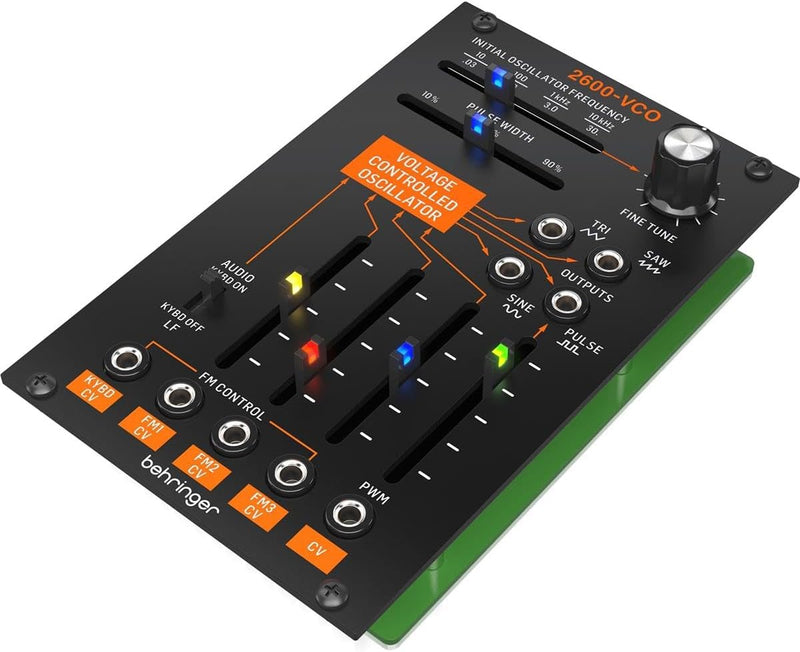
Behringer 000-E5N00-00010 2600 VCO Eurorack Module
The ARP 2600's iconic VCO architecture in Eurorack format — four simultaneous waveforms, authentic vintage circuitry, and CV control precision that earns its rack space.
View price on Amazon
Affiliate Disclosure: As an Amazon Associate, Studio Supplies earns from qualifying purchases made through links on this page, at no additional cost to you. This helps support our editorial team.
Notice a mistake? Let Us Know
Overview
Key Features
Amazing sounding VCO module from the ’70s
Authentic reproduction of original ARP* 2600 circuitry
VCO features 4 simultaneous waveforms: sine, triangle, saw and pulse
VCO offers wide frequency control from 10 Hz to 10 kHz or 0.03 Hz to 30 Hz in LF mode
PWM can be simultaneously controlled manually and via external CV input
Specifications
Module Type
Voltage-Controlled Oscillator (VCO)
Format
16HP Eurorack
Waveforms
Sine, Triangle, Sawtooth, Pulse (simultaneous)
Frequency Range (Audio)
10 Hz – 10 kHz
Frequency Range (LF Mode)
0.03 Hz – 30 Hz
PWM Control
Manual and external CV (simultaneous)
Circuit Design
Authentic ARP 2600 VCO reproduction
Frequently Asked Questions
How faithfully does this module reproduce the original ARP 2600 VCO sound?
Behringer's 2600-VCO uses an authentic circuit recreation of the original ARP 2600 oscillator topology, not a digital model. The result is the characteristic warmth and slight harmonic complexity of the original — audible in the saw and pulse waveforms especially.
Can all four waveforms be used simultaneously in a patch?
Yes — sine, triangle, saw, and pulse each have their own output, and all four are active simultaneously. You can mix them externally or route each to a different destination, which dramatically expands the tonal palette of a single oscillator.
How is pulse width modulation controlled on this module?
PWM is controllable both manually via the front panel knob and simultaneously via an external CV input. You can set a static pulse width and modulate it dynamically with an LFO or envelope — both sources sum together for compound modulation behavior.
What is the LF mode, and when would I use it?
In LF mode, the frequency range drops to 0.03–30 Hz, turning the VCO into a low-frequency modulation source. This lets the same module serve as a precision LFO for slow filter sweeps, vibrato, or rhythmic CV patterns without requiring a separate dedicated module.
What is the module's HP width and power requirement?
The module occupies 16HP in a standard Eurorack enclosure. Confirm your case's power supply capacity against Behringer's published current draw specs before installing — vintage-accurate analog circuitry can draw more current than comparably sized digital modules.
Related Products


