



Behringer
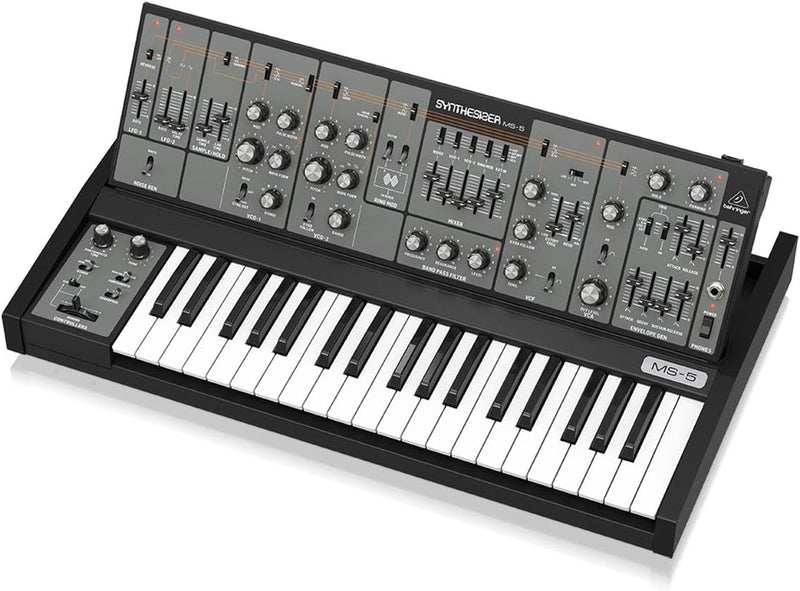
Behringer 0722-AAR86-US1 MS-5 Analog Synthesizer
The Behringer MS-5 brings authentic SH-5 analog circuitry to your studio or stage — fat oscillators, a punishing 4-pole filter, and real transistor-level warmth that digital emulations can't fake.
$559.00*
View on Amazon
✓ In Stock on Amazon.com
*Price sourced from Amazon.com. Last updated:Oct 21, 2026.Price and availability are subject to change — details.
Affiliate Disclosure: As an Amazon Associate, Studio Supplies earns from qualifying purchases made through links on this page, at no additional cost to you. This helps support our editorial team.
Notice a mistake? Let Us Know
Overview
Key Features
2-voice Monophonic Analog Synthesizer with 37-key Semi-weighted Keybed
4 Switchable Oscillator Waveforms
Foldable Playing Design
4-pole/1-pole VCF
Noise Generation
Specifications
Type
2-Voice Monophonic Analog Synthesizer
Keys
37 Semi-Weighted with Velocity Sensitivity
Oscillators
2 VCOs, 4 Switchable Waveforms Each
Pulse Width
Variable
Filter
4-Pole / 1-Pole Switchable VCF
Signal Mixer
5-Slider Configuration
Noise Generator
Included
Dimensions
31.1 x 19 x 6.7 inches
Weight
26.8 lbs
UPC
787790559757
Frequently Asked Questions
Does the MS-5 require any external power or will it run on USB?
The MS-5 requires a standard IEC mains power connection — it does not run on USB bus power. Plan accordingly for live rigs where power routing matters.
How does the 4-pole VCF compare to a 1-pole configuration, and when would you switch between them?
The 4-pole mode delivers the classic steep resonant rolloff associated with the original SH-5 — thick, singing, and capable of self-oscillation. The 1-pole mode opens the filter up for brighter, more open timbres with gentler attenuation. Switch to 1-pole when you need the filter to shape without dominating.
Is there MIDI implementation on the MS-5 for DAW integration?
Yes, the MS-5 includes MIDI connectivity for sequencing and parameter control from a DAW or hardware sequencer. For tight session integration, sync it to your DAW's MIDI clock and automate filter sweeps in real time.
What does "matched transistors and JFETs" mean for the sound?
Component matching reduces channel-to-channel variation in the analog circuit, which tightens oscillator tracking across the keyboard and keeps the filter character consistent. In practice, you hear more predictable, musical resonance behavior rather than the drift typical of unmatched vintage hardware.
Can the dual VCOs be detuned for classic analog chorus thickness?
Yes — the two VCOs can be tuned independently and set to different waveforms, enabling the beating, chorus-like analog thickness that defines the SH-5 sound. Even subtle detuning produces a lush, three-dimensional quality in the low-mid range.
Related Products


