



Behringer
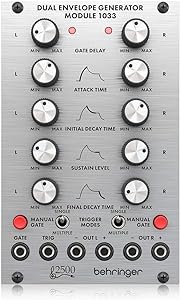
Behringer DUAL ENVELOPE GENERATOR MODULE 1033 Eurorack Analog Module
Bring 1970s analog envelope architecture into your Eurorack — the 1033 module delivers dual DADSR control with gate delay down to 3ms.
View price on Amazon
Affiliate Disclosure: As an Amazon Associate, Studio Supplies earns from qualifying purchases made through links on this page, at no additional cost to you. This helps support our editorial team.
Notice a mistake? Let Us Know
Overview
Key Features
Classic 1033 analog dual DADSR module from the '70s
Authentic reproduction of the circuitry from the "2500" Series
The module contains two identical envelope generators for creating control signals
Each generator features 5 adjustable parameters: Gate Delay, Attack Time, Initial Decay Time, Sustain Level, Final Decay Time
Gate enables the beginning of the envelope to be delayed between 3 ms and 3 seconds
Specifications
Module Type
Analog Dual DADSR
Series
2500 Series
Number of Envelope Generators
2
Adjustable Parameters per Generator
Gate Delay, Attack Time, Initial Decay Time, Sustain Level, Final Decay Time
Gate Delay Range
3 ms to 3 seconds
Frequently Asked Questions
What makes a DADSR envelope different from a standard ADSR, and how does the gate delay parameter change what you hear?
A DADSR adds an initial Gate Delay stage before the Attack — the envelope does not begin until the delay time elapses, which ranges from 3ms to 3 seconds on this module. In practice, this means you can program a stutter, a swell-in delay after a gate trigger, or a rhythmic offset between two envelopes on the same patch. A standard ADSR would respond immediately to the gate; this one holds back, which opens up rhythmic and textural possibilities that require creative patching to approximate otherwise.
Can both envelope generators be used independently, or do they share a trigger input?
Both generators are independent and identical — each has its own gate delay, attack, initial decay, sustain, and final decay controls. They can respond to different gate sources simultaneously, or both can be driven from the same trigger for layered control voltage shapes with different timing offsets via the gate delay parameter.
What Eurorack power format does this module use, and what is its current draw?
The module is designed for standard Eurorack power (±12V and +5V buses). Specific current draw figures are not listed in the available specification data — verify with Behringer's published spec sheet before placing it in a power-constrained case.
How faithful is the recreation to the original ARP 2500 Series 1033 circuitry?
Behringer describes it as an authentic reproduction of the "2500 Series" circuitry. The DADSR topology and parameter ranges (including the 3ms–3 second gate delay) match the original module's architecture. Sonic fidelity to vintage ARP hardware will depend on component tolerances, but the functional behavior and control range are drawn directly from the '70s original.
What is the primary difference between "Initial Decay" and "Final Decay" in this envelope?
Initial Decay sets the fall time from the Attack peak down to the Sustain level — the standard "D" in ADSR. Final Decay is the release stage that follows when the gate closes, determining how long the envelope takes to fall from the Sustain level to zero. Having separate controls for both decay phases gives you independent shaping of the attack transient tail and the release tail, useful for designing percussive sounds where those two decay curves need to behave differently.
Related Products


