



Behringer
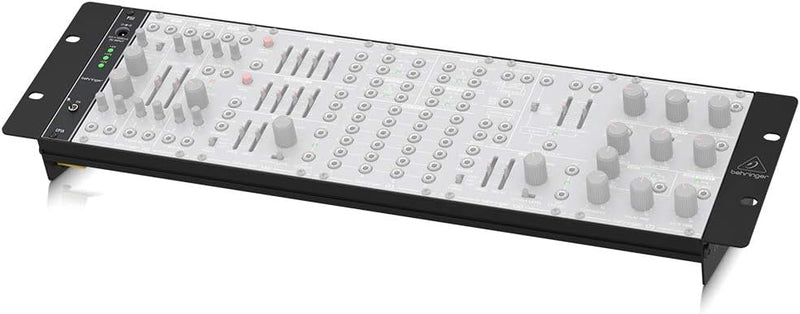
Behringer EURORACK RACK 19" Eurorack Chassis - 84 HP with PSU
An 84 HP aluminum Eurorack chassis with integrated PSU that turns a standard 19" rack bay into a fully powered modular system in minutes.
$85.90*$99.00Save 13%
Check availability
*Price sourced from Amazon.com. Last updated:Oct 21, 2026.Price and availability are subject to change — details.
Affiliate Disclosure: As an Amazon Associate, Studio Supplies earns from qualifying purchases made through links on this page, at no additional cost to you. This helps support our editorial team.
Notice a mistake? Let Us Know
Overview
Key Features
Desktop/rack-mount kit converts 19" rack into 84 HP Eurorack chassis
Ideal for Behringer synthesizers and other Eurorack equipment
Rugged aluminum chassis accommodates 84 HP rack-mounted and desktop setups
Compact 4 HP power supply with two flying bus boards included (+12 V@1 A, -12 V@1 A, +5 V@0.5 A)
Easy positioning of your modules with the included 52 sliding nuts
Specifications
Format
Eurorack
HP Size
84 HP
Chassis Material
Aluminum
Power Supply Included
Yes
Power Supply HP Size
4 HP
Power Supply Output (+12V)
1 A
Power Supply Output (-12V)
1 A
Power Supply Output (+5V)
0.5 A
Mounting Options
Desktop/19" Rack-mount
Included Accessories
52 sliding nuts
Frequently Asked Questions
What is the total power output of the included PSU, and is it enough for a full 84 HP build?
The included compact 4 HP power supply delivers +12V @ 1A, -12V @ 1A, and +5V @ 0.5A via two flying bus boards. 1A on the ±12V rails is workable for a moderate density build — VCOs, filters, and envelopes — but high-current modules like polyphonic voice cards or complex DSP modules can push against that ceiling fast. Audit your module current draw before filling all 84 HP.
Can the two flying bus boards power modules simultaneously, or do they share the same rail budget?
Both bus boards draw from the same PSU rail budget — +12V @ 1A total across both boards combined, not 1A per board. Distributing modules evenly across both boards helps prevent localized voltage sag, but the aggregate current limit is shared.
Does the chassis support both rack mounting and desktop use?
Yes. The kit is explicitly designed as a 19" rack-mount and desktop dual-use chassis. The aluminum frame fits a standard 19" rack bay while the form factor is stable on a desk surface, making it practical for both studio installations and desktop modular rigs.
How many modules can the sliding nut system accommodate, and what HP increments do they support?
The chassis includes 52 sliding nuts, which is sufficient to mount a fully loaded 84 HP row with standard 2-bolt module faceplates. The sliding nut system accommodates standard M3 Eurorack mounting screws and allows free positioning across the full rail width.
Is the PSU noise floor a concern for audio-rate signals?
Switching power supplies at this price point can introduce noise artifacts into audio-rate signals — a relevant concern for VCOs and sensitive filter circuits. The flying bus board topology helps, but proper module grounding and keeping power-hungry digital modules electrically separated from analog voice modules on the bus boards is advisable practice.
Related Products


