Behringer

Behringer FOUR LFO 4-Channel Eurorack LFO Module

4.3 (20 reviews)

Four channels of voltage-controlled modulation from 500Hz down to 28-hour cycles — deep movement for any Eurorack patch

$76.99*$81.90Save 5%
Check availability

*Price sourced from Amazon.com. Last updated:Jun 27, 2026.Price and availability are subject to change.

Affiliate Disclosure: Studio Supplies may earn a commission from qualifying purchases made through links on this page, at no additional cost to you. This helps support our editorial team.

Notice a mistake? Let Us Know

Overview

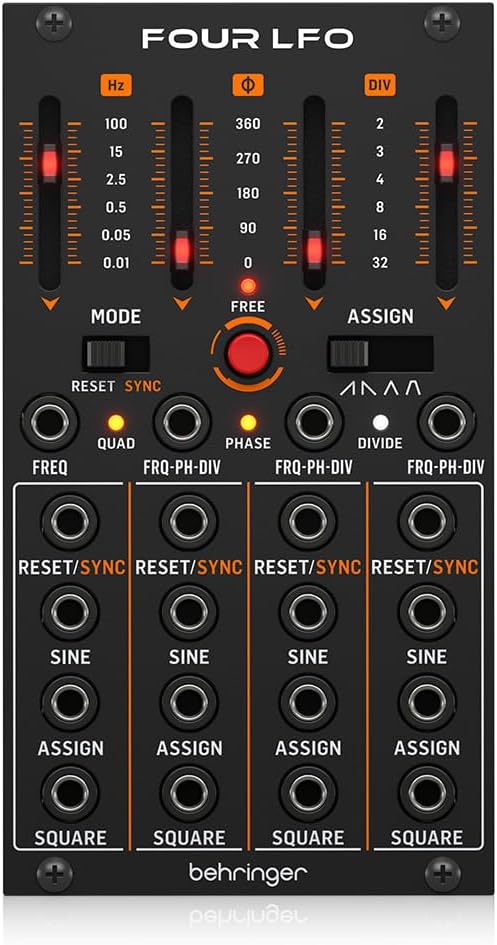
The Behringer FOUR LFO is a quad voltage-controlled low-frequency oscillator module designed to be the modulation engine at the heart of a Eurorack system. Based on the open-source Xaoc Batumi design, it delivers four channels of independently assignable waveform modulation across an extraordinarily wide rate range — from 500Hz audio-rate oscillation, where it can serve as an FM source generating metallic, harmonically complex timbres, down to 28-hour cycles that create imperceptibly slow parameter shifts for evolving ambient installations and generative compositions. The four operating modes — free, quadrature, phase, and divide — transform how the channels relate to each other, opening up everything from four completely independent modulation sources to tightly locked multi-channel relationships that produce rotating stereo movement, rhythmically related parameter sweeps, and phase-offset animation across your patch.

In practice, the module earns its rack space through sheer versatility. The four faders provide immediate hands-on rate control, and the zoom mode solves the precision problem inherent in mapping such a vast frequency range to a single fader throw — essential when you need to nail a specific vibrato speed or lock a filter sweep to a particular rhythmic feel. Per-channel reset and sync inputs mean each LFO can slave to external clock or trigger sources, keeping modulation tightly coupled to your sequencer's timing. The 14HP footprint is reasonable for a quad module, and the USB Type B connector provides a path for potential firmware updates. Build quality is functional Behringer standard — the faders and jacks do the job, though they lack the tactile refinement of the original Batumi. For modular musicians building out their system's modulation capability on a budget, this module delivers four channels of deep, flexible movement that would otherwise require significantly more investment and rack space.

Key Features

4 voltage-controlled LFOs with user-assignable waveforms based on open source Xaoc Batumi*

4 faders to control ultra-wide LFO rates from 500 Hz to 28 hours

Free, quadrature, phase and divide modes for creative sound shaping

Zoom mode for precise frequency settings

Reset and sync input for each channel

Specifications

Brand
Behringer
Model
FOUR LFO
Module Type
Quad LFO (Eurorack)
Width
14HP
Channels
4
Rate Range
500Hz to 28 hours
Waveforms
User-assignable per channel
Modes
Free, Quadrature, Phase, Divide
Features
Zoom mode, per-channel Reset and Sync inputs
Connector
USB Type B

Pros & Cons

👍 Pros

  • Four independent LFO channels in 14HP provides dense modulation capability without consuming excessive rack space
  • Ultra-wide rate range from audio-rate 500Hz down to 28-hour cycles covers everything from FM synthesis to glacial generative evolution in a single module
  • Quadrature and phase modes create coherent multi-channel modulation relationships that produce rich stereo movement and rotating spatial effects
  • Per-channel reset and sync inputs allow each LFO to lock to external clock sources for tempo-synchronized modulation across your entire patch
  • Zoom mode enables precise fine-tuning of rates that the full-range faders alone cannot achieve, critical for dialing in exact vibrato depths or rhythmic sync points

👎 Cons

  • Based on the Xaoc Batumi design but built to Behringer's cost targets, so component quality and long-term reliability may not match the original module
  • Fader-based rate control across such an extreme range means small physical movements create large frequency jumps in normal mode, making precise setting difficult without zoom
  • No individual waveform output per shape — you get one assignable output per channel rather than simultaneous access to all waveform shapes from each LFO
  • 14HP width is moderate but adds up quickly if you are building a small portable skiff where every HP counts
  • USB Type B connector suggests firmware update capability, but documentation on available updates and expanded features can be limited

Frequently Asked Questions

Each channel offers user-assignable waveforms — based on the open-source Xaoc Batumi design — allowing you to select sine, triangle, sawtooth, square, and stepped random shapes per channel, giving you independent modulation characters across all four outputs simultaneously.
At the fast end, 500Hz pushes the LFO into audio-rate territory, allowing you to use it as an FM source for metallic, sideband-rich timbres. At the slow extreme, 28-hour cycles create glacial parameter shifts perfect for evolving ambient textures and generative patches that transform over extended performances or installations.
Free mode lets each channel run independently at its own rate. Quadrature locks all four channels to the same rate but offsets them by 90 degrees for rotating spatial effects. Phase mode lets you set custom phase offsets between channels. Divide mode derives each channel's rate as a division of Channel 1, creating rhythmically related modulation patterns.
Each channel has its own reset and sync input — sending a clock or trigger pulse resets the waveform cycle to its starting point, allowing you to lock LFO cycles to your sequencer tempo or sync modulation sweeps to rhythmic events in your patch.
Zoom mode narrows the range of the fader to a small frequency window around the current setting, letting you make fine-grained rate adjustments that would be difficult with the full 500Hz-to-28-hour sweep — essential for dialing in precise vibrato rates or tempo-matched modulation speeds.