



Behringer
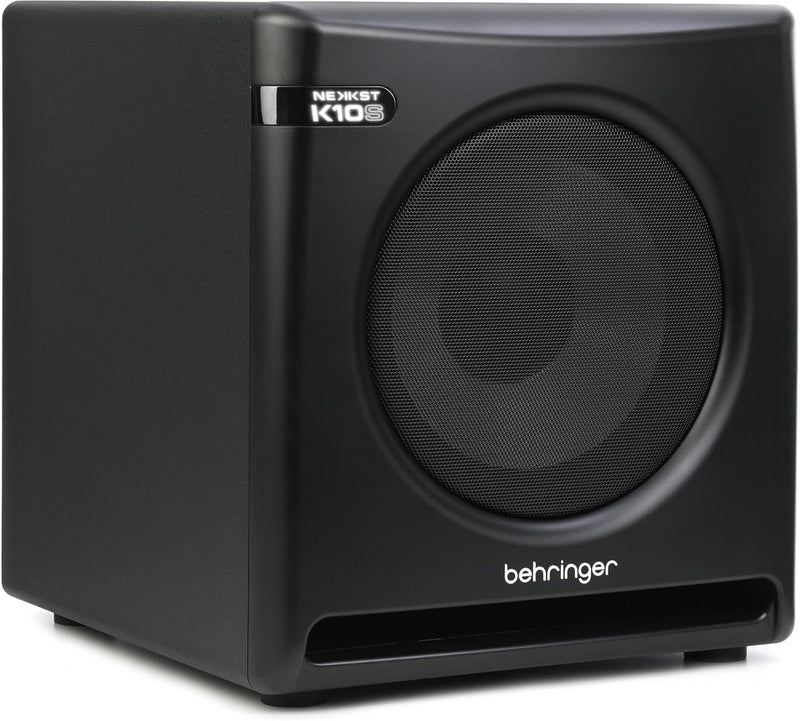
Behringer K10S 10" Powered Studio Subwoofer
300-watt reference subwoofer with a variable low-pass filter and phase switch engineered to integrate cleanly into stereo studio monitor systems.
$369.00*
View on Amazon
✓ In Stock on Amazon.com
*Price sourced from Amazon.com. Last updated:Oct 21, 2026.Price and availability are subject to change — details.
Affiliate Disclosure: As an Amazon Associate, Studio Supplies earns from qualifying purchases made through links on this page, at no additional cost to you. This helps support our editorial team.
Notice a mistake? Let Us Know
Overview
Key Features
Ultra-linear 300-Watt reference-class studio subwoofer
Designed by renowned acoustic icon Keith Klawitter, founder of KRK*
Powerful bridge-mode amplifier provides detailed reproduction of full low frequency spectrum
High excursion 10” woofer with deformation-resistant glass fiber cone
Variable low-pass filter and phase switch for optimum crossover alignment with stereo monitor systems
Specifications
Woofer Size
10"
Cone Material
Glass fiber (deformation-resistant)
Amplifier Power
300 Watts (bridge-mode)
Low-Pass Filter
Variable
Phase Switch
Yes (0°/180°)
Connectivity
Wired (unbalanced)
Color
Black
Recommended Use
Studio reference monitoring, 2.1 monitor integration
Brand
Behringer (Nekkst series)
Model
K10S
Frequently Asked Questions
What is the K10S's amplifier topology, and how does it affect low-frequency reproduction?
The K10S uses a bridge-mode amplifier rated at 300 watts. Bridge mode sums two amplifier channels in opposing polarity to effectively double the voltage swing across the woofer — this increases headroom at low frequencies where cone excursion demands are highest, contributing to tighter transient response at elevated playback levels.
How do I set the low-pass filter crossover point for my existing monitors?
The K10S provides a variable low-pass filter — adjust the cutoff frequency to match or sit slightly below the low-frequency roll-off point of your satellite monitors. Start with the crossover set around 80Hz as a reference, then tune by ear and with a real-time analyzer to achieve a smooth acoustic handoff with no audible gap or overlap in the 60–120Hz region.
What does the phase switch do, and when should I use it?
The phase switch (0°/180°) compensates for phase offset between the K10S and your satellite monitors at the crossover frequency. In-room acoustic anomalies and cable routing can create cancellation in the crossover region — flip the phase switch and compare SPL at the crossover point to determine which setting produces the fuller, more coherent low-mid response.
Is the 10" woofer cone material significant for studio use?
Yes. The glass fiber cone is chosen for its stiffness-to-mass ratio — a stiffer cone reduces unwanted flexural resonance (breakup modes) that would otherwise color transient material like kick drum attacks and bass guitar plucks. In a reference monitoring context, cone material directly affects how accurately fast transients are reproduced.
Can the K10S be used for music production, or is it better suited for home theater?
The K10S is designed and voiced for studio reference use — flat, analytical low-frequency reproduction rather than the boosted, room-filling character typical of consumer subwoofers. The variable crossover and phase alignment controls are specifically included for integration with studio monitor pairs, not for home theater bass extension.
Related Products


