



Behringer
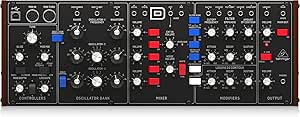
Behringer Model D Legendary Analog Synthesizer Eurorack Format
Behringer's Model D brings the fat, ladder-filtered analog tone of the original Minimoog to Eurorack — at a price that puts classic synthesis within reach of working musicians.
$264.16*
Check availability
*Price sourced from Amazon.com. Last updated:Oct 21, 2026.Price and availability are subject to change — details.
Affiliate Disclosure: As an Amazon Associate, Studio Supplies earns from qualifying purchases made through links on this page, at no additional cost to you. This helps support our editorial team.
Notice a mistake? Let Us Know
Overview
Key Features
Amazing analog synthesizer with triple VCO design allows for insanely fat music creation
Ultra-high precision 0.1% Thin Film resistors and Polyphenylene Sulphide capacitors
Pure analog signal path based on authentic VCO, VCF and VCA designs
5 variable oscillator shapes with variable pulse widths for ultimate sounds
Classic 24 dB ladder filter with resonance for legendary sound performance
Specifications
Voice Architecture
Monophonic Analog
Oscillators
3x VCO (Triple VCO design)
Oscillator Shapes
5 variable shapes with variable pulse width
Filter
24dB/octave Ladder Filter with Resonance
Resistors
0.1% Thin Film
Capacitors
Polyphenylene Sulphide (PPS)
Signal Path
Pure Analog VCO, VCF, VCA
Format
Eurorack Compatible
CV Connectivity
1V/oct pitch, filter cutoff, volume, gate in; pitch CV out
Frequently Asked Questions
Does the Model D require a Eurorack case to operate, or can it be used standalone?
The Model D is self-contained and includes its own power input — it does not require a Eurorack case to function. It can sit on a desk and operate standalone. However, its Eurorack-compatible dimensions and CV/gate connectivity mean it integrates directly into a modular system if you have one.
How does the 24dB ladder filter on the Model D behave at high resonance — does it self-oscillate?
Yes, the ladder filter self-oscillates at maximum resonance, producing a clean sine-wave tone. This is consistent with the original Moog ladder filter topology it's based on. The resonance sweep is usable across its entire range — it thickens the sound progressively before reaching the self-oscillation threshold, rather than jumping abruptly.
What CV inputs are available for modular integration?
The Model D provides CV inputs for pitch (1V/oct), filter cutoff, and volume, plus a gate input for triggering the envelope. It also outputs pitch CV, making it usable as a CV source for other modules. The panel connections are 3.5mm Eurorack-standard jack format.
Can the Model D produce polyphonic sounds on its own?
No. The Model D is a monophonic synthesizer — it plays one note at a time. Chord or polyphonic textures require external sequencing into a polyphonic instrument. Its strength is in bass lines, leads, and mono pads where the triple-VCO detuning creates dense, wide tones.
How does the 0.1% Thin Film resistor spec affect the sound versus a standard analog synth build?
Higher-tolerance components in the VCO tuning circuits mean the oscillators track pitch more accurately across the keyboard range and hold tuning more reliably with temperature changes. In practical terms, the Model D stays in tune longer between recalibrations than lower-tolerance builds — a meaningful difference in live and recording contexts.
Related Products


