

Behringer
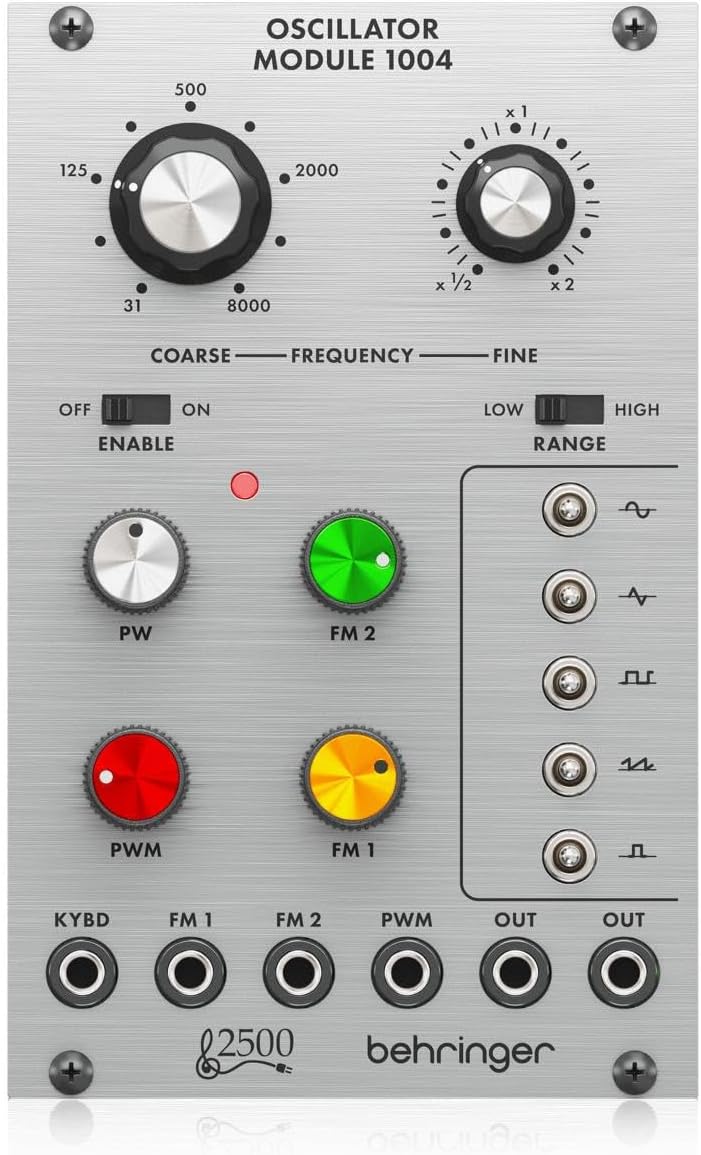
Behringer 1004 Dual Analog VCO Eurorack Module
Two channels of authentic '70s analog oscillator circuitry in a single Eurorack module — five waveshapes per VCO, from sub-bass rumble to 16 kHz screech.
$64.99*
View on Amazon
✓ In Stock on Amazon.com
*Price sourced from Amazon.com. Last updated:Oct 21, 2026.Price and availability are subject to change — details.
Affiliate Disclosure: As an Amazon Associate, Studio Supplies earns from qualifying purchases made through links on this page, at no additional cost to you. This helps support our editorial team.
Notice a mistake? Let Us Know
Overview
Key Features
Classic 1004 dual analog VCO module from the ‘70s
Authentic reproduction of the circuitry from the “2500” Series
VCO features 5 waveforms: sine, triangle, square, sawtooth and pulse
Waveforms can be combined and inversed into the audio outputs
Output frequency range from 0.03 Hz to 16 kHz in 2 ranges
Specifications
Type
Dual Analog VCO Module
Series
2500 Series (ARP 2500 reproduction)
Waveforms per VCO
Sine, Triangle, Square, Sawtooth, Pulse
Frequency Range
0.03 Hz to 16 kHz (2 ranges)
Connector Type
3.5 mm TS (Eurorack standard)
Format
Eurorack
Dimensions
5.08" L x 3.19" W x 1.77" H
Frequently Asked Questions
How accurate is the 1004's reproduction of the original 2500 Series VCO circuitry, and does it track V/oct?
Behringer states this is an authentic circuit reproduction of the ARP 2500 Series 1004 module. Like the original, it uses analog exponential converters for pitch tracking. V/oct tracking accuracy depends on calibration and temperature stability of the expo converter — classic analog behavior, not a digital approximation. Expect the characteristic warmth and slight drift of a thermally dependent analog circuit.
What is the frequency range of each VCO, and can it operate as an LFO?
Each VCO covers 0.03 Hz to 16 kHz across two selectable ranges. The 0.03 Hz lower boundary is approximately one cycle every 33 seconds — deep enough for use as a slow LFO for filter sweeps, tremolo, or slow pitch modulation, without needing a separate LFO module for those applications.
Can the two VCOs be hard-synced or FM-modulated against each other?
The 1004 provides waveform combination and inversion capabilities at its outputs, and the module exposes CV inputs appropriate for cross-modulation between the two oscillators. Hard sync between the two VCOs follows the original 2500 Series architecture — consult the module's patch documentation for the specific sync input routing.
What connector format does the 1004 use, and what Eurorack power does it draw?
All patch connections use 3.5 mm TS (mono) jacks — standard Eurorack format, compatible with all current Eurorack patch cables. Power draw specifications are available in Behringer's technical documentation; the module requires a Eurorack power supply with a standard 16-pin or 10-pin Eurorack header.
How does the 1004's output sound compared to modern digital oscillators at the same price?
The 1004 produces the thermally reactive, subtly unstable character that is intrinsic to analog expo-converter VCO design — slight pitch drift, waveform asymmetry, and harmonic saturation that digital models approximate but do not fully replicate. These are sonic properties, not flaws. Users seeking pixel-perfect pitch stability should choose a digital or VCOS oscillator; users seeking the texture of vintage analog synthesis will find it here.
Related Products


