



Behringer
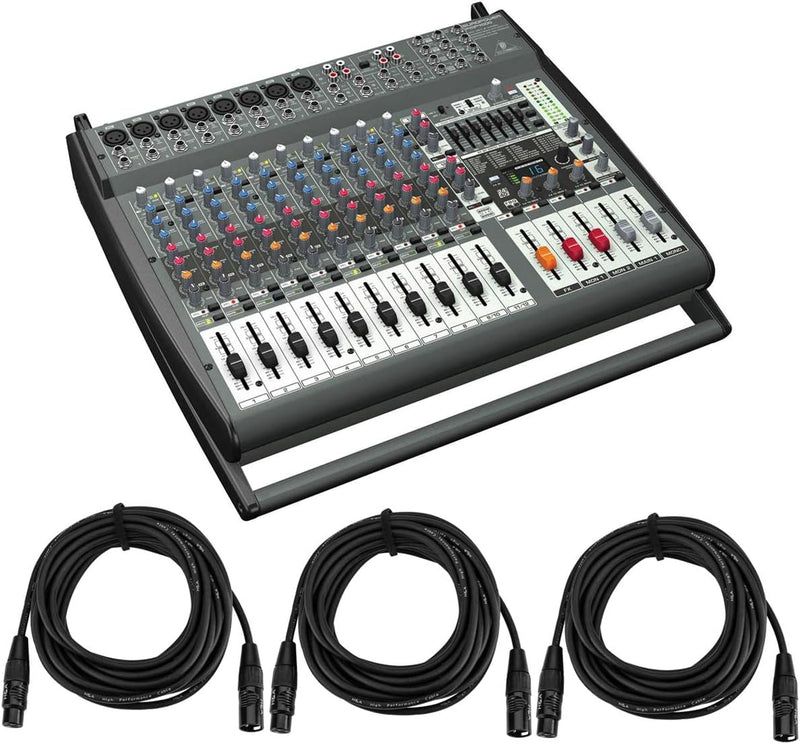
Behringer PMP4000 1600-Watt Powered Mixer FX 3 XLR Cables
Sixteen channels of powered mixing with 1,600 watts and studio-grade Xenyx preamps — a single-rack solution for live PA, houses of worship, and touring small venues.
View price on Amazon
Affiliate Disclosure: As an Amazon Associate, Studio Supplies earns from qualifying purchases made through links on this page, at no additional cost to you. This helps support our editorial team.
Notice a mistake? Let Us Know
Overview
Key Features
1600W High-Power Performance – Delivers up to 1,600 watts of clean, reliable power, making it ideal for live performances, houses of worship, events, rehearsals, DJs, and portable PA systems.
16-Channel Professional Mixing – Features 16 input channels with premium microphone preamps, 3-band EQ, multiple aux sends, and flexible routing for effortless mixing of vocals, instruments, and audio sources.
Built-In Multi-FX & Feedback Control – Integrated digital Multi-FX processor provides professional-quality reverb, delay, chorus, and more, while FBQ Feedback Detection helps quickly identify and eliminate feedback during live performances.
Ready-to-Use Bundle – Includes (2) 25-foot XLR male-to-female microphone cables, giving you everything needed to connect microphones or other balanced audio equipment right out of the box.
Perfect for Live Sound Applications – Rugged all-in-one powered mixer combines amplification, mixing, equalization, and effects into a single portable unit, making setup fast and efficient for bands, churches, schools, conference rooms, and event venues.
Specifications
Brand
Behringer
Model
PMP4000
Power Output
1,600W (2 × 800W stereo / 1,600W bridged)
Total Channels
16
Mic Preamps
8 Xenyx Mic Preamps
Stereo Channels
4
FX Processor
24-bit Multi-FX, 100 Presets
EQ
7-Band Stereo Graphic EQ with FBQ Feedback Detection
Frequency Response
<10 Hz – >200 kHz (−1 dB / −3 dB)
Gain Range
+10 dB to +60 dB
Mic Input Connector
XLR (electronically balanced)
Dimensions
18.74 × 18.11 × 4.8 in
Weight
32 lbs
Included
3 × 25ft XLR M–F Cables
Frequently Asked Questions
What does the bridged mono mode do and when should I use it?
Bridging combines both internal amplifier channels into a single mono output, delivering the full 1,600-watt rating into a single speaker cabinet — useful when driving a high-powered subwoofer or a single main PA in a mono configuration. In stereo mode, each amplifier channel delivers 800 watts.
How do the Xenyx mic preamps affect what I hear on stage?
The Xenyx preamps are transformer-less designs with a stated +60 dB gain range. In practice, they deliver clean, transparent gain on close-miked vocals and instruments, though at the upper end of the gain range you'll notice the noise floor rising — especially on dynamic mics with low output. For condenser mics on acoustic sources, you'll get more headroom and lower self-noise at moderate gain settings.
Does the PMP4000 supply phantom power for condenser microphones?
Yes, the PMP4000 provides 48V phantom power on its XLR mic inputs, required for most condenser microphones. Confirm that phantom is engaged before connecting condensers — and always mute the channel before plugging in ribbon mics, which can be damaged by phantom power.
How does the onboard FBQ Feedback Detection system work during a live set?
The FBQ system illuminates LEDs on the graphic EQ bands that correspond to frequencies approaching feedback, giving the engineer a visual cue to pull those bands before the loop becomes audible. It's a reactive tool, not a predictive one — it responds to feedback as it develops, so it supplements rather than replaces proper gain staging and monitor positioning.
Can I use the PMP4000 as a monitor mixer as well as a front-of-house mixer?
The PMP4000 includes aux sends that can be routed to stage monitors. The number of independent monitor mixes will be constrained by the available aux buses — review the channel routing before committing to multi-monitor configurations in complex stage plots.
Related Products


