



Behringer
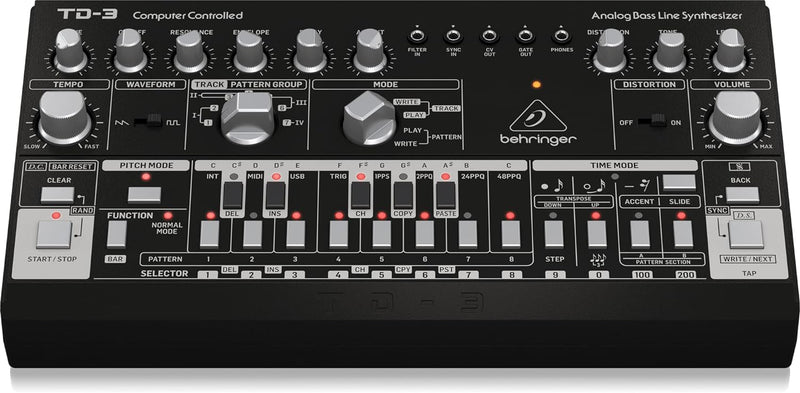
Behringer TD-3-BK Analog Bass Line Synthesizer
Authentic analog acid basslines with matched-transistor circuitry and a 4-pole resonant filter that snarls, squelches, and breathes exactly like the original.
$149.00*
Check availability
*Price sourced from Amazon.com. Last updated:Aug 29, 2026.Price and availability are subject to change — details.
Affiliate Disclosure: As an Amazon Associate, Studio Supplies earns from qualifying purchases made through links on this page, at no additional cost to you. This helps support our editorial team.
Notice a mistake? Let Us Know
Overview
Key Features
Amazing Bass Line synthesizer with true analog circuitry for bass and groove sounds
Authentic reproduction of original circuitry with matched transistors
Pure analog signal path based on legendary VCO, VCF and VCA designs
Sawtooth and square waveform VCO with transistor wave-shaping circuitry
Amazing 4-pole low-pass resonant filter with cut-off, resonance, envelope, decay and accent controls
Specifications
Type
Analog Bass Line Synthesizer
Circuitry
True Analog (matched transistors)
VCO Waveforms
Sawtooth, Square
Filter
4-pole low-pass resonant VCF
Filter Controls
Cut-off, Resonance, Envelope, Decay, Accent
Sequencer
16-Step with pitch, gate, slide, accent
Poly Chain
16-Voice
Connectivity
MIDI In/Out, 6.35mm audio output
Color
Black
Frequently Asked Questions
How closely does the TD-3's analog circuitry replicate the original bass line synthesizer sound?
The TD-3 uses matched transistors in a true analog signal path — VCO, VCF, and VCA all discrete analog components — rather than digital modeling or sample playback. The characteristic squelch and resonant peak of the 4-pole filter behaves like the original circuit, including the non-linear saturation characteristics that define the acid bass sound.
Does the TD-3 require external sequencing or does it have its own?
It has an onboard 16-step sequencer that programs pitch, gate, slide, and accent per step — the same basic architecture as the original. You can drive it from external MIDI or CV/gate as well, integrating it into a larger modular or DAW-based setup.
How does the accent control affect the sonic output on individual steps?
Accent increases the filter envelope depth and VCA level on accented steps, producing the louder, more aggressive hits that define the classic acid pattern. The interaction between accent, decay, and resonance is where the distinctive squelch comes from — dial up resonance near self-oscillation and the accented steps will howl.
Can the TD-3 integrate with a DAW for MIDI sync and recording?
Yes. MIDI in/out allows clock sync and note sequencing from a DAW. Audio output is a standard line-level signal via a 6.35mm jack, ready to route into any audio interface. Many producers record the dry analog signal and process it through their DAW plugin chain for additional distortion or filtering.
What does the distortion circuit add to the TD-3's sound?
The onboard distortion adds harmonic saturation to the already resonant filter output, pushing the signal from clean squelch into aggressive, overdriven acid — particularly effective on high-resonance settings where the filter is near self-oscillation.
Related Products


