



Behringer
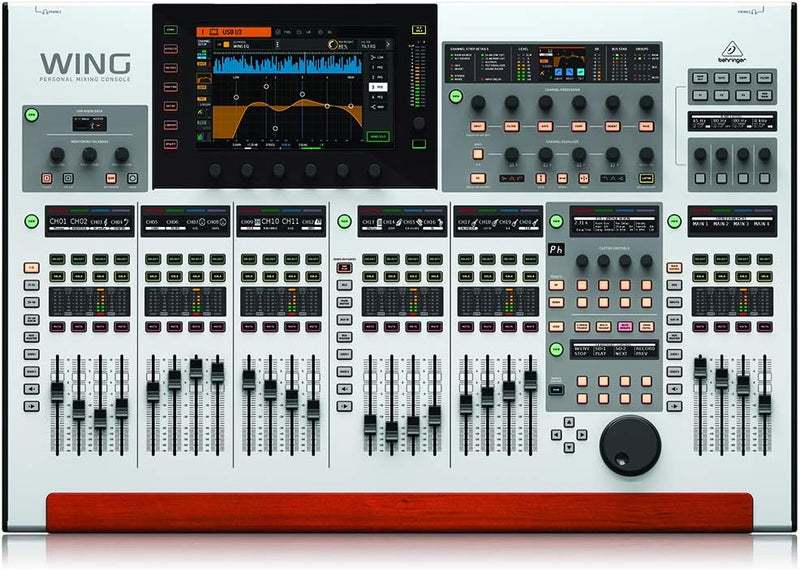
Behringer Wing 48-Channel Digital Mixing Console Touchscreen
48 channels, 28 buses, and Midas PRO preamps in a touchscreen console that rewrites what mid-market digital mixing sounds like.
$3,299.00*
Check availability
*Price sourced from Amazon.com. Last updated:Oct 21, 2026.Price and availability are subject to change — details.
Affiliate Disclosure: As an Amazon Associate, Studio Supplies earns from qualifying purchases made through links on this page, at no additional cost to you. This helps support our editorial team.
Notice a mistake? Let Us Know
Overview
Key Features
8 award-winning Midas PRO mic preamps and 8 Midas PRO outputs onboard
24 motorized 100 mm faders in 3 separate, fully configurable sections
"Plug and play" remote I/O connectivity for up to 144 input and output signals over 3 AES50 ports featuring Klark Teknik’s SuperMAC technology for ultra-low jitter and latency
Large main display with capacitive touch screen and adjustable display swivel
Unique touch-sensitive channel editing section with 11 rotary controls and dedicated color TFT for staying on top of all channel properties
Specifications
Channels
48
Buses
28 (Full Stereo)
Faders
24 Motorized 100mm
Main Display
10" Capacitive Touchscreen (adjustable swivel)
Onboard Mic Preamps
8 Midas PRO
Onboard Outputs
8 Midas PRO
Remote I/O Connectivity
3 × AES50 (up to 144 I/O)
AES50 Technology
Klark Teknik SuperMAC (ultra-low jitter/latency)
Brand
Behringer
Model
Wing
Frequently Asked Questions
How do the Midas PRO preamps in the Wing compare sonically to what engineers typically find in this price tier?
The Midas PRO preamps are the same circuit heritage used in consoles that cost five to ten times more. In practice this means a lower noise floor, more usable gain before saturation, and a warmer, more open top end than the brittle transparency typical of budget digital preamps. At moderate gain settings the headroom is generous; pushed hard, the breakup is musical rather than harsh.
What does AES50 connectivity with SuperMAC technology actually enable in a live or install scenario?
Each of the three AES50 ports on the Wing carries 48 channels bidirectionally at low jitter, giving you up to 144 inputs and outputs routable to remote stage boxes without additional clocking infrastructure. SuperMAC keeps latency under 1ms over the network, which is below the threshold of audible comb filtering even in acoustically live rooms. For touring or install work, this means running a single Cat5e snake to the stage rather than a bundle of analog cables.
Can the Wing's 24 motorized faders be organized across different workflows simultaneously?
Yes. The 24 faders are divided into three independently configurable sections, each of which can be assigned to any combination of input channels, buses, DCAs, or effects returns. A live engineer can have inputs on the left bank, mix buses in the center, and DCA masters on the right — all moving simultaneously when scene changes are recalled.
How does the Wing handle internal effects processing — does heavy use of onboard FX introduce latency or load instability?
The Wing runs its processing on dedicated DSP hardware rather than a general-purpose CPU, so effects load does not degrade system stability or introduce variable latency. Internal latency through the console is fixed regardless of processing load, which is essential for in-ear monitor mixes where timing consistency matters.
Is the Wing's touchscreen practical for fast, high-pressure live mixing, or is it more suited to studio work where deliberate navigation is acceptable?
The 10" capacitive touchscreen is designed as a supplement to physical control, not a replacement. The dedicated channel editing section with 11 rotary controls and a per-channel TFT display means most routine adjustments — EQ, dynamics, aux sends — are handled with knobs, not taps. The touchscreen accelerates routing, scene management, and setup tasks where deliberate interaction is expected.
Related Products


