



JVC
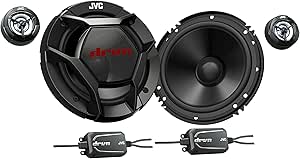
JVC CS-DR601C 6.5" DR Series Component Speakers
360W60W
Separate carbon mica woofers and 1-inch PEI dome tweeters give your car audio the clarity and detail a coaxial speaker simply can't deliver.
$74.95*$89.45Save 16%
View on Amazon
✓ In Stock on Amazon.com
*Price sourced from Amazon.com. Last updated:Oct 20, 2026.Price and availability are subject to change — details.
Affiliate Disclosure: As an Amazon Associate, Studio Supplies earns from qualifying purchases made through links on this page, at no additional cost to you. This helps support our editorial team.
Notice a mistake? Let Us Know
Overview
Key Features
2-way car component speakers
360W max
60W RMS
6.5" carbon mica woofers
Two 1" balanced dome polyetherimide (PEI) tweeters
Specifications
Configuration
2-Way Component
Woofer Size
6.5 inches
Woofer Material
Carbon Mica Cone
Tweeter Size
1 inch
Tweeter Material
Balanced Dome PEI (Polyetherimide)
Max Power
360W
RMS Power
60W
Mount Style
Shallow Mount
Crossovers
Included (passive)
Quantity
2 tweeters, 2 woofers per set
Frequently Asked Questions
What's the difference between these component speakers and standard coaxial car speakers?
Component speakers separate the woofer and tweeter into physically distinct drivers, each reproducing only the frequencies it's optimized for. This creates cleaner audio separation — highs come from the tweeter mounted at ear level, lows from the woofer in the door — versus a coaxial design where both drivers share a single mounting point and compromise imaging.
What does 360W max / 60W RMS mean for these speakers' real-world amplifier requirements?
The 60W RMS is the continuous power rating that matters for amplifier matching — this is the sustained power these speakers can handle cleanly. The 360W max is a peak burst figure. For optimal performance, pair these with an amplifier delivering 50–80W RMS per channel, not a factory head unit which typically outputs 15–20W RMS.
Do these speakers require a separate amplifier, or will they work with a factory head unit?
They will function with a factory head unit, but at 60W RMS rated capacity they'll underperform at factory power levels (typically 15–20W RMS per channel). An aftermarket amplifier at 50–80W RMS per channel will fully resolve the speaker's output capability and audible clarity improvement.
What vehicles does the 6.5-inch size fit, and is a depth adapter required?
6.5-inch is one of the most common car speaker sizes, fitting a wide range of vehicles in front and rear door positions. However, shallow-mount design helps with tight door cavities — verify your specific vehicle's mounting depth against the CS-DR601C's specifications before ordering, as some vehicle doors require additional spacer rings.
Where should the included 1-inch PEI dome tweeters be mounted for best sound?
Tweeters mounted at ear level — A-pillars, sail panels, or dash corners — produce the most accurate stereo imaging. Mounting tweeters in the door at woofer level produces a sound stage that feels low and narrow rather than wide and forward. The included crossovers ensure the tweeter only receives high-frequency content, protecting it from bass frequencies that would cause distortion or damage.
Related Products


