



Korg
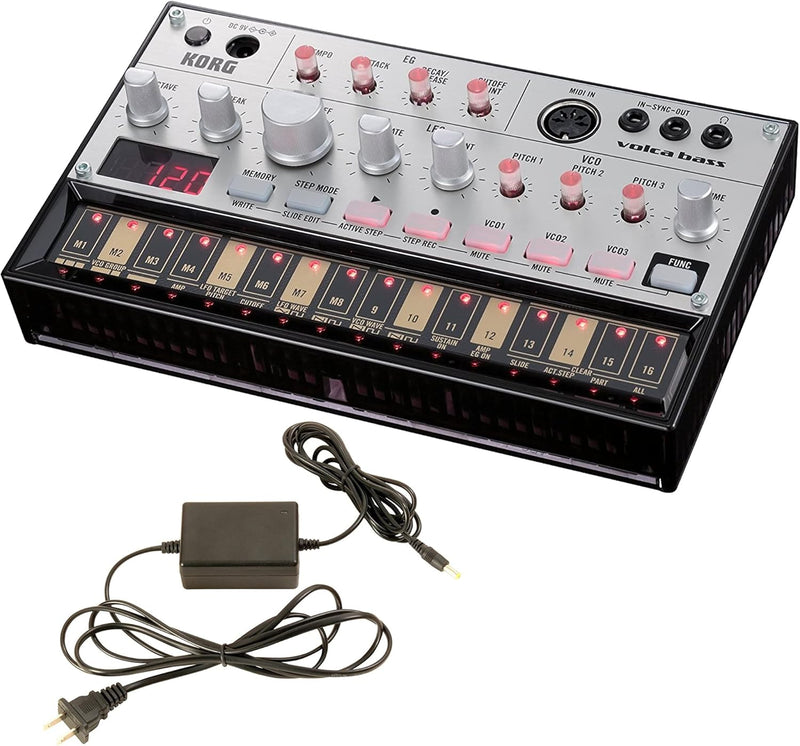
Korg AUS-VOLCABASS-COMBO-AMZ-1 Volca Bass Analogue Machine Bundle
Three analog oscillators and a resonant low-pass filter make the Korg Volca Bass the most cost-effective acid machine on any studio desk.
$159.99*
View on Amazon
✓ In Stock on Amazon.com
*Price sourced from Amazon.com. Last updated:Aug 28, 2026.Price and availability are subject to change — details.
Affiliate Disclosure: As an Amazon Associate, Studio Supplies earns from qualifying purchases made through links on this page, at no additional cost to you. This helps support our editorial team.
Notice a mistake? Let Us Know
Overview
Specifications
Type
Analogue Bass Machine
Oscillators
3 Analog VCOs
Filter
Low-Pass Filter with Resonance
Sync
Sync In / Sync Out (Volca Series and Monotribe compatible)
Power Supply
Korg 9V 600mA (included)
Brand
Korg
Model
AUS-VOLCABASS-COMBO-AMZ-1
Frequently Asked Questions
Does the Volca Bass produce true analog signal, or is it digitally modeled?
The Volca Bass runs three genuine analog VCOs through a real analog low-pass filter — there is no digital modeling in the signal path. What you hear is hardware oscillator drift, filter saturation, and transistor ladder character that no plugin replicates exactly.
What does the Sync I/O actually do, and which devices does it work with?
The Sync In and Out jacks carry a clock pulse that locks the Volca Bass sequencer to other units in the Korg Volca series and the Monotribe. It is a simple analog pulse sync, not MIDI clock — so it chains tightly with hardware but won't sync directly to a DAW without a MIDI-to-sync converter.
How deep can the filter resonance go — can it self-oscillate?
The low-pass filter on the Volca Bass will resonate aggressively at high settings and can reach near-self-oscillation, producing the piercing, whistling tones central to classic acid bass sounds. It responds well to cutoff sweeps via the front-panel knob for live performance.
Does the included power supply replace batteries, or does the unit require both?
The bundled Korg 9V 600mA power supply is the primary power source and eliminates the need for batteries during studio or stage use. The unit does support AA batteries for portable operation when the adapter isn't available.
Is the Volca Bass monophonic, and can it play chords?
The Volca Bass is fundamentally a mono bass machine — its three oscillators are designed to play in unison, octaves, or fifth intervals rather than independent polyphonic voices. This stacked oscillator approach is what gives it its thick, dense bass character.
Related Products


