Korg

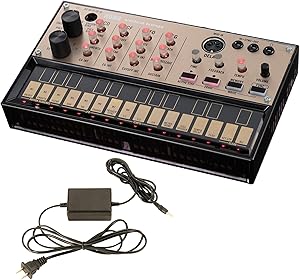
Korg Volca Keys Analogue Loop Synth Power Bundle

4.7 (5 reviews)

Three oscillators, ring modulation, and true analog voice architecture — the Korg Volca Keys bundle delivers warm, complex tones straight out of the box with a dedicated power supply included.

$159.99*
Check availability

*Price sourced from Amazon.com. Last updated:Jun 27, 2026.Price and availability are subject to change.

Affiliate Disclosure: Studio Supplies may earn a commission from qualifying purchases made through links on this page, at no additional cost to you. This helps support our editorial team.

Notice a mistake? Let Us Know

Overview

The Korg Volca Keys is a compact analog synthesizer built around a three-oscillator architecture with a resonant low-pass filter, dedicated VCA envelope, and a ring modulator between oscillators 1 and 2. What those components mean sonically: you get a signal path capable of generating everything from clean, bell-like single-oscillator tones to dense, beating pad textures when all three oscillators are detuned in unison mode — and when the ring modulator enters the chain, you reach into metallic, clangorous territory that sits well in electronic and experimental contexts. The LFO can be routed to pitch, filter cutoff, or volume for classic vibrato, wah, and tremolo effects. Because this is a true analog circuit, the filter self-oscillates at high resonance settings, generating pitched sine tones independent of the oscillators — a behavior that digital models approximate but don't quite replicate in feel.

The Volca Keys is built for loop-based composition, sound design exploration, and analog texture work in desktop studio environments. The 16-step sequencer is the workflow anchor: it records pitch, gate length, and motion-sequenced parameter automation simultaneously, allowing you to build self-evolving sequences that change with each pass as modulation shapes the filter and LFO in recorded arcs. Sync and MIDI input make it a cooperative citizen in larger setups — lock it to a DAW grid or chain it with other Volca units and it tracks tightly. The included power supply in this bundle addresses the most practical limitation of the standalone unit for studio users: battery-powered operation introduces voltage sag over a session that affects pitch stability and filter character, while a regulated 9V supply keeps the analog circuitry running at its intended operating point throughout a session.

Specifications

Type
Analogue Loop Synthesizer
Oscillators
3 (unison, chord, poly modes)
Polyphony
3 voices
Ring Modulator
Yes (oscillators 1 and 2)
Sequencer
16-step with motion sequencing
MIDI
In via 3.5mm (receive only)
Sync
In/Out (3.5mm analog pulse)
Power Supply (Bundle)
Korg 9V 600mA (included)
Brand
Korg

Pros & Cons

👍 Pros

  • True analog signal path through three oscillators, a resonant filter, and a VCA produces the harmonic complexity and natural warmth that defines the character of classic analog synthesis — audibly distinct from digital emulation in pad and lead contexts.
  • Built-in 16-step sequencer with motion sequencing records and plays back knob automation, enabling evolving, self-modulating loops without a DAW or external controller.
  • Ring modulator between oscillators 1 and 2 generates metallic, inharmonic tones that sit outside what a standard subtractive patch can produce, significantly expanding timbral range.
  • Sync in/out and MIDI input allow the Volca Keys to lock tightly into multi-Volca setups or DAW-driven studios, making it a practical addition to an existing signal chain rather than an isolated toy.
  • Bundle inclusion of the 9V 600mA power supply removes the ongoing battery cost and voltage sag that affect sustained studio sessions on batteries alone.

👎 Cons

  • Three-voice polyphony is a hard architectural ceiling — complex chord work or layered arrangements will expose the limitation quickly, as notes steal voice allocation in real time.
  • No audio input means the Volca Keys cannot be used as a filter or effect processor for external signals — the analog filter stays internal to the instrument's own signal path.
  • The built-in speaker is present but not suitable for critical listening or mixing decisions — the Volca Keys requires routing through headphones or monitors for any serious session work.
  • MIDI is receive-only via 3.5mm jack with no 5-pin DIN port natively — sending MIDI out of the Volca Keys to external gear requires a workaround or additional hardware.
  • Limited patch storage: the Volca Keys does not save patches in a traditional sense — sequences and motion data can be stored, but front-panel knob positions are not recalled on power-up.

Frequently Asked Questions

The Volca Keys is a fully analog, voltage-controlled synthesizer built around three oscillators running in unison, chord, or poly modes. Because the signal path is entirely analog — oscillator through filter to amplifier — the sound has the natural harmonic warmth and the slight pitch instability that digital models approximate but cannot replicate. You hear the difference most clearly in sustained pads and slow filter sweeps, where the analog circuitry introduces micro-variations that feel organic rather than static.
This bundle includes the Korg 9V 600mA power supply, which eliminates the need for batteries during studio or desk use. The Volca Keys can also run on six AA batteries for portable or stage use, but the power supply is not included with the standalone unit — that's the practical value of this bundle over buying the synth alone.
The Volca Keys is three-voice polyphonic. In chord mode, all three oscillators are stacked to play a single chord voicing, which produces a thick, detuned sound ideal for lush pad textures. In poly mode, each of the three oscillators can play an independent pitch. This is a limited polyphony count — it shapes the Volca Keys as an instrument for harmonic texture and loops rather than complex chordal arrangements.
Yes. The Volca Keys has a sync in/out — a 3.5mm analog pulse clock — that allows it to lock to other Volca units or any device that outputs a compatible sync pulse. It also receives MIDI over a 3.5mm MIDI input (with a standard 5-pin adapter), enabling tempo sync and note triggering from a DAW or sequencer. It does not transmit MIDI out.
Yes — a 16-step analog-style sequencer with motion sequencing is built in, allowing you to record and play back knob movements (filter cutoff, LFO rate, etc.) alongside pitch and rhythm data. This is one of the instrument's most musically powerful features for building evolving loop-based sequences.